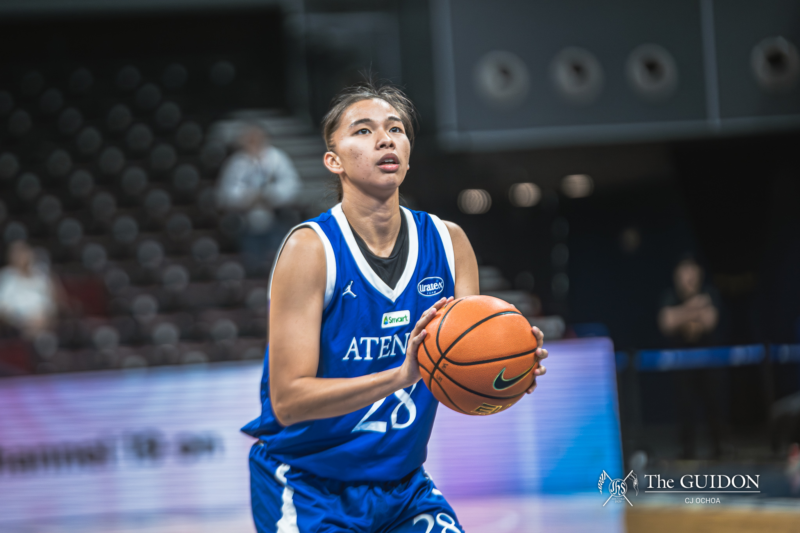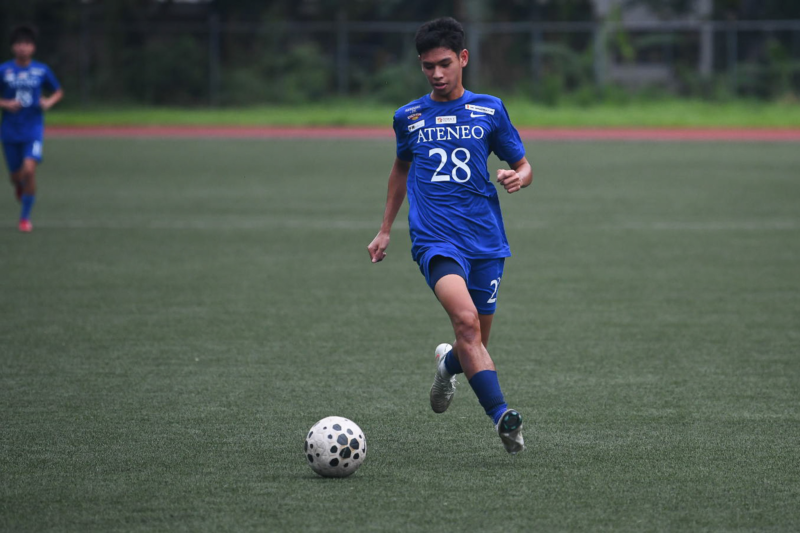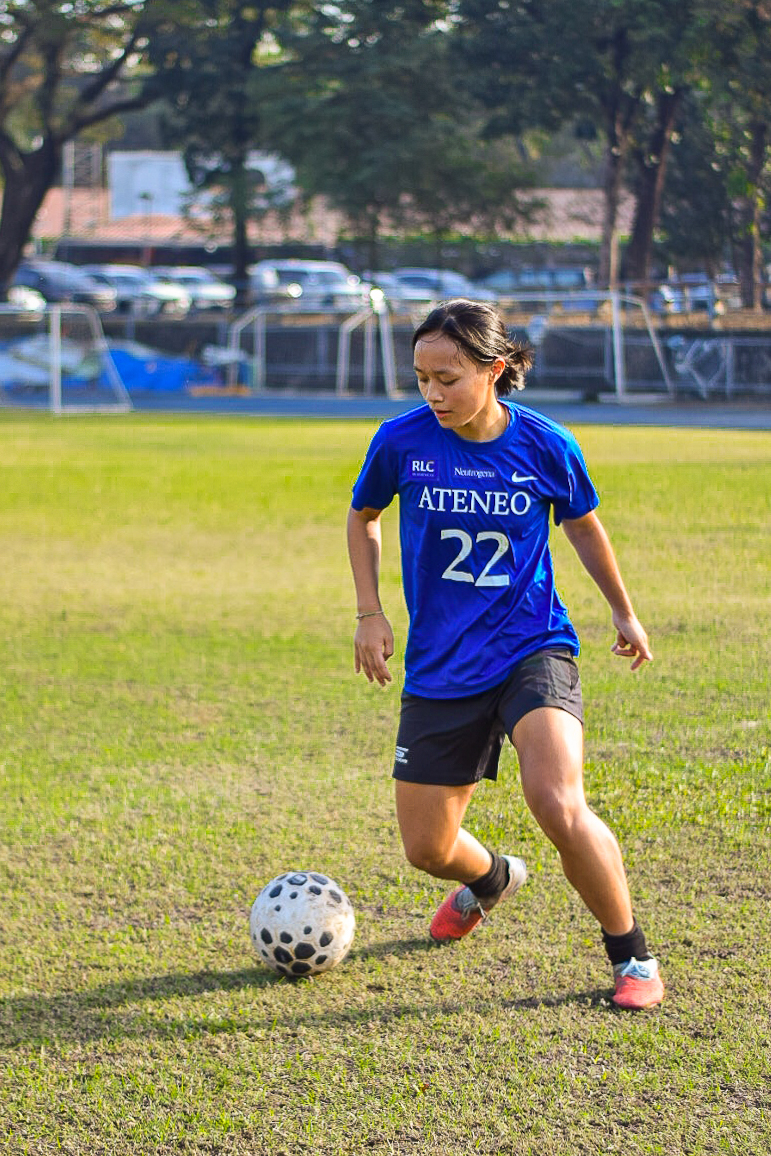
A DECADE of near-misses and unmet expectations has defined much of the Ateneo Women’s Football Team’s (AWFT) recent history—a stretch marked by close calls despite consistently talented lineups. That search has begun to bear fruit with the arrival of Jada Bicierro, as the striker has emerged as a key figure in Ateneo’s attack, delivering when it mattered most and providing the cutting edge the team previously lacked.
Before becoming the Blue Eagles’ primary attacking option, Bicierro’s development was shaped by years of competitive football in the United States and her early exposure to high-level play long before arriving in Loyola Heights.
Foundations of a finisher
Growing up in a family of athletes in New York, the sophomore developed an early attachment to football. Introduced to the sport at just four years old, she further developed her game with the New Hyde Club in Long Island, where her first taste of competitive play helped shape her as a player.
Even at a young age, the sophomore striker was driven by a constant desire to stay a step ahead. Improvement was never incidental for Bicierro, but something she actively pursued day after day.
“With my family, they always wanted me to get better, and I wanted that for myself too. I was always asking what I needed to work on and how I could become a better player,” the striker reflected.
Guided by this drive, Bicierro relocated to the Philippines in 2019. She suited up for Miriam College’s high school football team, where she first crossed paths with head coach Bob Manlulo—now at the helm of the AWFT. Even then, Bicierro’s potential was evident, catching Manlulo’s attention early and setting the foundation for her eventual path to the Blue and White.
Having experienced both systems, the difference in structure and competitiveness quickly became clear to her. “In America, even at the younger stages, it’s really competitive and advanced in the way they coach and handle things,” Bicierro shared. “[…] They really fund and support you there, and that’s one of the biggest differences compared to the Philippines.
Coming from abroad, Bicierro admitted she had limited familiarity with the local collegiate landscape beyond the so-called Big Four—Ateneo, De La Salle University, University of the Philippines, and University of Santo Tomas. However, repeated endorsements from her seniors in Miriam College left a lasting impression on the striker. By eighth grade, she had already identified Ateneo as her preferred choice.
Despite interest from several University Athletic Association of the Philippines (UAAP) programs, the blue-chip recruit chose to don the Blue and White, a move that altered the course of her career and the outlook of the Loyola Heights-based squad.
Strikingly blue
As Bicierro entered the AWFT, she brought with her numerous lessons and experiences, such as leadership that quickly translated to her performance on the pitch.
The transition into the collegiate game meant adjusting not only to the physicality and the competition but also to the pressures that came with representing a program that has long been searching for success.
For Bicierro, that adjustment was immediate. “I think just the pressure of being in UAAP, […] that was the biggest adjustment that I had to make,” Bicierro stated, recalling how different the environment felt compared to the tournaments she had grown accustomed to before college. Even with years of experience as a leader in high school under her belt, the unpredictability of college football was at another level.
Yet, this pressure did not hold the striker back as she sharpened her role within the team. Bicierro’s impact took center stage and materialized in her sophomore year—UAAP Season 88. What had long been potential began turning into results.
Her effect on the team peaked in a moment that captured both her individual growth and the team’s collective breakthrough. Ateneo’s long struggle against De La Salle University (DLSU) has haunted the Blue Eagles for a while, but their much-awaited victory did more than add a mark in the win column; it signaled that the Blue Eagles have arrived.
Bicierro played a crucial role in this victory by making the assist to rookie Tisha Salazar for the one and only goal that sealed the win for Ateneo. The Blue Eagles proved that they could compete and win in the moments that mattered, where the lights shine bright.
For Bicierro, that was the moment where belief and performance finally aligned, and the team’s effort translated into something substantial.
By season’s end, the results were clear. Bicierro emerged as one of the league’s most decisive forces, earning the Best Striker award for the season while helping the Blue Eagles secure its first podium finish in a decade with a bronze medal finish.
With a breakthrough season finally achieved, the question now is no longer whether Bicciero and the Blue Eagles could rise, but how far they can go next.
Journey forward
For Bicierro and the team, their focus is not for their success to stay stagnant, but to build on it. “Our hope for the future is that none of us settle for what we’ve done last season,” she said. “We’re still hungry for more […] most importantly, we want to win a championship.”
Growth remains Bacierro’s central motivation. Even with all the individual accolades and team accomplishments, she views improvement as a daily responsibility rather than an occasional goal. “There’s so much room for improvement,” she declared. “That’s one of the reasons why I continue football.”
The sophomore has big ambitions for her future, especially after the collegiate level. Having already represented the Philippines in futsal with Pinay5 and many other national team stints, Bicerro hopes to continue competing at higher levels, such as for the national team.
She notes that one of her dreams is to play futsal or football in a different country, viewing international exposure as a chance to learn new styles, cultures, and perspectives that will elevate her play.
Yet, personal ambition is only part of the picture. In a sport still shaped by gender imbalance, Bicierro understands the visibility and exposure that come with her role as a female athlete. “There’s a sense of responsibility […] to help inspire and also motivate the younger players,” she reflected. “How can us players help the little girls be more excited to play football?”
For the footballer, representation begins with presence. Whether on the field, in the community, or even in the lives of the young athletes who approach her after games, she believes each interaction contributes to building pathways for the next generation.
Her message to aspiring players, especially those from outside traditional football hubs, is simple: enjoy the game, embrace growth, and do not fear improvement.
For years, the AWFT searched for a breakthrough. Through the emergence of Bicierro, that promise has began to materialize. Season 88 marked the program’s turning point, shifting from rebuilding to contending, and if anything, Bicierro and the Blue Eagles’ story has just begun.