TWO JESUIT priests and a professor in the Ateneo each aired their sides on the Reproductive Health (RH) Bill, which is now in its second reading in the House of Representatives.
Reaching a second reading is a feat not achieved by similar bills of recent years.
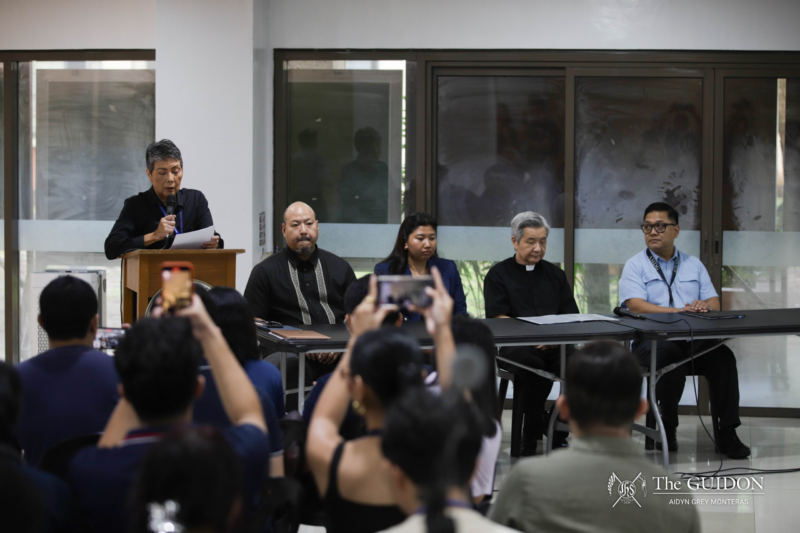
In response to a call of the Catholic Bishops’ Conference of the Philippines (CBCP) for more dialogue on the issue, the School of Humanities organized a talk on February 6 to encourage more discourse on the bill.
Interdisciplinary Studies Lecturer Marita Guevara, Ph.D., an author of the 14 Ateneo professors’ statement supporting the RH Bill, Loyola School of Theology (LST) President Fr. Jose Mario Francisco, SJ, and LST Executive Secretary Fr. Eric Marcelo Genilo, SJ, discussed the social realities, legal issues, and Catholic morality surrounding the bill, respectively.
A “listening Church”
Guevara called upon the Church to take a look at the real-life situations of its members, and quoted from Bishop Chito Tagle, who said that “the church must learn to listen the way God listens and must lend its voice to the voiceless.”
She shared some stories of families with whom she had been acquainted through the course of her research, and described how a large number of women in areas such as Baseco, Manila and Gabaldon, Nueva Ecija, suffer of childbirth-related complications, and in some instances die, because their bodies can no longer handle giving birth to a tenth or eleventh child.
Guevara said that the RH Bill would be key to helping families, especially women.
Civil rights affected
Francisco largely focused on the rights concerned with the RH bill, most especially those regarding sex education. Because the RH Bill seeks to establish a program for sex education in school curricula, he said this may breach the right of parents to choose what their children learn in school.
Francisco also said that the question regarding abortion and contraception is not one of when human life begins, but when legal protection of human life begins. He said that the bill is unclear about this matter.
Acknowledging that the RH bill “is a complex issue [that] raises complex questions,” he concluded with a question: “How can we discuss the bill in a way that looks at social realities and at the same time respects religion?”
“Please consider our objections”
Genilo sought to present clarifications on the CBCP’s take on the bill.
He said the presence of different points of view is undeniable, and that “the CBCP affirms that the bill has positive points that are beneficial for Filipinos.” He said, however, that the CBCP objects to certain points in the bill. Considered by the CBCP as “fatal flaws,” these include the following:
• ambiguity with regard to when protection of life begins;
• the requirement of sex education in schools since “different schools have different traditions;
• the requirement of employers to offer reproductive health services to its employees, when this might be in contradiction to the employers’ beliefs;
• limiting the freedom of speech of those who may oppose this law, since contesters would be considered lawbreakers; and
• failure to consult the different religious institutions (such as the Christian and Muslim congregations) involved in the matter.
Call for action
The talks were followed by a few questions from the audience. Many of the questions were directed toward Genilo. The three speakers, however, provided some input for each question.
An interesting twist to the discussion came when Benjamin de Leon, president of the Forum for Family Planning and Development, reported that the bill is now in its second reading and is supported by 113 representatives. He said, however, that there were 22 opposers in the House who were not ready to give up the fight.
Although de Leon is confident that the bill might be passed sometime in April, he urged students to become active in expressing their views by writing their congressmen to pass the bill.
Lukas Köhler, a student from the Jesuit school University of Philosophy in Munich, commented on the open forum by saying, “You must have sex education; it’s not a question. They [the educators] could surely discuss if contraception or something like that is okay, but they must educate the people.”
He added, “As a Western student, I would say that there should be no discussion that the RH Bill should be passed or not [because it should be passed]. The only thing which should happen is that there should be a dialogue.”
For Kristine Wee (IV AB DS), the talk was just a reiteration of previously discussed views. “I’ve already read the several positions…so his talk…[was] just a clarification of the several points and an update on where the bill is now.”
Wee also said that “it is good to hear that it is now in its second reading in [the House] and it’s actually going somewhere, and that the Church is actually open to discussion.”