Photo by Jessica L. Roasa
Once upon a time, data was known to be obtainable only through books and other printed material. Now, any form of knowledge is accesible just by typing a few keywords on a search engine; information research and storage has become exponentially limitless, eliminating all constraints in the acquisition of data.
The Internet, aside from providing easy access to information, has the power to disseminate information that could have otherwise been overlooked—or even censored—if subjected to processes followed in traditional media. Processes like proof reading and copy-editing sometimes obscure the messages that the authors had intended to convey. These processes, however, do not exist in most of cyberspace—allowing netizens to share any kind of information they have to the rest of the world.
In the Ateneo, though, the Internet has not only served as a tool for more effective information dissemination to students. It has become a major instrument for fostering greater student discourse, and has paved the way for the discussion of matters and the revelation of truths that, otherwise, wouldn’t have surfaced to the Atenean public.
Direct action
Nowadays, social networking sites such as Facebook and Twitter are popular among audiences of all backgrounds due to the convenience these online services offer, particularly in the sharing of information. Even institutions, such as the Ateneo itself, have their own accounts in these platforms. The school, for example, uses its Facebook and Twitter accounts to post relevant announcements, ranging from UAAP score updates to news regarding the suspension of classes.
One of the more popular online communities that the Ateneo public pays attention to is the “Overheard at the Ateneo de Manila University” Facebook page. Posts that range from professors’ humorous quotes to blind items are shared here, and the free-for-all nature of the page has made it quite popular among students.
Aside from providing entertainment to its members, though, the Facebook page has also become an avenue for the posting of opinions or information that may displease school authorities.
It is the same page where screenshots of the graduation speech of Ateneo de Manila High School’s class valedictorian of SY 2009-2010, Henry Fernando, were posted, alongside a speech by Robert F. Kennedy—the former’s speech apparently plagiarized the latter’s.
The screenshots were posted by a mysterious online persona who assumes the name of Toni Gramsci, a prominent Italian Marxist philosopher. He says that he posted the screenshots with the aim of informing the community about the plagiarized speech.
The university apparently posted a copy of Fernando’s address on its website prior to Gramsci’s posts, but he claims that Fernando’s speech was taken down after news of the plagiarism began circulating. Gramsci says that it was only after several months that a copy of Fernando’s apology could be found in the university website’s archives.
“It was never disseminated properly, since it was just stored in the archives of the Ateneo website,” said Gramsci, questioning how the school seemed to just hush up the whole affair.
Gramsci’s story serves as an example of how Internet platforms can be used to spread information that may be hushed up by authorities. His effort to bring the incident to light can be considered a case of “direct action,” a term he defines as “a form of political activism, in which participants act directly, ignoring established political procedures.”
Gramsci is reminiscent of the controversial whistleblower site, WikiLeaks, which has gained renown for making information that is normally hidden or swept under the rug by authorities accessible to the public.
As a result of WikiLeaks’ activities, different institutions and governments have devised plots to silence the site, with its founder, Julian Assange, being the usual target. Banks have blocked donations to the organization, and efforts to get the WikiLeaks website down and Assange in jail have sometimes been successful.
Gramsci has experienced something similar, although on a smaller scale. Associate Dean for Student Affairs Rene San Andres sent him a cease and desist letter back in July 2010, ordering him to stop what he was doing in connection to Fernando’s speech. “Your failure to cease and desist from such acts… would be seen as defiance of this order and, as such, of the Ateneo de Manila University as an institution,” the letter read.
But this didn’t stop Gramsci at all. “After all,” he says, “just interpretations can only be derived from just information.”
Messengers in disguise
One of the Internet’s potential advantages is that its users can use it for the exchange of information without having to reveal their personal information. One of the first rules of netiquette, after all, is for users to always be cautious in revealing their names and contact details online, lest such information be misused by third parties.
However, the leader of the Gadfly Society, a secret school organization which communicates to the student body through online platforms, mentions other reasons for the group’s online presence. The society’s Facebook account is now being used to publish the group’s comments and statements every now and then, with this online platform replacing the society’s former online abode at Blogspot.com. The group’s old blog—and arguably, the society itself—had its heyday around three to four years back. Still, not once in the whole history of the society have its members revealed their true identity to the public.
“[Anonymity] gives off a sense of terror to people,” the leader of the Gadfly Society says. This anonymity, the leader says, reminds people, specifically the Sanggunian, that their actions are constantly being monitored by those who may not be satisfied with the status quo. Apart from that, the group’s leader says that the Gadfly Society’s anonymous online presence “strategically surprises people and can have more of an impact on them [in this form], which is the advantage of using the medium and the guise of anonymity.”
Gramsci, who is also a regular online commentator on different school issues, shares similar sentiments. He explains, though, that in his attempt to inform the Ateneo public of Fernando’s case, he wanted people to focus more on the message, and not on the messenger.
“I’ve noticed that one of the deeply entrenched cultural idiosyncracies of the Filipinos is that they focus too much on the subject,” he says. “In other words, it is a culture of extreme personalism.”
Gramsci says that if he had revealed his identity when he brought Fernando’s case to light, people would have made assumptions and, instead of focusing on the issue of plagiarism, they would have conjured up myths that might have obscured the whole situation altogether.
Democratic spaces
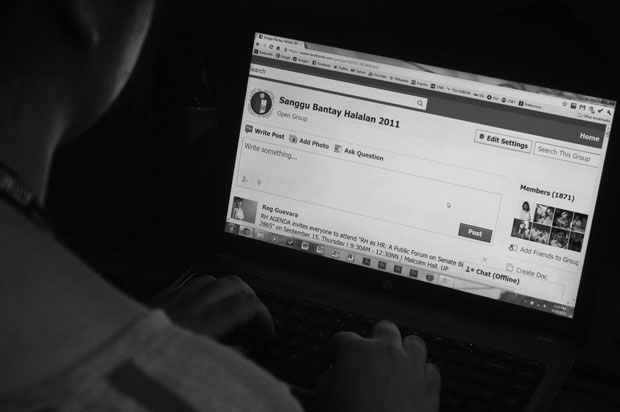
Anna Margarita San Pedro, a senior development studies major who founded the renowned “Sanggu Bantay Halalan 2011” Facebook page during last February’s Sanggunian elections, states that the reason the Facebook group was created was so that members of the Sanggunian themselves can directly answer students’ questions, especially those that might have been overlooked in real-life forums and events. The Facebook page is now probably the widest reaching Atenean online forum where the student body converges for the discussion of current issues.
“Not every student can or will attend the miting de avance, [or] other avenues wherein they will be able to get to know their candidates,” she says. “I knew that there were many others like me [who] wanted the opportunity to get to know the different candidates… in a medium that was convenient to many—thus the creation of the group.”
Gramsci, who regularly comments on Bantay Halalan, explains that he prefers Facebook as a means of information exchange because it will remain unrestricted regardless of any attempt by the school authorities to censor information.
This is, indeed, the advantage presented by the Internet’s democratic nature, and it is most strikingly seen in Bantay Halalan. While this online forum is of great influence and significance to the student body, it is still a student-run affair—the school authorities have no say in how things play out in this turf.
Editor’s Note: Toni Gramsci and the leader of the Gadfly Society were kept anonymous by their request.
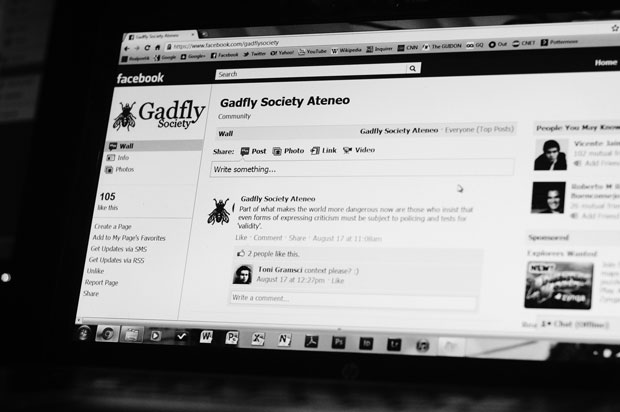
Photo by Jessica L. Roasa