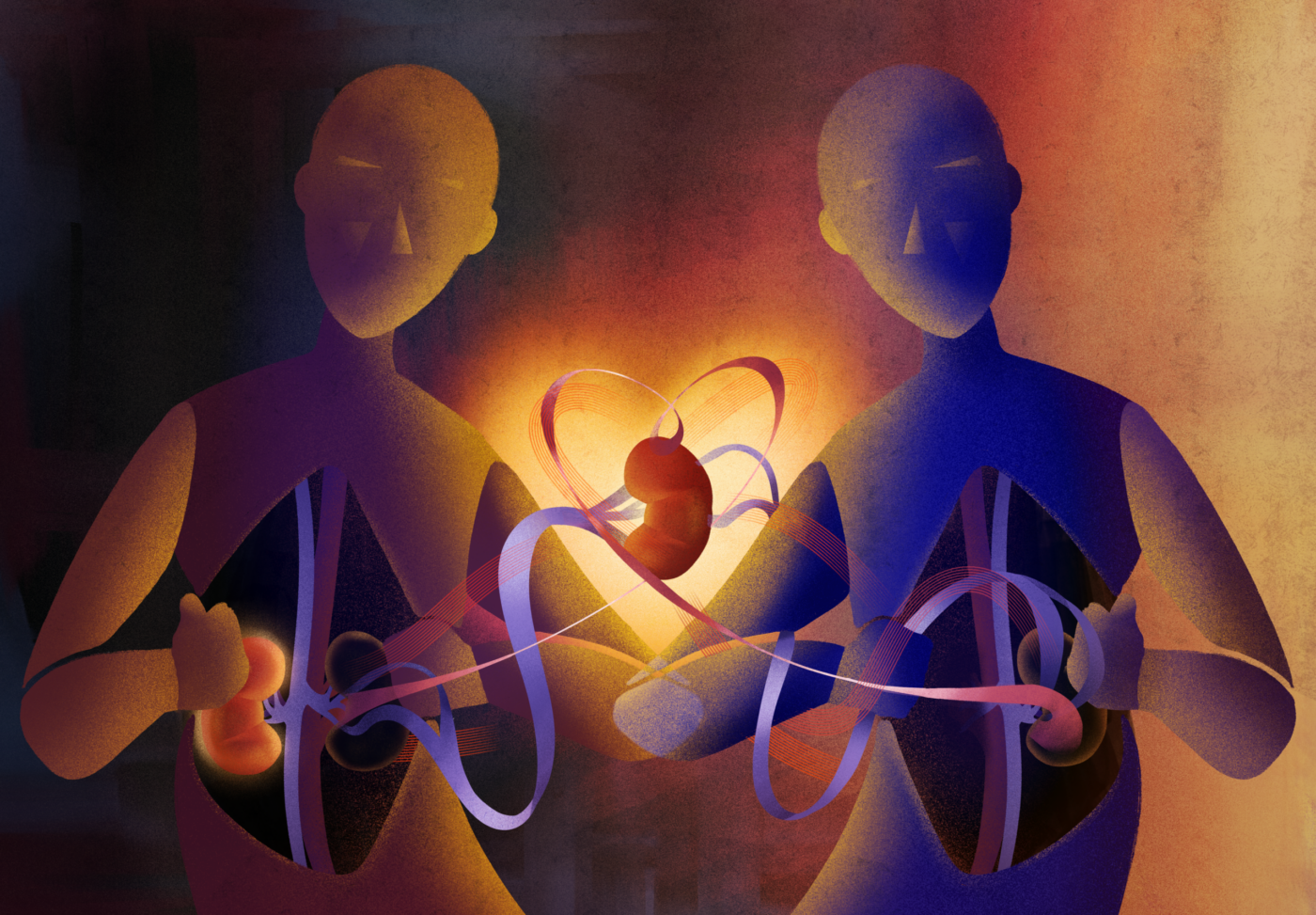
Siblings are often taught to split everything evenly among themselves, but some things are harder to share than others.
TO GIVE and to take is a mutual compromise embodied through the act of organ donation. While organ matches may be found in donors who have passed on, some cases call for another person to step up and live with the cost of a body that is not quite the same after the operation.
In the Philippines, organ donation rates remain lower than in many parts of the world. In 2024, 621 live kidney transplants were recorded among a global sum of 41,000. Misconceptions about organ donation and ambiguous laws surrounding the procedure dissuade potential donors from volunteering. Furthermore, organ donation is inaccessible as the limited number of transplant centers is highly concentrated in Metro Manila.
Despite organ donation being uncommon in the Philippines, sometimes the only way to survive a failing body is through a transplant. For brothers Ferdinand and Joven San Andres, a shared pair of kidneys became a renewal of life—but it also came with a cost.
An extension of life
When Ferdinand was 30 years old, he was still the picture of health—going to the gym, playing sports, and abstaining from vices. He was even strong enough to work at a factory in Japan from 2005 to 2006.
“Ang bisyo ko lang talaga noon [ay] kumain,” Ferdinand recalls fondly. “‘Yun pala, naging masama rin ‘yung hindi ka na tumigil sa kakakain,” he shares.
(My only vice then was to eat. As it turns out, eating without moderation is also a bad thing.)
While working abroad in 2006, sickness came upon Ferdinand all at once. Although he thought his habits were helping his body, his protein overconsumption eventually landed him in the hospital.
“Sumobra taas ng blood pressure ko, kaya siguro nasira na nang tuluyan [yung katawan ko]. Kasi noong na-ospital ako, ‘yung Japanese doctor, ‘di ko masyadong maintindihan. Naiintindihan lang namin na delikado yung sakit ko—na kailangan ko nang umuwi ng Pilipinas.”
(My blood pressure shot up. Maybe that’s why [my body] failed. When I got hospitalized, I didn’t understand the Japanese doctor. All we knew was that my illness was serious, and that I had to go home to the Philippines).
Ferdinand urgently flew home and was then rushed to the hospital. While he was getting treated for internal hemorrhoids in Capitol Medical Center, he was diagnosed with chronic kidney failure, which prompted his immediate transfer to the National Kidney and Transplant Institute. There, he underwent emergency dialysis for three months while awaiting a kidney donor.
At first, Ferdinand’s family found potential donors who were unrelated to them. However, the would-be donors would back out due to unforeseen circumstances.
As Ferdinand ran out of options, his donors narrowed down to his father, as well as his brother, Joven.
Joven, who was in his 20s at the time, could not stand the idea of their elderly father undergoing surgery. For him, contemplating whether or not to donate his kidney was a battle with his own conscience.
“Ayoko talaga mag-donate sa totoo lang. Siyempre matatakot ka ‘di ba? Ibibigay mo laman loob mo […] Kung hindi ko gagawin, mawawala [ang] kuya ko. At least nadugtungan ko yung buhay ng kuya ko,” he shares.
(Honestly, I didn’t want to donate at first. Who wouldn’t be scared? You’d be giving away a part of yourself […] If I hadn’t done it, we would have lost my brother. At least I was able to extend my brother’s life.)
In the end, after much push and pull, and reassurance that kidney transplant compatibility is often stronger between siblings, Joven donated his kidney to his brother.
In a rich man’s world
20 years have passed since the transplant, but for both brothers who get by on precarious incomes, the commitment to a healthy lifestyle is a hard-earned luxury, and much less of the discipline to abstain from old habits.
Ferdinand, now 51, does not have a regular job. Although he briefly worked at a local sports bar after his transplant, the job entailed late working hours and unhealthy meals, which exacerbated his kidney recovery. Now, while he is in control of his diet, the rest of his plate remains full with dire attempts to meet his doctor’s prescriptions.
To meet his treatment plan, Ferdinand was once accustomed to taking trips to the Philippine Charity Sweepstakes Office, queuing with his mother from 3:00 AM until late afternoon for free immunosuppressants, which he is prescribed to take as a lifelong medication. However, even such tedious efforts were insufficient to keep up with the demands of his health and the price they necessitate.
“I was only able to take immunosuppressants for five years [after my transplant]. I can’t afford it, and it’s hard to ask for help from the government,” Ferdinand shares in a mix of Filipino and English.
On the other hand, Joven, now 44 and employed as a company driver, finds that the transplant left him with a frail immune system. His maintenance medication and mandatory check-ups are sustained by the benefits of a health card and occasional earnings from a side hustle. Yet, amid avenues of support, Joven and his family continue to face financial constraints.
When a medical emergency in February 2025 kept him in and out of the hospital, his children had to stop schooling. At this time, Joven’s personal earnings fell short, and he banked on his relatives for monetary support.
Still, no matter the setting—at home or in the daunting hospital bed—Joven’s children remain at the forefront of his mind.
“Ayoko maranasan ng mga anak ko [ang kailanganin ng transplant]. Pang-mayaman ang sakit na iyon, (I don’t want my children to experience [the need for a transplant]. That kind of illness is for the wealthy,)” Joven says.
Hating kapatid
For donors and donees, organ transplantation is a learning experience that extends beyond individual health, altering the trajectory of their lives and those of their families. This is the case for Joven and Ferdinand, who are fathers to three and eight children, respectively.
With one kidney each and a shared understanding of fatherhood, the two cannot help but wonder whether their children might one day face the same ordeals.
At the mere thought of his children ever needing a transplant, Joven is adamant about avoiding a situation that could mirror his and Ferdinand’s.
“[Kung sakaling] magkasakit ang isa [sa mga anak ko], hindi ko papayagan o ipu-push ang anak ko na mag-donate [ng organ] sa kapatid niya—maghahanap ako ng ibang donor.”
(If one of [my children] were to get sick, I would not allow nor push my child to donate [their organ] to their sibling—I would look for another donor.)
Joven knows that such a circumstance would cause two of his children to suffer enduringly. He, as their father, would carry the burden of watching their aspirations put to a halt by a single medical procedure. This is the weight of a sacrifice Joven knows all too well, having given up his dream of working abroad for the sake of his brother’s transplant.
Trying to make sense of his own experience, Ferdinand marks a faint line bridging science and faith.
“Kaya siguro ginawang dalawa yung kidney natin ng Diyos, dahil yung isa pang bigay siguro, pantulong. Kasi isang kidney lang mabubuhay naman yung tao (Maybe God gave us two kidneys so we can give one away, because a person can live on just one kidney),” he elucidates.
In the hospitals and homes of an ideal world, organ donation would feel less like a battle among stability, dreams, and survival.
While Ferdinand and Joven express no regrets, their respective roles as donee and donor mark a point of no return for their finances and health. This experience reflects the lived reality of many transplant patients, shocked by their own bodies and betrayed by the healthcare system. Unless meaningful reforms are made, health will remain a matter of privilege for the everyday Filipino.