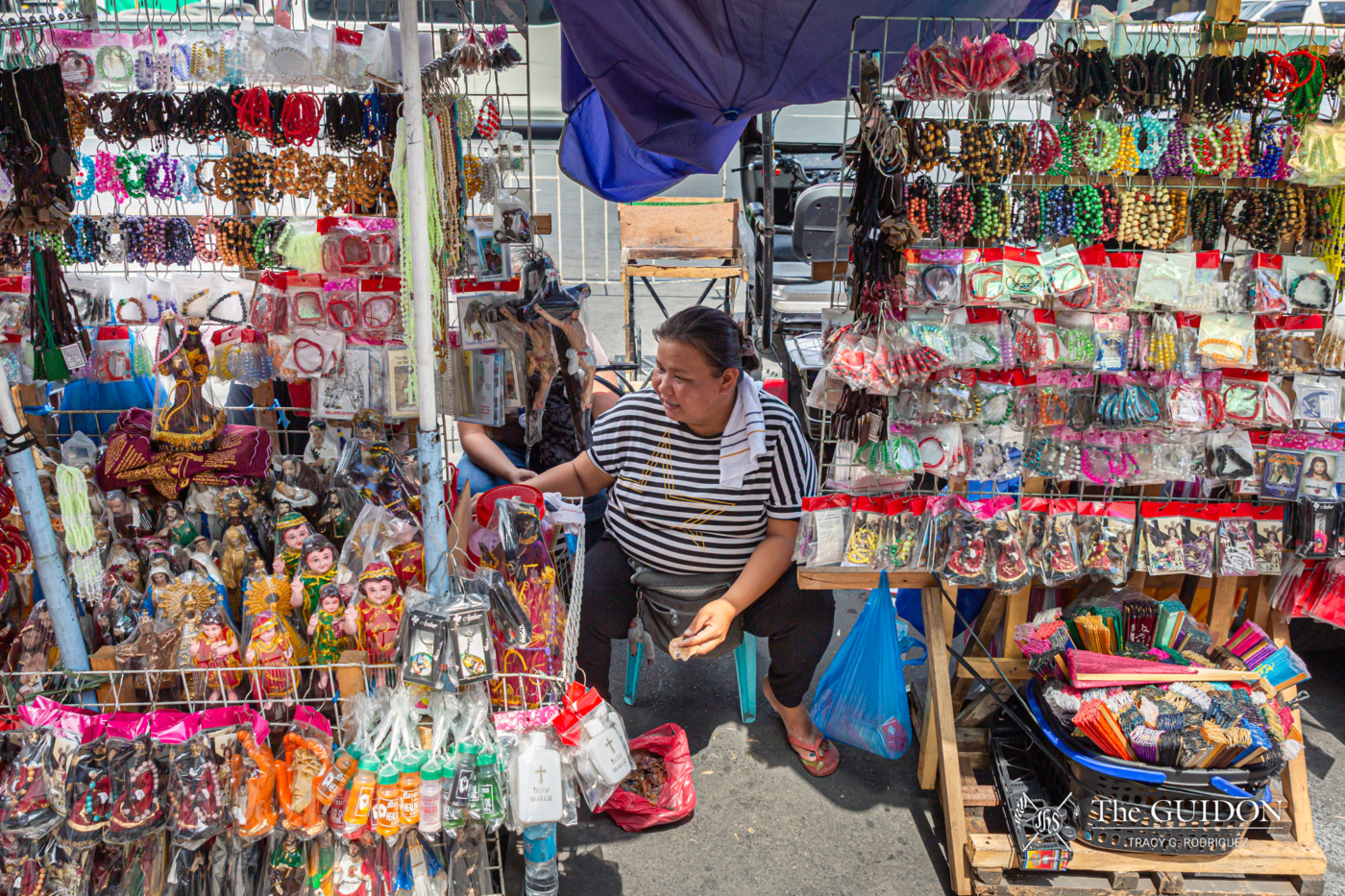
In the heart of “the old downtown of Manila” are hidden alleyways where folk traditions are kept alive by faith healers and fortune tellers.
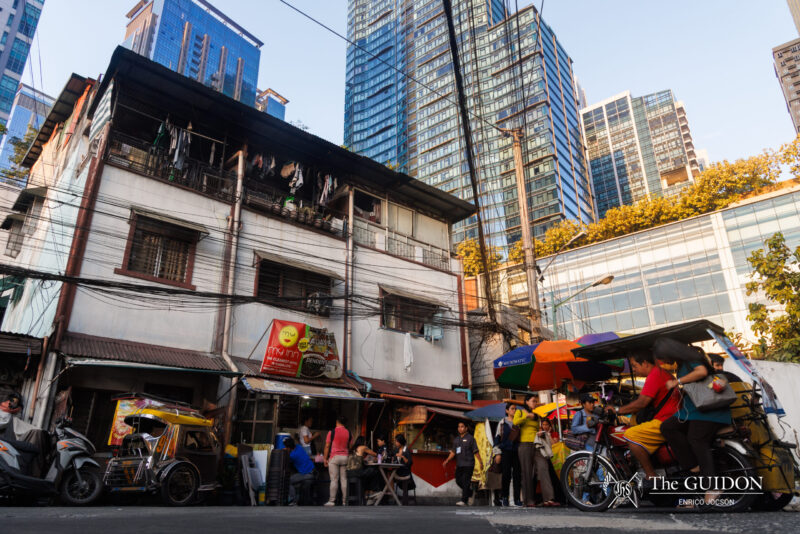
SPIRITUALITY PERMEATES beyond the sanctified walls of the Quiapo Church. Devotees, vendors, and healers spill into Plaza Miranda and through the crowded veins of the district. From treating simple sprains to healing cancer, the stalls outside promise visitors anything for the right price.
Drawing people from all walks of life, Quiapo is a place where anything is possible, so long as one believes.
Batang Quiapo
A stone’s throw away from Quiapo Church is an albularyo who waits beneath the shade of a larger-than-life umbrella, with blank strips of paper in his hands, preparing to interpret kulam (black spells), perform rituals, and hilot.
Nhonoy Quiapo’s practice started in 1998, when he met a mentor in Quiapo—a chance encounter that reshaped the course of his life.
“Kapag nakakilala ka [ng] taong marunong [sa folk healing], doon ka [matututo] wala namang school ‘yan.” (If you meet a person who knows how to perform folk healing, you study under them; there’s no school for it,)” he states.
Now 55 years old, Nhonoy has been an albularyo for over 25 years. Guided by his mentor, he eventually established his own practice, charging only what people can afford and treating his work as a form of sacrifice. He entrusts his livelihood to God, believing that each patient—whether someone with empty pockets or a respected, high-paying doctor—will help provide enough for his daily needs.
Working in Quiapo for over two decades, Nhonoy often encounters patients who have either been rejected by hospitals due to insufficient findings or patients who face financial constraints. Serving as their last hope for healing, he does everything he can to ensure that patients receive the right spiritual and physical care.
However, not all his patients follow his advice. Some suffer with more pain, while others even face death. “Natanggal na ang espirituwal na sakit, binigyan ko [ng] gamot, [pero] hindi sinunod, [kaya] namatay,” Nhonoy recounts. He emphasizes that healing does not end with the ritual itself, but depends equally on the patient’s willingness to believe and obey his advice.
(The spiritual disease has been taken out already. I gave medicine, but they wouldn’t follow, so they died).
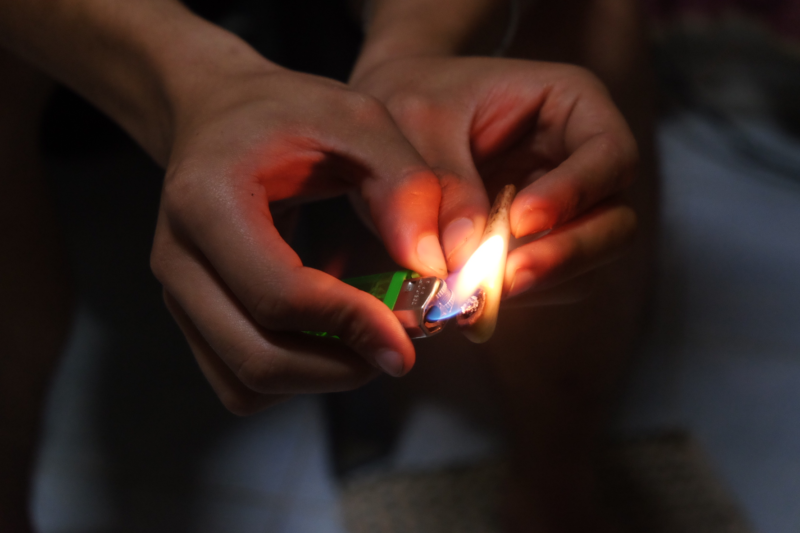
When treating patients, Nhonoy usually starts by asking about their problems. He then performs pagtatawas (a form of diagnosis), where he places oil on a blank sheet of paper and attaches it to a patient’s forehead. Afterwards, he carefully reads the shapes, contours, and patterns that form upon the forehead’s indentation.
What the oil reveals, only Nhonoy can interpret. He views the forehead as one’s spiritual gateway, and can identify the type of kulam and the features of the mangkukulam (curser).
Upon the patient’s consent, prayers and rituals are performed to break the kulam. Once the curse has been broken, he advises his patients to buy herbal medicine to ease their pain.
Weeks after treatment, patients would come to Nhonoy and express their gratitude for being healed. “Kapag gumaling [ang pasyente], nakatulong ako ng tao. Puntos ko na ‘yan sa langit, kasi wala namang singil, ‘yung [ma]ibibigay lang,” he expresses.
(If a patient is healed, it means that I have helped someone. God will see that because I only charge what people can give.)
Ever since 1998, Nhonoy’s small corner in Quiapo has remained a place where desperation, faith, and healing meet. Whether through prayers, rituals, or herbal medicine, patients continue to return to him, carrying the same belief that has sustained his practice for years.
Takbo ng kapalaran
As one reaches the heart of Plaza Miranda, they are met with a narrow alleyway leading to a shaded area that houses a variety of vendors. There are cellphone repair stalls lined up on the left, a generic drugstore on the right—and in the middle of it all are manghuhulas, waiting for people to walk into their fate.
Among them is Ka Boyet, who has been practicing panghuhula since the age of 12. Now, turning 60, he admits he never thought that fortune-telling would end up as his livelihood. “Ayoko manghula [dati], kasi sinumpa ito [ayon sa kasulatan] (I didn’t want to read fortunes because it’s been cursed [by the scriptures]),” he shares.
During his teenage years, Ka Boyet recounts that his divination began back when he worked as a janitor for Quiapo Church. One day, while going through his cleaning routine, he encountered an old woman who blessed him with prayers for divination.
As a parting gift, he was also given a red panyo (handkerchief) that the woman claimed to carry raw spiritual powers. However, Ka Boyet reveals that he later on let go of it, as the power was too strong for him to bear.
Presently seated in a small alleyway of Quiapo, Ka Boyet can be found using his trusted bolang kristal and a deck of tarot cards for his divination process. His fortune reading starts with a question of birthdates. From then on, he recounts his clients’ experiences through intuition and astrology.
After sharing brief glimpses of the past, he shuffles his tarot cards to show what he sees in the future.
With every card that Ka Boyet lays down, it comes with the awareness that the opinion on folk alternatives, such as panghuhula, is now perceived differently. But even as time passes by, he stands firm in his belief that fortune-telling is not meant to dictate a person’s life, but rather, to interpret it.
“Hindi ang hula ang magiging [solusyon] para sa [buhay ng mga tao]; mga pangarap ang daan. Kami[ng] [mga manghuhula] ay tagabasa [lang] sa mga takbo ng kapalaran,” he explains.
(Divination is not the way [for the lives of people], dreams are. We are [only] readers of fate’s paths.)
Having to walk away from Ka Boyet’s small table with the weight and knowledge of tomorrow may be a hard process to bear. But just as he shares, manghuhulas only carry insights of the future, and what comes after depends on the actions and hopes that people carry.
Sa harap ng altar
The altar of Quiapo Church is not only a place that offers solitude to those who have Catholic practices, but also leads beyond to where folk belief has its own place. In the area full of life, some take their time lighting candles and kneeling before the carved images that symbolize Catholicism, while others consult and seek answers from folk alternatives.
Despite the differences, there is one thing that collectively ties everyone in Quiapo together: hope.
In the eyes of Nhonoy, the healing that he can extend to his patients on a daily basis is what keeps him going. Helping other people without expecting anything in return is his own way of keeping hope alive within the streets of Quiapo.
Meanwhile, Ka Boyet believes that the guidance he can bring to people with panghuhula, is what pushes him to continue with his craft. “[Isang] bahagi lang ako ng [mga] karanasan [sa buhay] mo (I’m just a single part of your life’s many experiences),” Ka Boyet advises his clients.
For Filipinos constantly looking for guidance and comfort alongside the church’s busy streets, the presence of these specialists anchors them and reminds them that hope can still be found—whether it is seeking healing and cleansing, or looking for meaning in life through a glance at the future.
The continuous presence of albularyo like Nhonoy and manghuhula like Ka Boyet stands as a living testament to how folk belief is not something to be shunned, but a reflection of the endurance of Filipino culture.
In the end, no one can truly say where all the healing and answers in Quiapo come from—whether from Nhonoy’s sacrifices and rituals, Ka Boyet’s bolang kristal and tarot cards, their patients’ and clients’ faith, or a spiritual being. But for their patients who arrive with nowhere else to turn, perhaps belief alone is enough to keep them going.