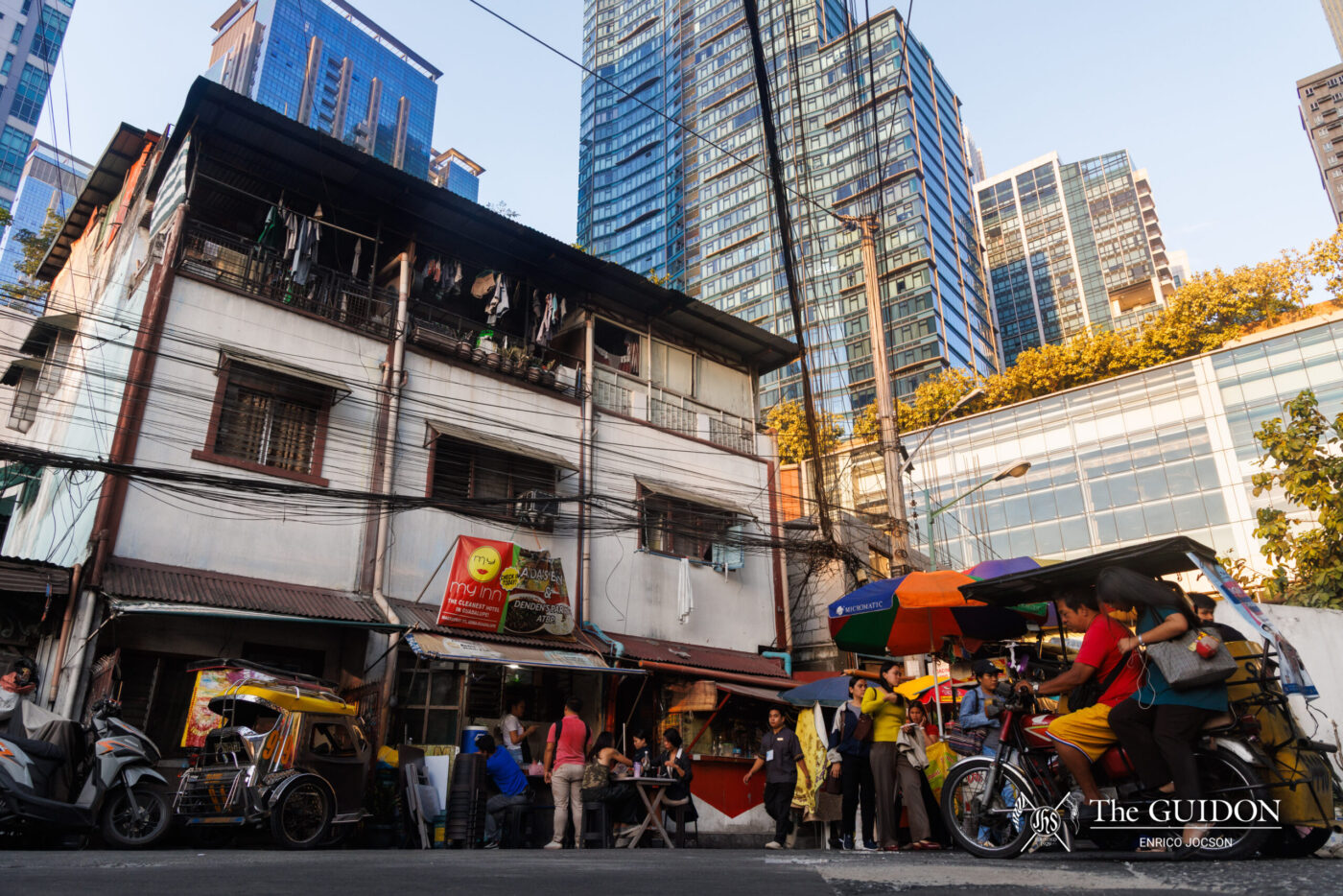
Passing through the City of Taguig’s urban sprawl, prosperity is driven by its new but old residents, whose needs have become outliers in the city.
A HOLE in the contours of the high-rise glamour Bonifacio Global City (BGC), known as Butas or Lagusan in South Cembo, was carved to connect a community that feeds and transports the service workers of City of Taguig.
What is now upscaled by a cemented pedestrian path and a vertical garden was once a farmland of kangkong and gabi. Historically, the Enlisted Men’s Barrios (EMBO) were barangays that served as military housing for the Armed Forces of the Philippines and later as a shortcut for workers passing through the area.
However, following a Supreme Court decision promulgated on December 1, 2021, which placed BGC and South Cembo under Taguig’s jurisdiction, governance shifted from the local government of the City of Makati to the City of Taguig. These tensions of upscale developments and aging in the metropolis have caught Nanay Mila and Siony—two elderly women whose roots run deeper than the foundations of BGC.
Hole in the wall
Nanay Mila Magtanao, now 63, was a second-year college dropout who left Samar to work in Metro Manila. Her beginnings as a dishwasher and eventual promotion as a cash register clerk led her to meet her husband.
At 29 years old, she became a widow while being pregnant with her fourth child. Looking back, she fell into self-pity as she navigated motherhood amid the economic pressures of living in the city. At that time, she believed that raising her four children alone would only lead to them suffering as they grew up.
However, she soon embraced her fears and her role as the breadwinner, selling bananacue along the alleys of South Cembo. Today, the street food cart remains sturdy, a witness to her journey as a single mother and to the success of her children as scholars under the Makati Government.
With loyal customers from the nearby hospital and Butas, she earns Php 3,500 on high-traffic days. Her bananacues remain among the more affordable meals in the area, as she recalled how her son—who once worked in BGC—would complain about a single meal worth Php 700.
A portion of Nanay Mila’s profits goes to her 20-year-old grandchild, who regularly visits to sell her bananacues by the opening of the Butas. Currently, her grandchild is a student at a state university.
“Gusto ko makatapos ‘yung [apo ko] kasi siya lang naman ang mayroon ako eh. Habang kumikita ako, tutulungan ko ‘yun,” she shares.
(I want my grandchild to finish school because he is all I have. As long as I can earn, I will help him.)
However, this responsibility is not as easy for a senior citizen like Nanay Mila. These days, she has to do daily stretches to soothe the aches in her body. Before starting her day, she also spends more time idling, so as not to easily strain herself.
Nanay Mila recognizes that she can only do so much to prolong her life with a body that often requires maintenance. Access to her medication has become sparse and limited since the turnover of governance, leaving the community’s elderly population even more vulnerable.
Sign of the times
A fellow resident of Nanay Mila, Siony Mondejar, enters the conversation. The 76-year-old military veteran stands out in brightly colored ukay-ukay clothes, a reflection of the high spirits she carries along South Cembo.
In the streets of her barangay, she points to her carts of coconut juice and deep-fried peanuts. Nanay Siony says she is referred to as the “[god]mother” of this area, who shares her profit with neighbors who need the extra cash.
As she and her husband are pensioners, she acknowledges that her military background has afforded them privileges that not many people have: housing and their combined pension that funds their needs.
Their apartment is among the many things in the neighborhood that she holds close to her heart. Granted to her and her fellow military personnel in 1972, the home witnessed her family grow to eight members, and then gradually dwindle as her children began to leave the nest.
Today, all six of Nanay Siony’s children are financially independent. But, beyond familial milestones, her apartment has also borne the marks of the many changes that transformed the community around it.
“Dati, itong [kalsada ay] kangkungan, hindi pa sementado. Parang may aircon [kami noon] dito […] hindi [pa] kami nagve-ventilator,” she says, recalling what the area once looked like when it was still largely rural.
(Before, this road was a plantation of water spinach; it wasn’t cemented yet. It felt like we had air-conditioning back then; we didn’t even need electric fans.)
More recently, since the EMBOs have fallen under the jurisdiction of the City of Taguig, Nanay Siony points to a change she believes has been for the worse: the healthcare system.
According to her, the healthcare services are far from the level of convenience once provided by Makati, where medicines were delivered directly to her. She adds that while she is supposed to receive maintenance medication from “head to toe,” including care following her eye operation, she is only provided with medication for her blood pressure.
Recalling remarks that her fellow residents were merely “spoonfed” by Makati, Nanay Siony rejects the notion that demanding efficient delivery of healthcare services is wrong.
“Yung mga binibigay [ng gobyerno], pera rin ‘yun ng bawat isa sa amin. No regrets na dito kami [nakatira sa South Cembo], but it is our regret na masakop ng Taguig,” she says.
(Whatever the government gives, that is still money that comes from each of us. We have no regrets living here in South Cembo, but we regret that it has fallen under the jurisdiction of Taguig.)
Amid the continuing transformation of the South Cembo landscape, Nanay Siony and Nanay Mila are left to navigate systemic gaps on their own.
Home is where the heart is
As Nanay Mila shares, conditions in EMBOs have been exacerbated due to the encroachment of private entities with interests in the lands cultivated by the local community.
A day before the interview, Nanay Siony was urged to sell their property, accompanied by threats that the potential buyer would purchase their right of way. Nanay Siony prides herself on responding with a firm “no,” though some of her neighbors, like Nanay Mila, do not share the same sentiments.
According to Nanay Mila, private developers have made several attempts to transform the streets they call home into business hubs and modern establishments. With the rapid and ongoing modernization of BGC, land prices in the area have significantly increased.
“Mahal na yung bilihan [ng lupa] dito. Php 350,000 per square meter. Dati, ang lupa lang dito ay [may halagang] Php 30 [per square meter],” Nanay Mila states.
(Land is already expensive here. Php 350,000 per square meter. Before, the land here was worth only Php 30 per square meter.)
While an acceptance of these figures offers temporary relief, Nanay Siony believes it lacks what money cannot buy: the fulfillment of a vow to her aging husband.
“Ang sabi ng [asawa ko], ‘In this house, you have all the happiness in life.’ Sabi pa niya, ‘If in case I will pass away, stay here. Maaalala niyo ako palagi,’” Nanay Siony shares, fondly recalling the life she and her husband built together.
(My husband once said, in this house, you have all the happiness in life. He also said, ‘If I pass away, stay here. You will always remember me.”)
The space Nanay Mila and Nanay Siony seek is simple—a community where their homes, histories, and everyday realities are treated with dignity amid a rapidly changing city.
At the height of urban progress and promises, there remains a hole in development itself: The elderly and working-class residents who keep the city running live in the shadows of the buildings that tower over them.