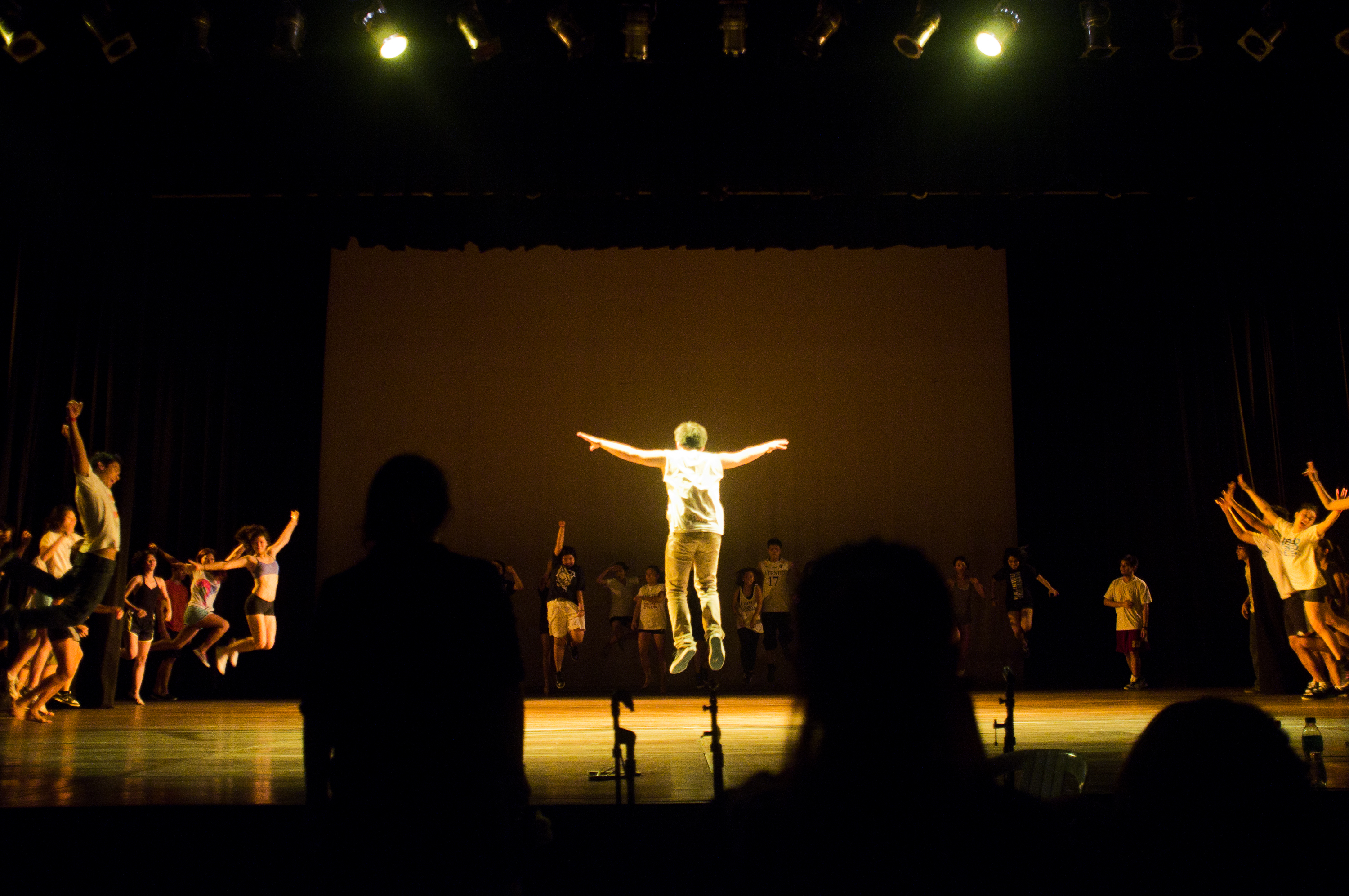
Photo by Joseph S. Angan
The movement had erupted two hours earlier—the stage was set ablaze at Cascade, the Company of Ateneo Dancers (CADs) year-end concert. The dances embodied a spectrum of emotion, each saturated with passion as stage lights brightened their seemingly fire-lit skin.
After the finale, with the curtains still open, performers and members of the production staff embraced, crying and sharing words of genuine gratitude. This was not just a concert to cap off a year of work, but a product of the ties that bind these people who have struggled and grown together.
Ateneans are familiar with the glamorous side of CADs, but a lot more occurs behind the scenes. Beyond the heavy velvet curtains, we take a look at what’s underneath the glittering exterior.
Putting it all together
Each concert starts with a lot of thinking. After much collaboration, the Executive Board and the Creatives committee decide on a theme. For Cascade, it was emotion.
Dance heads and groups are then chosen. “They choreograph themselves, so each group is a reflection of the members,” says Pat Teng, CADs officer. CADs takes particular pride in emphasizing artistic freedom.
This allows multiple approaches to surface. CADs explored a variety of emotions in Cascade. Jazz dancers used the feistiness of Adele’s “Rumour Has It” to reveal what scandal feels like. A partner dance delved into the doubt felt when falling for a friend, the delicate interplay reflected in the fluid sweeps and lifts. CADS even featured a 9Gag-themed performance, proving that they can dance to anything, even the Nyan Cat song.
With around 160 members under seven committees, coordination between the groups is key. “I always remind them that they can’t just work on their own. They have to ask help from others who are specialized,” says former CADs President Paten Encarnacion.
During the shows, waiting in the wings is never static. “You have to be on your toes. Jazzers are always stretching to keep warm,” says Mitchi Kawpeng. As the statuesque Jazz Head, Kawpeng personifies grace, but dancing isn’t always effortless. “I’m asthmatic, so right after I perform, my best friend usually runs to me with water and my inhaler. Backstage, people always help each other,” she says.
A dancer’s life
Being a dancer comes with its challenges. Despite all the effort, it’s difficult to get recognition from a lot of people. “We practice for three months from 4 to 10 PM daily at most. At the end, we dance for one show. I get about 10 minutes of stage time,” says Teng.
It can be draining in several ways. It’s a struggle to balance rehearsals with other commitments. Training sessions for the year-end concert are especially challenging since they coincide with end-of-sem hell weeks.
But as was apparent when I sat in during their rehearsals, they continued to work hard, cheering each other on while learning the finale dance. During the concert itself, the music accidentally stopped near the end of the finale. But the entire group continued dancing, even singing to fill in the sound.
Though preparations are extensive, the unexpected still occurs. Encarnacion recalls, “Before we performed [during the Rhythm in Blue Inter-organization Dance Competition], I realized I had a splinter. When we took it out, it was actually glass!” A pair of glasses had accidentally broken backstage. After many consecutive dances, a performer may collapse, which was the case at a concert several years ago. There is always first aid on hand, but these experiences remain unsettling.
Other surprises arise. During the Maximum Groovity 5 competition in 2009, a performer suddenly couldn’t make it because Typhoon Ondoy kept her stranded in Antipolo, so the blocking of the dance had to be changed on the day itself. Even the costumes aren’t immune to misfortune. “When the costume isn’t right, you have to get scissors and fix it!” says Kawpeng. As a dancer, you simply do what you can.
Making every beat count
“When there are people who love dancing [as much as you], you love it more,” says CADs jazz dancer Vyen Villanueva. He started out in CADs as a street dancer, but being exposed to jazz allowed him to discover his love for the genre. He hasn’t stopped since. “Jazz grew because of Vyen,” laughs Kawpeng. “He’d make us do the [jazz moves] he can’t do. We’re his toys!” CADs provides an environment for members to learn from each other.
Some numbers make the most out of these collaborations by featuring multiple dance genres. One Cascade performance combined jazz and street dance. Graceful yet exacting, Kawpeng was a queen dominating her male subordinates. She controlled them with each smooth extension, their sharp and forceful motion contrasting with her feline movements.
The work pays off when people appreciate what they do. When everyone is tired yet content after curtain call, or when the audience feels what the performers and production staff are feeling—there is transcendence.
Dancing offers something intangible yet invaluable. “Some families say, ‘Dancing won’t be useful for you’ or ‘It would be fine if you were in a varsity [team].’ But I think there’s something deeper about it,” Teng says. It serves as an important outlet for self-expression. “There’s the rush of being onstage. It’s almost like being someone else. It’s still me, but expressed in another way,” says Kawpeng.
Art itself is being given less importance in a world that values material wealth, but it hasn’t lost any meaning for them. “Art is something that’s always your own,” Kawpeng shares. Even if you’re inspired by others, art is something you draw out of your own being. Villanueva notes how the world is becoming more capitalist, but he carefully points out, “You still have to enjoy life. That’s the place where art lives.”
The meaning of unison
CADs possesses a palpable sense of community. “As a dance team, we train and struggle together—we consider each other as family,” says Teng.
In their training sessions leading up to Cascade, I saw the practices more and more for what they really were: the combination of a room, a group of people, music and a shared passion for movement that was not simply physical. The dancers push themselves for their art, fighting in unison. As a result, Cascade was not just a show, but a declaration of this bond.
On second thought, it would be inaccurate to say that their movement began with the opening notes of the first performance. It existed well before that, and it persists after the last bow. There is a good reason why, long after the finale, no curtains closed.