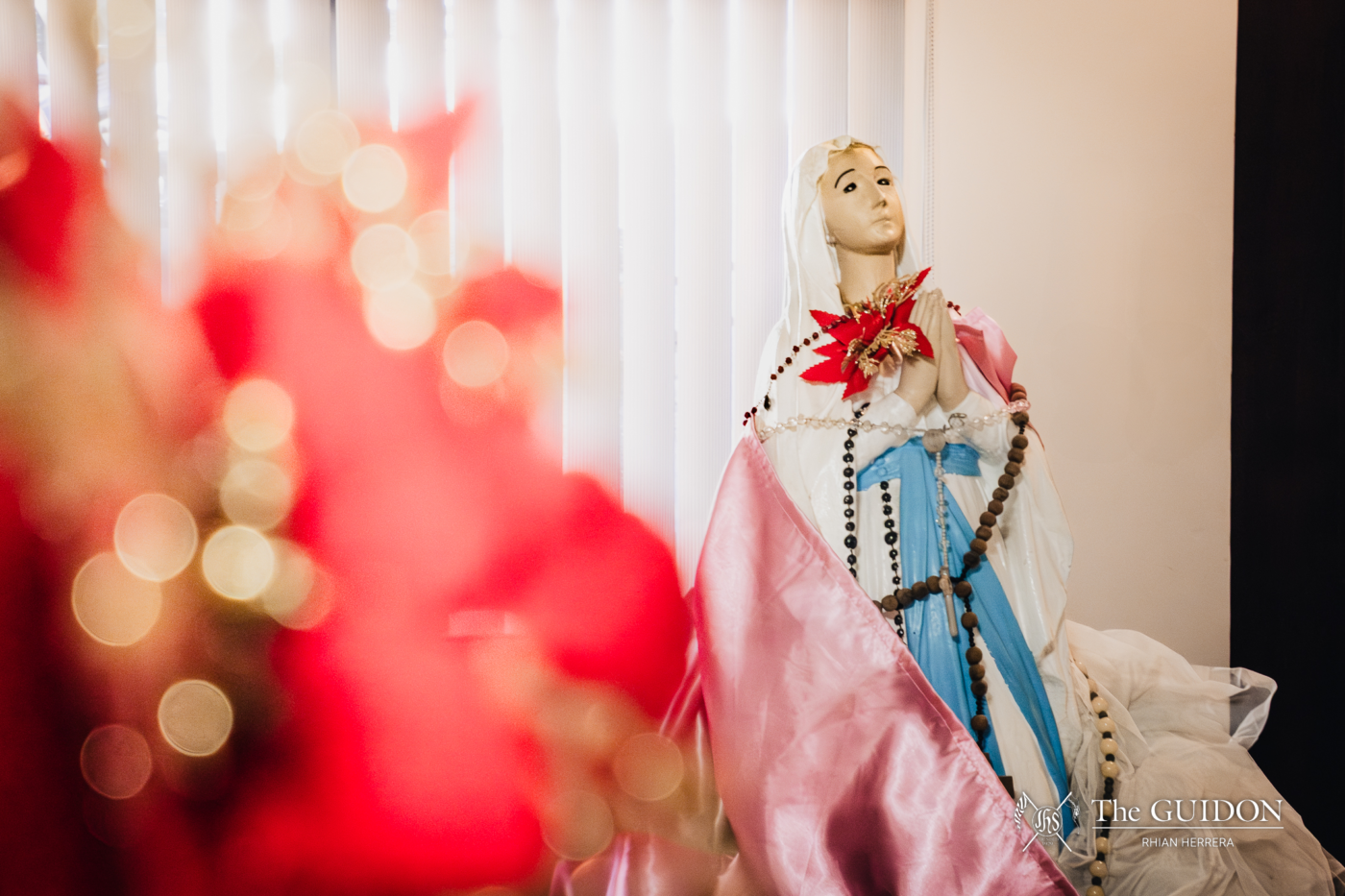
In every Flores de Mayo procession, one brings devotion to life through craftsmanship, while others embody it through performance, showcasing different images of Mother Mary.
EVERY MAY, the streets come alive with marching bands and an extravaganza of gowns as Sagalas take on the journey of expressing their devotion, walking the cross they bear with poise and elegance.
This celebration unfolds during the “Marian Month,” a time wherein Filipinos create art, design, and prayer centered around their faith in Mother Mary. Unlike other processions, Flores de Mayo encourages designers and reynas to be grandiose, equating great feats of art to even greater expressions of praise that intertwine religious belief with personal identity.
Stepping into the dress
From a young age, Nickky Martinez, now 53, started designing paper dolls with her brother. This developed passion for fashion eventually pushed them to open their own shop, making wedding dresses and Flores de Mayo gowns for their barangay.
With every dress she sews, Nickky extends her identity that mirrors both her faith and creativity. As part of her dressmaking process, she prays to create gowns with a clear and pure mind, centering her art in devotion to Mother Mary.
Once the dresses are finished, Sagalas bring life to the procession, with intricate arcs accompanying their confident performances through the streets. No stride is the same, with each Sagala embodying different biblical figures and titles of Mother Mary.
One who experiences the long walk is Alarice Laraño, a 17-year-old Sagala, who looks forward to May every year. She was first introduced to Flores de Mayo two years ago through an invitation to become a Sagala, though her unfamiliarity with the procession initially left her anxious. Seeking guidance, she turned to her family, who quelled her worries and encouraged her to see the experience as an opportunity to grow closer to Mother Mary.
“It’s the main reason why I wanted to [become a Sagala], I was inclined to do it in the first place, in dedication to Mama Mary and in dedication to my religion,” she shares.
With this in mind, she walked the streets and witnessed her barangays’ communal devotion, experiencing a deep fulfillment. The smiles of children and encouraging words of families continue to inspire her Sagala journey, where her artistry and faith intertwine in a prayerful community.
Long walks of pageantry
Marian devotion is often at the forefront of Sagala. However, today, the meaning of the parade is shrouded by pageantry. The true cost behind such spectacle is questioned as gowns get grander and faith begins to fade into the background.
“Unfortunately now, pagdating sa mga [Sagala], nagiging pabonggahan. Nawawala minsan yung concept ng Flores de Mayo,” Nickky says, reflecting how grandiosity can diminish the sanctity behind the festival.
(Unfortunately, now, when it comes to Sagala, it becomes about extravagance. We lose the concept of Flores de Mayo).
Moreover, Alarice echoes how such festivities become a tool to flaunt wealth. “[Grandiosity is] definitely a big issue. It’s like showing off your wealth, and it masks the true meaning of the tradition,” she shares.
She believes that such shows of spectacle can help attract more people, but it should not take away from what Flores de Mayo signifies—one built on faith, community, and piety. For Alarice, the festival’s tradition is one rooted in the intentionality of bringing people together who share the same expressions of faith.
Art for Her
When the spectacle ends, the streets are clear of all the grandeur from the gowns and flowers–but what’s left is faith stripped down to its simplest form in daily life.
While Nickky may have closed her shop due to the pandemic and her responsibilities at home, she continues to design gowns as an outlet for artistry and faith. Designing is still an extension of her devotion to the Virgin Mary, but now her acts of faith revolve around taking care of her mother and daily prayer.
“When I [create] a gown, especially for Flores de Mayo, it is my own way of offering my talents and thanking the Virgin Mary for giving me that talent,” she shares.
Meanwhile, Alarice spends most of her time studying as she waits for another May. In her Sagala experiences, she has found how adoration is transformative, noting how Sagalas has helped her connect with God, meet new people, gain confidence, and become open to new opportunities.
Similarly, Nickky’s experience of devotion, art, and identity is a reminder of how faith transcends the bounds of life, defying the inherent discrimination of bigots. She believes that her identity as a queer woman does not make her less of a Catholic, with designing being her own outlet for faith.
May it be in the gowns Nickky stitches together, or the painstaking walk Alarice endures, devotion finds its place in both masterful craft and performance. In this intersection of identity, artistry, and personal faith, self-expression becomes a sacred offering of one’s talent, all for Mother Mary.