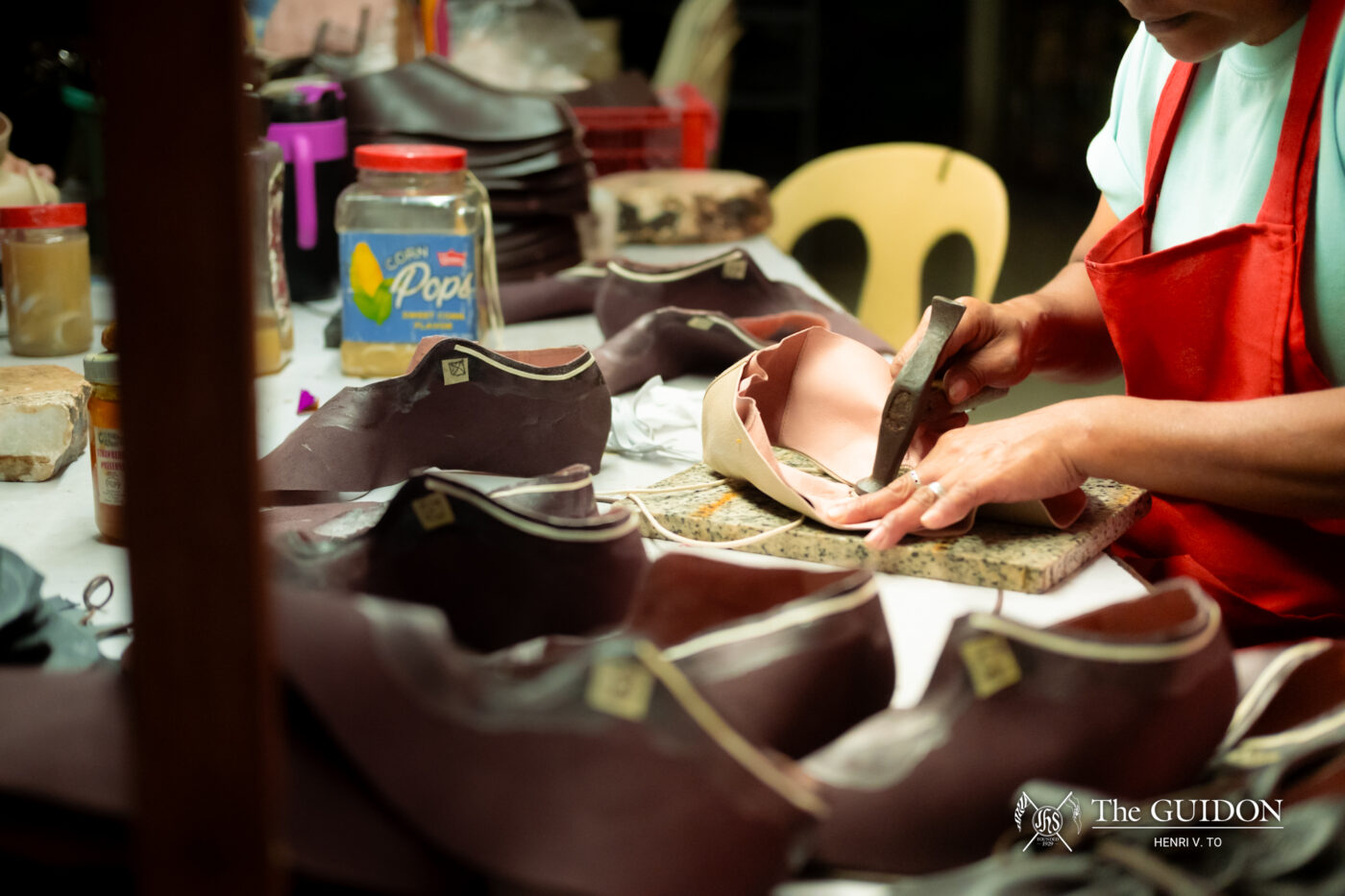
In a fast-paced world, Marikina’s sapateros endure, each shoe they craft carrying strength, memory, and the steps of a nation’s becoming.
THE BEST-FITTING shoes keep us standing tall and steady, every stride serving as a testament to a craftsman’s dedication and pride.
As malls and department stores teem with popular options from abroad, Filipino-made shoes hang on to their rightful place among the displays.
Many of these local shoes come from factories hidden in plain sight, scattered across the streets of Marikina. Some of these shops are tucked behind unassuming residential gates, serving as the ground floor of homes. Inside, sapateros endure the constant heat and scent of contact cement as they stitch sturdy pairs meant to walk their owners through life.
Stitched into skin
For some Marikeños, shoemaking is an inheritance.
Gloria and Alfredo Magtaos have been working with shoes since they were young, eventually deciding to start a business of their own. In 1988, they founded Alria, a factory that produced women’s leather footwear, along with its own label, Antonio Miguel.
Now, 37 years in, the business is managed by their four children. Alvin Magtaos, their youngest, serves as Alria’s finance manager and liaison officer. While his job does not warrant assembling products, he holds Alria’s shoes in his hands with familiarity.
Alvin was unsure about joining the business at first, but he always knew the craft was part of him. He recalls the summers of his childhood helping his mother, a former uppermaker, at the factory. “Halika dito, magpahid ka, (Come here, spread adhesive,)” she would tell her children, who would follow suit with rugby or contact cement. “Itiklop mo, ipukpok mo. Lahat. (Fold that, hammer this. Everything.)”
For Alvin, Alria’s longevity is due to their commitment to quality. From prototyping to producing, they refuse to compromise on any part of the process because Marikina shoes carry a reputation for excellence.
Just a few blocks away, Abby Medina carries this same commitment. Her father ran Medz Shoes, a purely manufacturing business. Out of four siblings, it was Medina who turned her love for footwear and her family into a business of her own, Shoe Room.
“Noong magsa-start pa lang ako, sinabi ko sa dad ko, gustong-gusto ko mag-sell ng shoes,” she recounts. “Pinagawa niya talaga ako ng pair of shoes.”
(“When I was starting out, I told my dad I really wanted to sell shoes. He made me craft a pair of shoes myself.”)
Her late father wanted her to know the feeling of making a pair of shoes by hand before managing her own factory. Although the pair she assembled, made of synthetic material, is already broken, the experience of putting it together remains with her and aids in her understanding of running Shoe Room.
Worn souls
Although both Alria and Shoe Room are selling well at the moment, the Marikina shoe industry struggles to keep up with the influx of mass-produced imports.
“Dati, nasa 100 plus [workers] kami dito,” recalls Rolando “Bruce” Par, a sapatero who has worked with the Medinas for 24 years. Since then, the number of workers has gone down to five, including Par himself.
The situation in Alria is similar, with only twelve workers. “Ang one month na production namin [ay] kaya ng isang company sa China na gawin within one week, (“One month of production [in Alria] can be done by a company from China within a week,”) Alvin explains. He also mentions that they lack the machines to match the rapid roll-out of shoes produced in China.
Over the years, Marikina’s shoemakers have declined significantly in numbers. The ones who remain are aging, with not enough people willing to take a similar career path. Since the shoemaking process is not formally taught to children, Alvin points out that they cannot take over the job. Along with the lack of measures to pass on the craft, Medina has observed that Gen Z’s entrepreneurial mindset points to their likelihood of selling rather than assembling.
Beyond the presence of imports and dwindling manpower, Alvin and Medina feel the need to adapt to a tech-reliant world. Medina’s nights run late, as she faces the camera to live-sell shoes on the platform. For both Medina and Alvin, success hinges on being able to have an effective digital presence for their businesses.
Still, even with digital adaptation, the handiwork itself remains unforgiving. Par recalls a batch gone wrong, “Mayroon din minsan ‘yung may sablay. Hindi maiiwasan sa production iyon. Naging maluwag [ang mga sapatos] hanggang sa maraming nababalik sa amin. […] Doon nalugi ‘yung amo.”
(“Sometimes there are production errors. That is unavoidable. Some shoes loosened until they were returned to us. That caused a loss for [Medina].”)
With every returned batch, however, Par did not rush to replace them; instead, he reviewed each pair, checking the stitching, fit, and finish. He ensured the next release had no errors, that every shoe was worthy of the excellence carried by Marikina.
In a flood-prone city such as theirs, even precision cannot shield the craft from the unpredictability of nature. Medina shares that such disasters pose risks both to lives and livelihoods.
During Typhoon Karina in 2024, she had planned a donation drive for school shoes because she was unable to sell them due to the floods. No one claimed them, but when floods hit Bicol months later, she did not hesitate. “Dinonate ko siya sa (I donated them to) Angat Buhay,” she says.
Since then, her cabinets have been elevated, the shoes now stored on higher ground. She knows the water may come again, but the next time, it will not reach the soles.
Where we still walk
To the Marikina sapateros, a pair of shoes is a beginning—a solid foundation in someone’s journey.
“Ang nakikita ko ‘yung sapatos ay parang pundasyon ng tao. Kumbaga kami ‘yung nasa ilalim. Tinataas namin sila. […] Mas nagiging proud sila—confident.” Alvin says.
(“I see shoes as a person’s foundation. In a way, we are the ones uplifting [our customers] from beneath. They become prouder—confident.”)
The craft is not just about footwear, but steady footing. Shoes affect the way someone walks into a job interview, a classroom, a street, or a new country—the kind of strength not always seen, but felt in every step. A well-made shoe carries the weight of someone’s hopes, steadies them in moments of uncertainty, and has soles that do not give up when life gets hard.
Hence, Alvin believes their work as sapateros is only fulfilled when the foundation they create for others is solid. Nevertheless, this kind of fulfillment does not end in the factories.
Medina dreams of reviving Marikina’s success, “Andun pa din naman ‘yung dream ko na maging known ulit ‘yung Marikina shoes talaga. Back to ‘yung glory days talaga na mas ipa-patronize ng kapwa mo Pilipino ‘yung gawa sa sarili mong bansa.”
(“My dream for Marikina shoes to be known again is still there, back to the glory days when Filipinos would patronize the work of their own countrymen.”)
But to reach that dream, the craft must be passed down—not just as a livelihood, but as a legacy. Par, after decades in the trade, knows that good shoemaking starts with heart, not just pay. He hopes that future sapateros will be willing to learn not just the steps, but the soul behind each pair.
A sapatero is an artisan, but also a storyteller and an architect of selfhood. What they make in the workshop does not stay there, but walks with buyers throughout life. The next steps, then, would be to walk with sapateros as the industry regains stability.
Until then, sapateros hope that the craft will endure long after them, confident that when people look down at the shoes and ask, “Where was this made?” the answer, proudly, will still be Marikina.