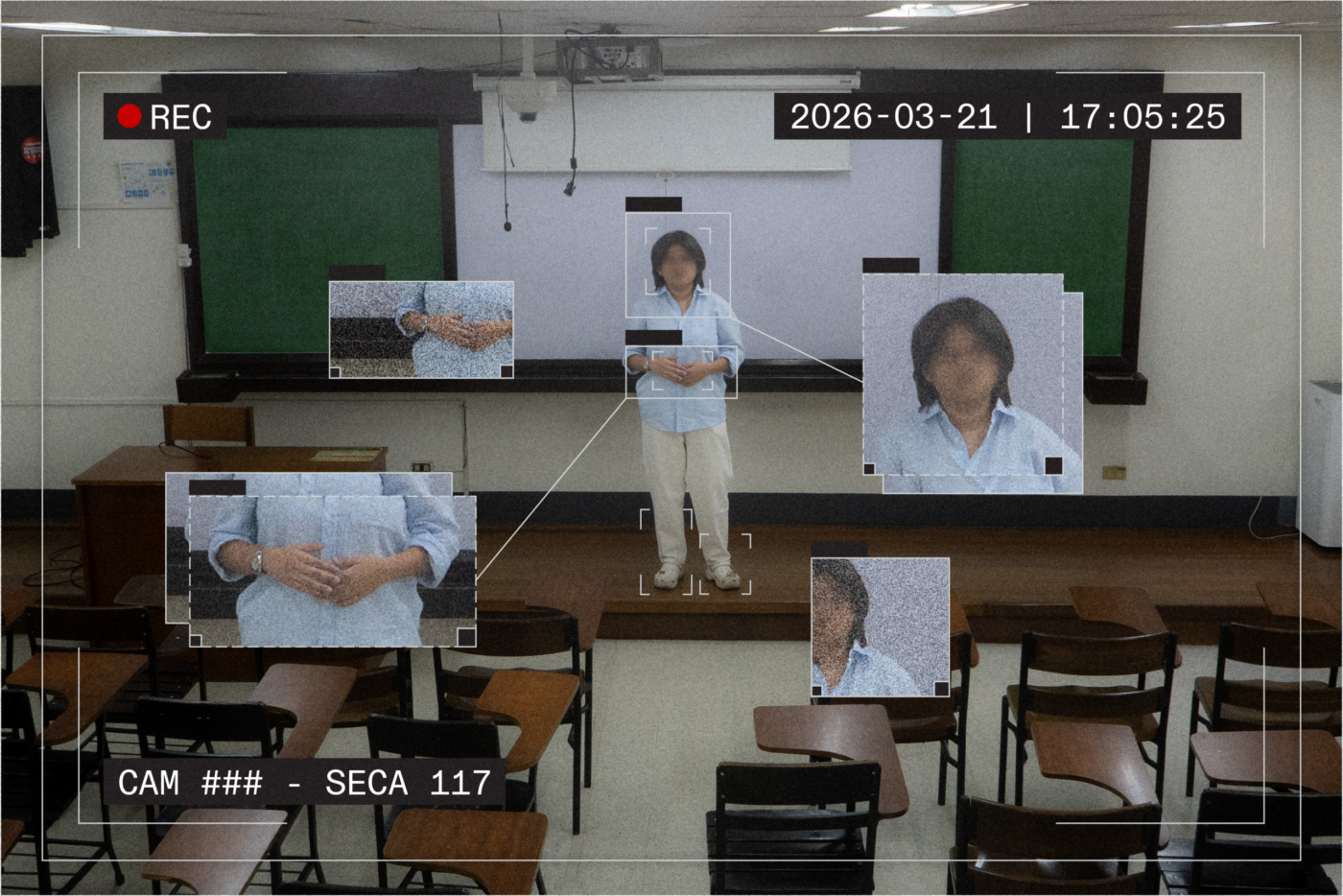
WITH THE intensified push to strengthen campus security, the recent installation of additional closed-circuit television (CCTV) systems in the University aims to tighten safety within academic spaces.
Expounding on the change, the Campus Safety and Mobility Office (CSMO) presents CCTV systems as tools for securing property, deterring crime, and maintaining order across campus. However, as monitoring increases, the presence of surveillance in classrooms raises questions about institutional oversight and ambiguity in the University.
Behind the lens
When the Ateneo administration began installing CCTVs, the University released a notice assuring that footage is stored for a limited period in controlled facilities with restricted access and used primarily for security purposes.
Following this, University Data Protection Office (UDPO) Director Atty. Jamael Jacob stated in an email exchange with The GUIDON that data privacy laws and the NPC Circular No. 2024-02 require entities to notify individuals when their personal data is being or about to be processed, along with relevant information about the data processing.
The GUIDON requested an interview with the CSMO for further discussion on CCTV footage handling, however, the office declined the publication’s request.
Despite the presence of a CCTV Notice and Privacy Policies, faculty accounts suggest inconsistent dissemination in informing the Ateneo community of the camera installations.
Philosophy Department professor Remmon Barbaza, PhD specifically recalls that he only realized CCTVs were present upon seeing them during class. He also shares his lack of awareness of certain operational aspects of the CCTV implementation in classrooms.
Similarly, Edgar*, another faculty member, observes that students are often unaware that CCTVs are present due to the cameras’ “discreteness,” attributing it to the administration’s lack of transparency. As such, he worries about how the CCTV footage is ultimately used, where it is stored, and who has access to it.
Such gaps between policy and practice reinforce concerns about how these systems are communicated and implemented.
These concerns are further underscored in a recent case involving the Ateneo Employees and Workers Union (AEWU), where CCTV footage was cited in disciplinary proceedings linked to alleged violations of the Work Rotation Program.
The University claims that its charges were grounded on documented administrative findings and formal Notices of Charge concerning alleged unauthorized meetings. However, AEWU questions the administration’s reliance on CCTV footage, emphasizing that such recordings may lack sufficient context to fully establish intent or surrounding circumstances.
Concerns raised by AEWU over unfair labor practices, stemming from the use of CCTV footage in the case, were brought before the National Labor Relations Commission (NLRC), yet the NLRC dismissed the complaint. While the University maintains that its actions were “appropriate and proportionate,” the ruling drew flak from the Ateneo community over its implications for labor protections.
Amid these procedural developments, deeper concerns emerge about how surveillance becomes embedded in everyday academic life, where unclear boundaries risk influencing teaching practices under continuous observation.
Recording in progress
Within the four walls of the classroom, Barbaza and Edgar acknowledge the role of CCTVs in ensuring safety on campus. Barbaza cites their utility in “critical areas” and in responding to hazards like fires. Edgar likewise notes that CCTVs along hallways can be useful for student safety.
Still, Edgar describes CCTVs inside classrooms as part of a larger surveillance culture that may impact classroom dynamics. While Edgar does not personally censor himself in his lectures, he explains that some faculty members might be more hesitant “to do activities that might be misinterpreted,” such as those that ask students to share personal experiences.
Barbaza likewise responds to the implementation of CCTVs with light humor, sharing that he sometimes jokes about being watched and possibly losing his job. While said in jest, the remark reflects an awareness that classroom interactions may be observed beyond those physically present in the room.
Beyond the classroom, Edgar also warns that security infrastructure can track the movement of individuals. For him, the mere presence of CCTVs carries an implicit warning that every movement is seen.
This concern extends with plans to expand CCTV installations into department offices, which Edgar believes signals a “situation of mistrust” toward faculty by bringing CCTVs into the “most intimate spaces of faculty.”
Edgar also contends that the administration’s lack of transparency may be intentional, serving as a means to evade accountability. By limiting disclosure, he argues that the University shuts down potential conversations about CCTV use.
“The institution retains liberty over its as long as it is within the interest of the institution,” Edgar emphasizes, in a mix of English and Filipino.
Nevertheless, Barbaza believes that the decision to install CCTVs stems from fear—closely tied to the human desire for security and comfort, often informed by perceived uncertainties. In this sense, he calls for the University to have a careful assessment of what exactly it fears, and how it is being addressed.
Rather than solely focusing on CCTVs, Barbaza urges the broader community to examine the wider dynamics that reveal the disconnect between the University’s identity and its recent practices, particularly in how its spaces are designed.
Widening the frame
Barbaza points to how surveillance systems form part of larger institutional choices. Expounding on this, he emphasizes that the Ateneo, as an academic institution, can treat its urban planning as a teaching opportunity.
“Ateneo is a university […] and teaching is [primarily] done in classrooms. But the way we design space also teaches—it is itself an educational act,” Barbaza explains. With this, he emphasizes that common spaces should be shaped by renewed avenues for dialogue, where the community can teach and learn together.
However, Edgar points to the lack of transparency surrounding CCTV use as inconsistent with the University’s values. “We keep emphasizing magis, even if we say cura personalis, [but with the way CCTVs are implemented,] even the institution [itself] doesn’t follow that,” he laments.
He points out that such dialogue is also limited by the absence of an active faculty union, making the Ateneo the only university among the “Big Four” without one. He stresses that this lack of representation may discourage faculty members from collectively raising concerns, reinforcing the broader sense of institutional imbalance.
Edgar thus underscores the need for the community to become more cognizant of major changes within the University—the CCTV installations being only one of them.
“Whatever policies, rules, [or] equipment that Ateneo brings to the classroom, to the hallways, [or] to public areas around the University, it molds how people move around. […] How can we be more aware of how we are being molded by [the] Ateneo in this process?” Edgar explains.
Altogether, Barbaza posits that the issue with CCTVs extends past concerns on professional autonomy, instead inviting the University to properly assess how it responds to perceived danger.
While safety measures may provide security, the challenge for the Ateneo is ensuring that its responses remain proportionate to such threats—responses that define the kind of community the University seeks to form.
*Editor’s Note: The name of the interviewee has been changed to protect their identity and privacy.