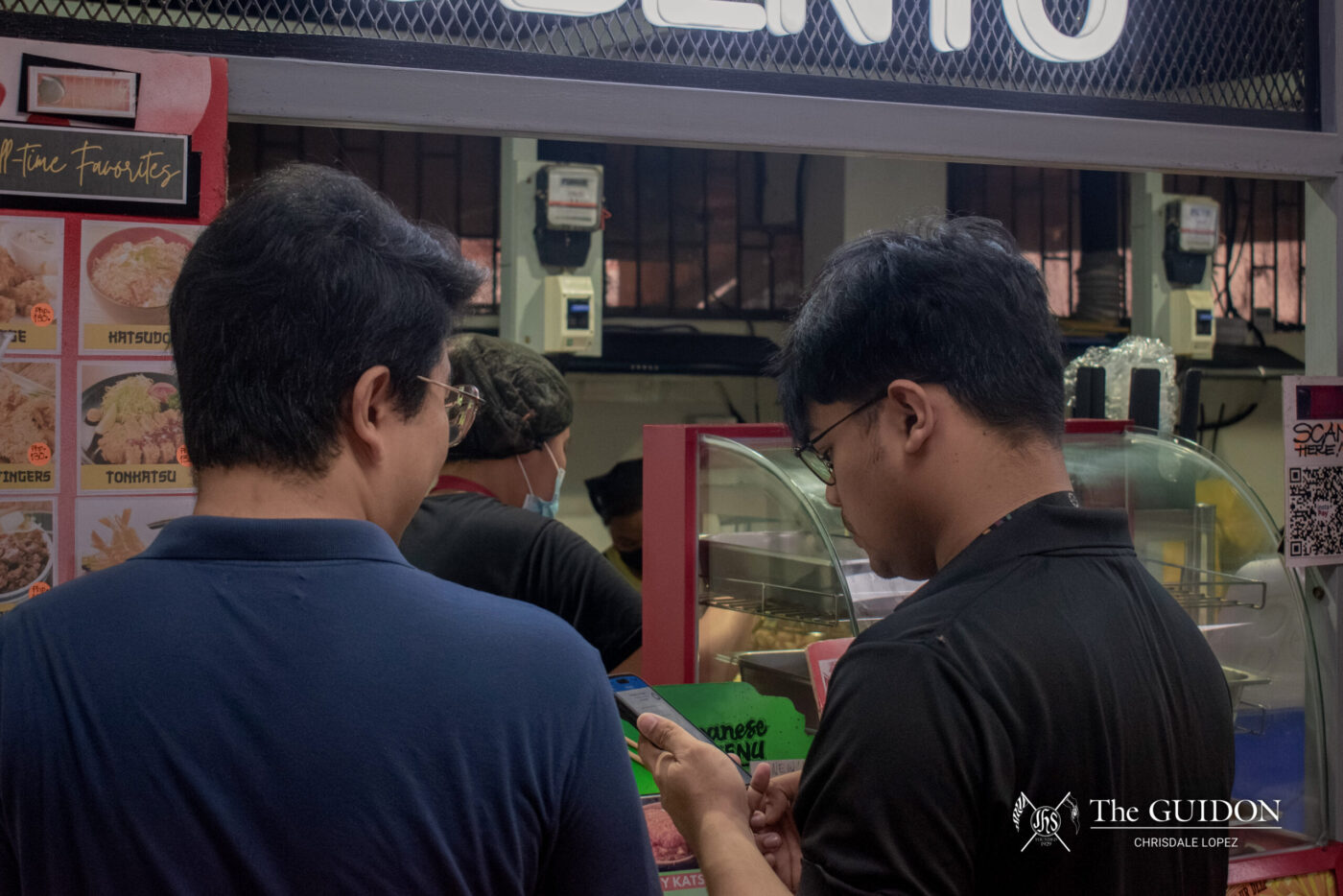
AS FOOD prices on campus rise, scholars bear the brunt of the ongoing challenge to secure daily meals.
Over the years, several initiatives have been introduced to support scholars, including food stubs and discount programs. However, scholars are still reported to regularly worry about having enough money for food, leading them to make daily food choices within a limited budget.
Meals within means
In the Ateneo, scholars like Asher Ayeras (4 BS LM) and Keara Pantalunan (1 BS MGT-H) note how rising food prices require careful meal planning and spending strategies.
For Ayeras, he brings pre-packed food from the province to Katipunan and portions it out to last several days. He plans his meals according to his class schedule, often eating heavy breakfast and using his food stubs midday.
While Ayeras believes there are many food options on campus, he points out that some areas such as the John Gokongwei School of Management Enterprise Center are already ruled out by scholars like himself because of high price points.
Similarly, Pantalunan decides on her daily food choices depending on her schedule and financial situation. If time and budget allow, she buys groceries and cooks for the week; otherwise, she uses food stubs and buys the cheapest options.
Pantalunan also tends to repeat the same meals she can consistently afford, automatically “[closing] off” options with high prices. Beyond campus, she adds that a single meal can cost from Php 200 to Php 300. Ayeras echoes this, noting that such an amount of Php 250 could already cover three sets of meals.
Given the lack of affordable options, scholars who prefer vegetable-rich dishes like Ayeras find it difficult to maintain a balanced diet. With healthier alternatives often costing more for scholars like Ayeras and Pantalunan, meals with larger portions become the more practical choice for nutrition.
“[A high] quantity [meal] wins [over a balanced diet] because I want my money to go farther,” Pantalunan shares.
With these struggles in mind, Scholars’ Sector Representative Hxyll Almonguera observes that these challenges discourage scholars from feeling included in the Ateneo community, especially in cafeterias. As such, many scholars resort towards surviving strategies for managing their daily food needs, such as the one meal a day scheme or sleeping through hunger.
Amid the surge of food costs, narratives of Ateneo scholars reflect their reliance on University support, and how these policies fall short in addressing food security within campus.
Plates and policies
To determine food prices, the University Business Affairs Office (UBAO) Director Victor Emmanuel S. Claravall explains that the UBAO mandates Ateneo concessionaires to follow a pricing scheme with a wide range of price points. In this range, UBAO strictly enforces a “student price” tier that requires meals to be offered below Php 100.
Despite such directives, the preliminary Scholars’ Sectoral Board (SSB) Food Security Study finds that actual prices for campus meals average Php 100 to Php 150, far above the Php 50 to Php 70 that scholars within the study deem affordable. The study also notes that Php 100 campus meals are perceived as inexpensive and not often questioned, further making affordability concerns less visible.
Almonguera also believes that institutional pricing structures are misaligned with the scholars’ financial needs. He describes the current food prices as “elite-centric” and says that this reflects the Ateneo’s shift toward commercialization.
Claravall, for his part, explains that UBAO’s primary mandate is to generate additional revenue from University resources. However, he discloses that UBAO strongly coordinates with the Office of Admission and Aid (OAA) to work with food concessionaires to provide discounts for scholars.
While The GUIDON invited the OAA for an interview, the invitation was declined due to scheduling constraints. Other OAA officials were subsequently sent an interview request, but no response was ultimately received.
Upon research into the office, the SSB and OAA’s Food Stubs program provides either 100 or 150 food stubs worth Php 500 for food concessionaires within the Ateneo, such as Ebai’s, TGS Fast Foods and Catering Services, 2Gonz, and Kitchen City. These stubs are given out on a monthly basis, with priority given to financial aid scholars.
Alongside these stubs, the OAA and SSB also coordinate with Gonzaga food stalls such as Chunky Chicks and Obento to provide 100% financial aid scholars with discounts on their meals.
The OAA also recently opened the SCHOmmunity Pantry at the OAA, which provides scholars a donation-based supply of free snacks and groceries sourced primarily from Ateneo alumni, faculty, and student organizations.
Yet, while Almonguera affirms that scholars deem food stubs helpful, he also acknowledges that this initiative remains a “band-aid solution” to the systemic food crisis within the University.
Ayeras points out that a Php 500 food stub can only last him three to five days. Likewise, Pantalunan shares that though food stubs can sustain her for a week, they are not enough for a whole month.
In recent months, Ayeras notes that the rollout of Php 800 Varda Group food stub means an additional three meals. However, while larger subsidies ease food expenses, scholars like Ayeras and Pantalunan still find themselves having to carefully ration these support mechanisms. Scholars, hence, continue to need solutions that address the root causes of food insecurity within the University.
Planning meals for tomorrow
Pantalunan recognizes hunger and resource management as a struggle that can not be solved by short-term solutions. While she believes that current initiatives address immediate food-related challenges, she hopes for a wider variety of affordable food options in Ateneo, similar to other schools in the Philippines.
“Collaboratively, Ateneo [should] get to a point where food is affordable for everyone. […] Not just scholars, but also the regular student[s] should have […] a balanced [and] affordable food option,” Pantalunan asserts.
At present, the Sanggunian Central Assembly (CA) recently passed the SSB-proposed Food Stubs Appropriation Act to institutionalize food stubs for scholars.
In the past, Almonguera explains that budget hearings during the first month of the school year delayed funding for the food stubs program. The Food Stubs Appropriation Act addresses this by mandating the next Sanggunian to regularly allocate 8% of its semestral budget from the Student Activities Allocation Fund to food stubs.
Almonguera also affirms that the SSB anticipates hosting more open forums so scholars can communicate with the administration. He also hopes for the SSB to create stronger working relationships with the University, particularly with UBAO.
Alongside efforts from SSB, Claravall shares that UBAO is developing a New Rizal Library cafeteria to provide more food options for students, as well as plans to extend cafeteria operating hours past 5:00 PM.
Regarding administrative efforts, Almonguera warns against complacency among all involved actors in addressing these concerns. “I think [the University, the Sanngunian, and the next SSB] have to face [the] reality that issues with food security will not fade away immediately, so it means we really have to be proactive in every semester, in every year we will be having,” Almonguera contends.
Thus, as food structures within the Ateneo continue to deprioritize the needs of scholars, Almonguera emphasizes the need for urgent and consistent University action, ensuring every Atenean can access the basic necessity of a meal.