THE THREE branches of government exist as coequals in terms of powers and functions in the general structure of the Philippine political system. In order to secure such democratic institutions, the framers of the 1987 Constitution made sure that each branch works under the principles of separation of powers and checks and balances.
For the legislature, lawmaking is the primary endeavor. Article VI of the Constitution states that, “The legislative power shall be vested in the Congress of the Philippines which shall consist of a Senate and a House of Representatives, except to the extent reserved to the people by the provision on initiative and referendum.”
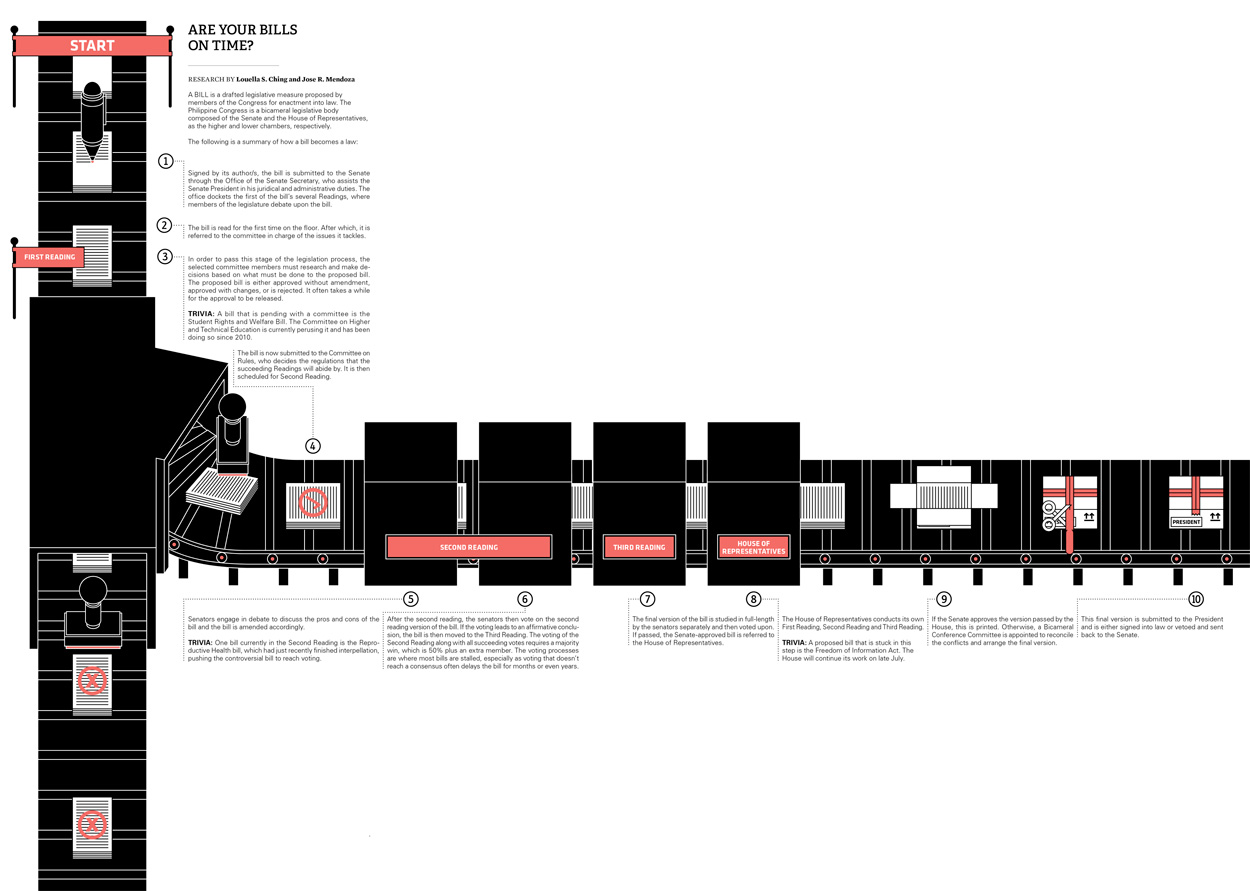
Before a bill fully becomes a law, proposals have to undergo three separate readings where members of Congress form committees that consolidate all procedural requirements and prepare for plenary debates that could lead to possible amendments, among others. (See infographic.)
While such a procedure aims to come up with refined and polished laws, questions are often raised concerning the slow process to which bills are subjected.
Last July 22, House Speaker Feliciano Belmonte concretized this situation, reporting through an official statement the achievements of the 15th Congress since the new administration began in 2010. “Until adjournment of the 2nd regular session in June—a span of only 128 session days—some 3,398 measures have been processed out of some 8,884 bills and resolutions filed,” he said.
Belmonte’s praise for the members of Congress notwithstanding—he branded the legislature as a “bastion of reform and outstanding performance”—only 27 measures out of thousands of proposed bills have been enacted as laws.
Pending bills
This legislative power of Congress has perhaps been put under much scrutiny, especially as the current pressing issues have become the same topics being discussed in public.
The Reproductive Health (RH) bill has been one of the most controversial bills ever crafted in the Philippines. It managed to raise opinions from all over the country as it intensified the tension between the Church and the government.
The issue of reproductive health has been a subject of debate for a long time, even dating back to the Marcos administration. The House has scheduled to vote on terminating the debates regarding the RH bill on August 7, which could then lead the members of congress to vote on the bill itself.
The Freedom of Information bill, which the 14th Congress failed to ratify last year, is also on the list of pending priority bills pushed for by different groups. It has recently been renamed as the People’s Ownership of Government Information bill, also known as the POGI bill.
Meanwhile, as the issue of the contractualization of workers pushes labor unions to clamor for the protection of their rights, the Security of Tenure bill has also been gaining support. In the same way, youth groups have been lobbying for the passage of the Students’ Rights and Welfare bill, which was filed in 2010.
Other bills have yet to be discussed in Congress, including the measure on the Armed Forces of the Philippines’ modernization, the Anti-Money Laundering Act, the measure on revenue sharing in the mining industry and the “Sin Tax” bill on cigarettes and alcoholic beverages.
Designed to be slow
While varied criticisms get thrown at lawmakers and the slow-paced legislation process, Cavite 2nd District Representative Lani Mercado-Revilla said in an e-mail interview with The GUIDON that careful reviewing of bills is indispensable.
“Considering that a bill passes three readings in both the House of Representatives and the Senate, then there is a need for around 286 district and party-list representatives to read, research and deliberate on the proposed measure,” she said, explaining that such measures are observed because they are needed.
As a congresswoman, Mercado claims that there are important parts of the legislation that the ordinary Filipinos do not witness. “They do not witness how congressmen and congresswomen prepare the legislative measures—bills or resolutions—that they want to author. They do not witness, unless they attend committee hearings or plenary debates, how a bill or resolution passes the first, second, and third readings,” she said.
She also stressed that above all else, it is the will of the Filipino people that should be considered when it comes to lawmaking.
Mercado believes that it is in the nature of lawmaking to have a long and meticulous process, given that the legislature is also the deliberative branch of the government. Much consulting is necessary within and outside Congress, but this, according to her, is not a sign of inefficiency but is instead done “for the sake of the common good.”
Improving from within
Activist Jeff Crisostomo agreed with Mercado, saying that the rigorous procedure of legislation is characteristic of the political system in the Philippines. “I can’t say that we can do without it. Each step of the process is still important,” he said in a mix of English and Filipino.
However, Crisostomo pointed out that the legislative staff working behind the process also plays a vital role in passing bills. “One really huge factor—no one has done a study about this—is the importance of having a competent and efficient legislative staff when it comes to handling the passage of particular bills,” he noted.
There could be a plethora of recommendations to address sentiments concerning the slow legislative process. However, it seems that the bottom line remains: insofar as the thousands of pending bills are concerned, Congress is slow when it comes to lawmaking because it is designed to be such. Bills, after all, will have a significant effect on the lives of the citizens once enacted as laws and therefore need to be perfected and not thoughtlessly imposed.
Are your bills on time?
Research by Louella S. Ching and Jose R. Mendoza, Infographic by Mich B. Salangsang.
Research by Louella S. Ching and Jose R. Mendoza, Infographic by Mich B. Salangsang.
A BILL is a drafted legislative measure proposed by members of the Congress for enactment into law. The Philippine Congress is a bicameral legislative body composed of the Senate and the House of Representatives, as the higher and lower chambers, respectively.
The following is a summary of how a bill becomes a law:
1. Calendaring for First Reading
Signed by its author/s, the bill is submitted to the Senate through the Office of the Senate Secretary, who assists the Senate President in his juridical and administrative duties. The office dockets the first of the bill’s several Readings, where members of the legislature debate upon the bill.
2. First Reading
The bill is read for the first time on the floor. After which, it is referred to the committee in charge of the issues it tackles.
3. Committee Hearings/Report
In order to pass this stage of the legislation process, the selected committee members must research and make decisions based on what must be done to the proposed bill. The proposed bill is either approved without amendment, approved with changes, or is rejected. It often takes a while for the approval to be released.
Trivia: A bill that is pending with a committee is the Student Rights and Welfare Bill. The Committee on Higher and Technical Education is currently perusing it and has been doing so since 2010.
4. Calendaring for Second Reading
The bill is now submitted to the Committee on Rules, who decides the regulations that the succeeding Readings will abide by. It is then scheduled for Second Reading.
5. Second Reading
Senators engage in debate to discuss the pros and cons of the bill and the bill is amended accordingly.
Trivia: One bill currently in the Second Reading is the Reproductive Health bill, which had just recently finished interpellation, pushing the controversial bill to reach voting.
6. Voting on Second Reading
After the second reading, the senators then vote on the second reading version of the bill. If the voting leads to an affirmative conclusion, the bill is then moved to the Third Reading. The voting of the Second Reading along with all succeeding votes requires a majority win, which is 50% plus an extra member. The voting processes are where most bills are stalled, especially as voting that doesn’t reach a consensus often delays the bill for months or even years.
7. Voting on Third Reading
The final version of the bill is studied in full-length by the senators separately and then voted upon. If passed, the Senate-approved bill is referred to the House of Representatives.
8. In the House of Representatives
The House of Representatives conducts its own First Reading, Second Reading and Third Reading.
Trivia: A proposed bill that is stuck in this step is the Freedom of Information Act. The House will continue its work on late July.
9. Back to the Senate
If the Senate approves the version passed by the House, this is printed. Otherwise, a Bicameral Conference Committee is appointed to reconcile the conflicts and arrange the final version.
10. Submission to Malacañang
This final version is submitted to the President and is either signed into law or vetoed and sent back to the Senate.
Source: http://www.senate.gov.ph/about/legpro.asp
Pieces of slow legislation
Research by Jessica Y. Velarde
THE CONGRESS, as the lawmaking body of the government, has crafted different bills to be passed as laws. However, the process does not go just as simple, as many have questioned the slow-paced system of the legislature. The GUIDON presents some controversial bills that have yet to be laws, given the speed of Philippine legislation.
| House Bill Number | Name | Significant Dates | Author | Purpose |
| 5043 | Reproductive Health Bill | 2008 | Rep. Edcel C. Lagman, Albay, 1st District | An act providing for a national policy on reproductive health, responsible parenthood and population development. |
| 1799 | Divorce Bill | 2008 | Rep. Luzviminda Ilagan, Gabriela | An act to legalize a Filipino-style divorce in the country. |
| 00022 | Freedom of Information (FOI) Bill | Date filed: 2010-07-01. Date read: 2010-07-27. | Rep. Marcelino R. Teodoro, Marikina City, 1st District | An act to make public documents more accessible to the public. |
| 2190 | Students’ Rights and Welfare (STRAW) Bill | 2007 | Rep. Walden F. Bello and Rep. Kaka J. Bag-ao, AKBAYAN | An act to protect and promote the rights of Filipino students. |
| 00190 | Salary Grade Increase of Public School Teachers (NOTE: Not the official short-title) | Date filed: 2010-07-01. Date read: 2010-07-27. | Rep. Rachel Marguerite B. Del Mar, Cebu City, 1st District. | An act that will increase the salary grade of public school teachers from grade 11 to 20. |
| 00013 | Protection of the Unborn Child | Date filed: 2010-07-01. Date read: 2010-07-27. | Rep. Roilo S. Golez, Paranaque City, 2nd District | An act to highlight and preserve the right of the unborn to develop and live. |
| 00003 | Household Help Scholarship Act Grants | Date filed: 2010-07-01. Date read: 2010-07-27. | Rep. Ronald V. Singson, Ilocos Sur, 1st District | An act to give discounts or scholarship grants to deserving and qualified household help. |
| 00006 | Prescribing A Fixed Term For The Chief Of Staff Of The Armed Forces Of The Philippines | Date filed: 2010-07-01. Date read: 2010-07-27. | Rep. Rodolfo G. Biazon, Muntinlupa City, Lone District | An act that will allow the Chief of Staff of AFP to fix his/her term in order to finish his/her projects |