
THE AUTOMATED system for the elections promises several things—speed and increased accountability among them—but what happens if the computers break down?
This was just one of the concerns that the Simbahang Lingkod ng Bayan (SLB) tried to address in their Kwentong Bayan situationer that clarified issues on the new voting procedures.
The topics ranged from the technicalities of the system to the morality of the elections.
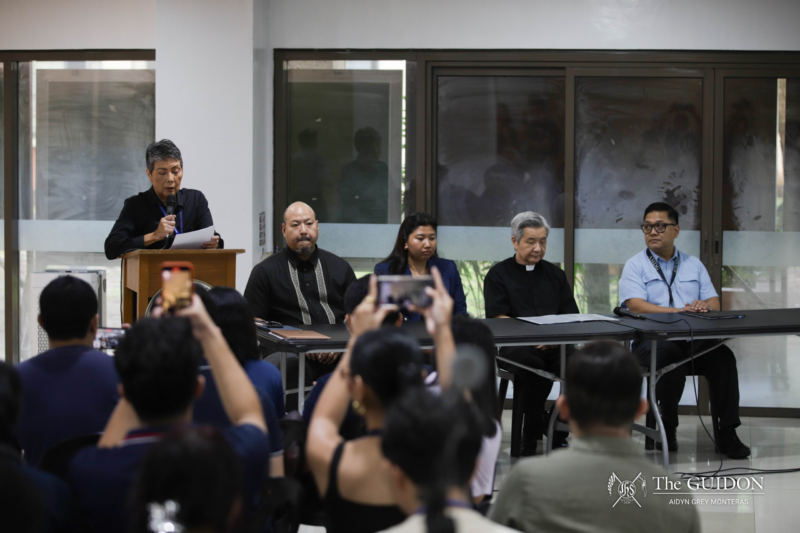
The forum, held last January 16, is part of the bi-annual series of national situationer forums that SLB conducts to discuss socio-political issues.
Insecurity
Ateneo Human Rights Center Executive Director Carlos Medina spoke about his concerns on the security and reliability of the machines, especially the sensitivity of the Precinct Count Optical Scan (PCOS).
“One of the concerns with the PCOS is having tainted ballots because this would lead to the rejection of [ballots],” said Medina. “Once a ballot is rejected, there’s no replacement for it.”

Verge of modernity. Comelec went through great lengths to ensure a sound and fair electoral system but citizens remain hesitant to the change. Photo by Rico B. Cruz
Fellow speaker Professor Pablo Manalastas from the Center for People Empowerment in Governance agreed. “A PCOS machine has problems recognizing some written things, what is 50 percent or more shading for us may not be how the machine reads it,” he said.
“[Comelec officials are also] using laptops that can easily be transported and carried… the GPRS modem may jam because of too much files being sent at once,” he added.
Medina, who is also part of the Legal Network for Truthful Elections, also worries about miscomputation.
“During the 2004, 2007, and ARMM elections, the concept of dagdag-bawas (add and subtract) proliferated… [When] we had the pilot test in ARMM, we had different results from the consolidation center as compared to the ARMM area,” he said.
There are people assigned to assist voters who are unfamiliar with the automated system but for Medina, their roles must be limited. “Things may be changed along the way,” he said.
Ambassador Henrietta de Villa, on the other hand, discussed the Catholic aspect of the election. De Villa is from the Parish Pastoral Council for Responsible Voting.
“The cultural environment [of the elections] consists of gold, guns, goons that affect people’s decision to vote. There is also the idea of voting based on patronage, pay offs and popularity,” said de Villa. “Moral values are set aside because of decline of conscience and belief in God, the automation of elections may be used by some for their personal gains.”
The back-up plan
Comelec Commissioner Gregorio Lardizabal was present to answer his co-speakers’ concerns. He said that the Comelec has been transparent with the automation process. “Automation is not an impossible dream. Despite what others say, it can be done.”
He said the Comelec ordered 80,200 PCOS machines for the elections. “There will be 6,729 space PCOS machines….There will be no clustering of precincts from different barangays… there will be only one PCOS unit per precinct cluster.”
The ballot box has also been made translucent to see where the ballot goes but not enough to read the vote. “The PCOS unit will be mounted on top of the ballot box. Once you cast your ballot, it falls and you can see it.”
Regarding concerns on the limited number of people that can be accommodated in the voting area, Comelec will allot a separate holding room for waiting voters and last-minute reminders.
Lardizabal is certain that it is difficult to tamper with the system. “We are assured of the security of the machine because it uses a 128 bit encryption code which is similar to the ones used by banks,” he said.
He added that the failure of machines does not mean failure of elections, because the Comelec has backup systems and machines available.
Only questions
Sanggunian Executive Officer Reg Guevara said she learned useful information about the elections, which she intends to share with her barangay. “I realized that voters’ education is really important because not many people are aware of what’s going to happen.”
However, she also realized that so many unresolved points and loopholes about the automation remain unaddressed.
Sr. Maria Dolores Aranda, FI left the forum unconvinced about the changes. “We all know the lapses of technology… but I am hopeful that these changes will bring greater good.”
“Although there are still some gray areas in the automation and some issues are not clear, with this talk, we realize that there is still hope,” said SLB Associate Director Bro. Jomari Manzano, SJ.
Manzano believes that the automation of elections will be better. “[It will be] a CHAMP election—Clean, Honest, Accurate, Meaningful, and Peaceful.”
Greater need
Manzano said that although he considers this talk a success, he realized that there is a greater need for more informative talks like this. “We will still continue having voter’s education and we will also be having trainings for teachers and other volunteers,” he said.




Are they really sure that those PCOS Machine will not fail? bless them.