This was Rick Olivares’ sentiment for Filipinos who do not care about climate change. He finds it “borderline criminal” when people are unconcerned with issues of the environment.
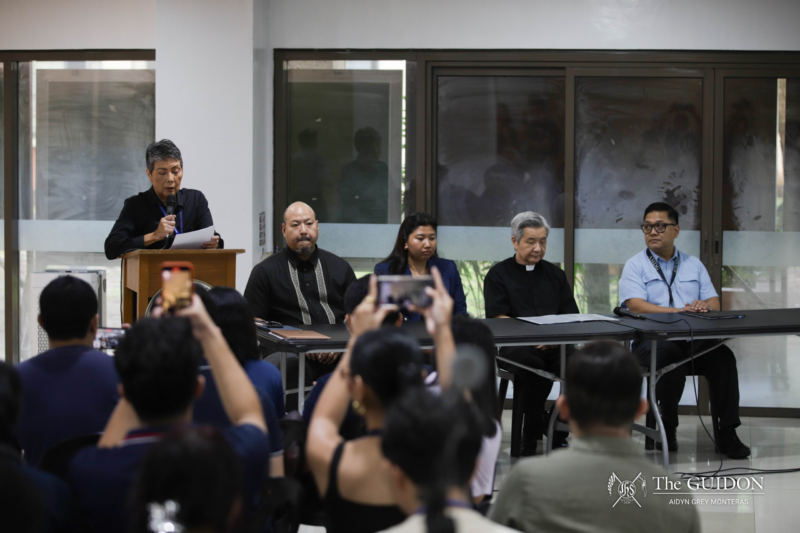
Olivares was referring to the low turnout of participants in the talk “Climate Change: How it affects us and what we can do about it” held on November 28. It was organized by the Ateneo Alumni Association (AAA) where Olivares is the Communications Manager.
Apart from a few Ateneo students, teachers and alumni who attended, there were also students from other schools and members of outside organizations.
“We’re so caught up with our everyday lives that we don’t realize [that this] is an issue,” Olivares said.
The Philippines is changing
Deanna Olaguer, the talk’s speaker, stressed that the Philippines is changing because of climate change. She added that it’s getting hotter each day to the point that even fishermen complain of the hot temperature in the sea.
Olaguer is the head of Klima Climate Change Center, an organization established by the Manila Observatory to conduct studies on how people can act against climate change.
“The natural habitat is changing, meaning there [will be] less food,” Olivares added.
Olivares also said that climate change has worsened and its effects are happening sooner than expected. He mentions certain effects such as the rise of water levels in Boracay and the loss of ice in Mt. Everest.
Local solutions
“Climate change is global but the solutions are local,” Olaguer said.
Some of these solutions include reducing the sources of greenhouse gases through the use of renewable energy and sustainable transport, and recycling. But Olivares said this is not easy and requires a paradigm shift for all.
Climate change, said Olaguer, also played a factor in the Ondoy flooding.
“Those living in low lying coastlines and low elevations [are at risk]. The poor are vulnerable here,” she said.
Olaguer, however, said there are ways to prevent another tragedy like the Ondoy flooding. But such solutions require “a lot of urban development,” like repositioning of buildings to give way to river flows.
Raising awareness
Karen Crisostomo, who attended the talk, said that it was very informative and very relevant to the times. “I think it’s good to raise awareness especially to the students. I hope that [conducting this talk] is not just a fad [or] an ‘in’ thing to do,” she said.
Crisostomo is a member of the Firefly Brigade, an organization that endorses the use of bicycles to promote clean air.
Kim Youngji, an exchange student from Korea, was also interested in the talk, especially when the speaker discussed climate change’s implication to economics. She said that she would definitely attend other lectures relevant to the issue.
The talk is the first of the three in AAA’s Speakers Bureau Series. The other two talks are scheduled next year and will tackle concrete measures to help mitigate the effects of climate change.