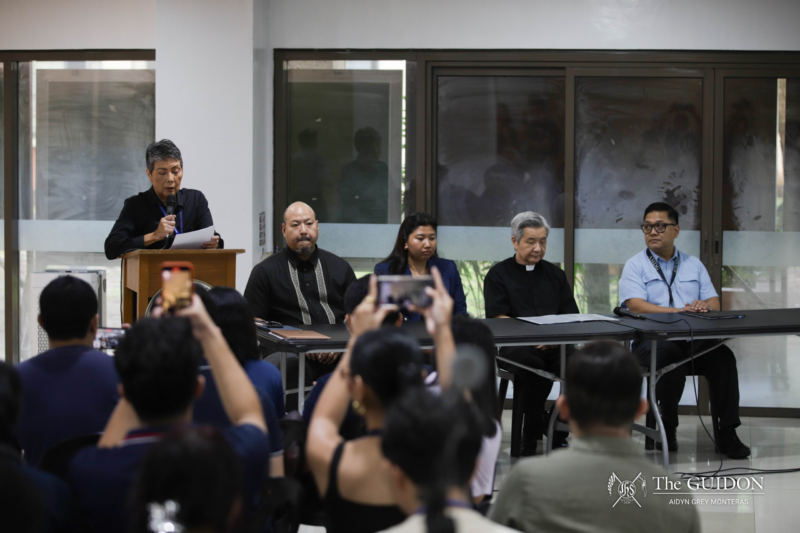
Sanggu President Gio Tingson formally presented the idea during a Central Board (CB) meeting, requesting elected officers to reflect on their commitment for the 2010 elections. The resolution was released to the public on November 20.
Voluntary action
The resolution states that the Sanggu is “an institution founded on the principles of representation, participatory democracy, accountability… towards the holistic formation of the Atenean.” It also says that its elected officials, right from the start, are committed to the institution’s thrusts, advocacies, and causes.
One particular advocacy is election promotion through the Ateneo Task Force 2010, which has been actively endorsing the 2010 elections. “By being examples in registering for the elections we give the affirmation that we are united with the [advocacies] of Sanggu,” said Tingson.
“I think this is the first time in Sanggu history that such a resolution was passed,” said Alex Ang, Executive Director of political party Ibig Agila. “It is hypocritical to advocate nation-building, voting, and registering for the elections if they themselves are not registered and cannot vote.”
Questioning the Sanggu
Some students questioned the resolution, specifically on the issue of democratic participation.
“For me, it felt like they were judging us,” said Course Representative Harald Tomintz. “Voting is a personal choice, [one] can influence and encourage people to register and vote but in the end, it is still up to them.”
For Leiron Martija, Office of Research and Advocacy Head for The Assembly, the idea was confusing. “[It] is troubling and ironic because it is imposing something that ought to be a choice… It defeats the idea of voting as a free and personal choice.”
On her blog, The Assembly President Ross Tugade even called the Sanggu “totalitarian,” comparing it with the Nazis and with the Russian tyrant, Joseph Stalin.
“To put it simply, it seems that the Sanggunian has severely fallen out of touch with the understanding that the deep political crises of our time requires consistent and chronic engagement outside the self-gratifying and solitary act of voting in the upcoming elections,” said Tugade in her entry.
Martija explained that the Sanggu seems to be claiming monopoly in political movement. He added that the resolution, which was publicized, made it seem like an imposition.
“It really feels like they are undermining the officers by presenting something that creates much guilt and troubles people when it should be a free choice in the first place,” he added.
For Tomintz, the Sanggu did not fully consider the situations of the other officers. “There are personal and external factors why a student wasn’t able to register [even] if they had the will to… Who’s to hold it against them?”
However, Martija understands the Sanggu’s situation. “It looks bad for any institution when they don’t practice what they preach but it seems that they place much effort on their image,” he said. “If it is all about their work [and] their service, then that is all there should be and nothing more.”
But while The Assembly is against the resolution, Martija said that they are not against registering and voting for the elections. “What we are against is treating the registering and voting in the elections as something like a pre-requisite for being a Sanggunian officer.”
As of press time, the Ateneo Debate Society is also drafting a statement on the resolution.
Open choice
Tingson welcomes comments and concerns such as those raised by The Assembly, because it shows that the community cared for the student government.
He said the Sanggu is not checking on people, harassing, or commanding anyone to resign. “What we ask them is to have an introspection to see if not registering affects their leadership in the Sanggunian. If it does not bear a difference, they are free to stay.”
Sanggu Vice President Jauro Castro said that there is no force involved in the resolution, and for him, the Sanggu is not totalitarian. “We are simply asking everyone to reflect and there is emphasis on the voluntary part.”
Castro added the resolution is not baseless and unfair. “All our efforts are geared towards institutionalizing the four thrusts of the Sanggunian and [social awareness] is one of those pillars,” he said.
“We are not taking for granted the service rendered by these officers, what we are telling them is what we promote to the students registering to the elections,” he added.
The resolution was not passed without consultation, said Tingson. “Majority of the CB officers present voted for it, 12 against three voted for the resolution to be passed.”
Tingson also revealed that he did not participate in the voting on the resolution.
“Our main point here is not to impose anything. People got so blinded by just one phrase that they did not anymore try to understand the…context,” Tingson said.
On faith formation
Sanggu also released another resolution on December authored by Finance Office Rob Roque that “[formalizes] the interpretation of spiritual maturity as a pillar of the Sanggunian vision.”
Due to the lack of formal institutional initiatives in spiritual formation, this vision has not been clearly interpreted, the resolution says. This lack of interpretation then prevented the Sanggu from “strategically and effectively engaging spiritual formation.”
“The Sanggunian… upholds the identity of the University as being Catholic, Jesuit, and Filipino,” said the resolution. “Spirituality… is a yearning for connection and fulfillment in the Christian Triune God.”
Although Sanggu is not imposing spirituality, it will work for and support programs and organizations that engage in spiritual formation and actual integration of spiritual formation.
However, some students remain oblivious to such a resolution. One Sanggu member, who refused to be named, said that she heard about it. “But it was really just a gist and [the resolution] wasn’t really disseminated that much,” she said.
Junior Max Fernandez, who was initially unaware of the resolution, said that while it’s well-written, it needs to be more specific. “It’s very important to define and clarify what [they] mean by spiritually mature, or academic excellence.”
The Sanggu member agrees that calling for spiritual maturity is good because it upholds Sanggu’s four pillars. However, she felt that the resolution seemed biased to the Catholic religion.
“I do understand that we are a Catholic university but the fact is, not all of us in the Sanggunian is Catholic,” she said. “Just because you’re not Catholic, doesn’t mean you’re not spiritually mature.”
As of press time, Roque could not be reached for comment.