AFTER TYPHOON Ondoy, water issues have become a hot topic for discussion.
“The question is how well we understand the processes that occur naturally in the environment, and how man’s activities affect these processes,” said Abigail Favis of the Ateneo Environmental Management Coalition (AEMC).
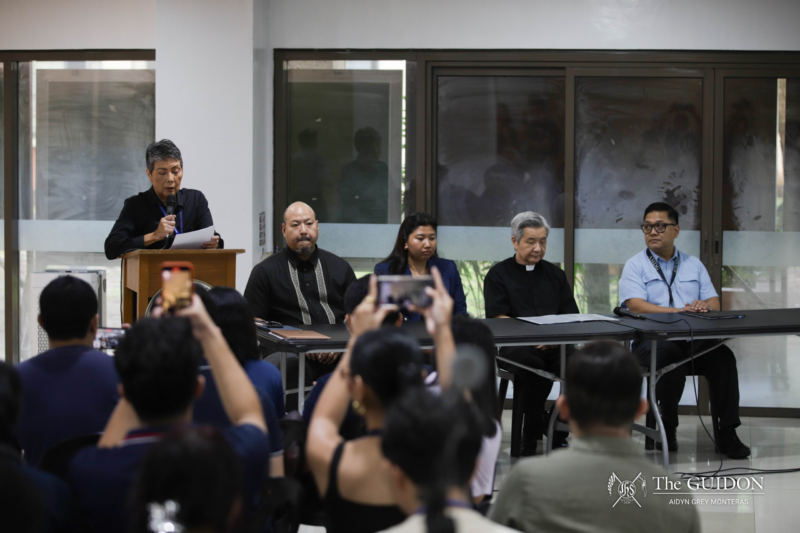
In light of recent events, AEMC held a lecture entitled “Understanding our Waterways: How Humans Affect the Water Cycle” on October 20. Vice President Ma. Assunta Cuyegkeng was the guest speaker.
The lecture was also in preparation for the Philippine International Marathon: A Run for the Pasig River on November 8, hosted by the ABS-CBN Foundation, Inc.
Pre-registration for the Loyola Schools was held after Cuyegkeng’s lecture, and on October 21 at Xavier Hall.
Intervening with nature
Due to the water cycle, people are able to use and reuse the Earth’s water resources. “The water we drink actually comes from sewage, except that it has been purified. The water has gone purification through the water cycle,” Cuyegkeng said.
However, Cuyegkeng added that various human activities—be it domestic, agricultural or industrial—have intervened with the water cycle.
The use of septic tanks is an example. “We are supposed to clean our water with the help of septic tanks and waste water treatment facilities so that when it eventually goes into the bay, it is partially cleaned up,” she said.
Because of illegal settlers who do not have septic tanks in their homes, most of the waste goes directly into the various waterways in Metro Manila. This has caused decomposition of organic matter, solid wastes, and thermal pollution, which leads to the destruction of waterways.
Quality in Wawa Dam
Cuyegkeng also talked about the water quality on Wawa Dam in Montalban, Rizal.
Based on the water quality research of AEMC on the dam, oil and grease in the water is seven times more than the prescribed limit. Meanwhile, fecal coliform in the water, which is the bacteria found in animal and human waste, is found to be three times more than the prescribed limit.
Cuyegkeng said that the water quality in the Wawa Dam is due to the human activities in Montalban, such as swidden-farming or kaingin, industrial effluents, and quarrying.
Conserving resources and reducing waste
Cuyegkeng ended her lecture by saying that at the history of the Earth’s formation, human beings were the last to appear after the dinosaurs. “Yet we have the profoundest impact on the entire planet,” she said.
What people could do is to conserve resources by cleaning up waterways and conserving use of clean water, and to reduce waste by segregation, renewing solid waste, and treating waste water, she said.
She added that in conserving resources and reducing waste, one must make use of the seventh-generation thinking. “What [resources] will our descendants use, seven generations hence?”
More on participation
Freshman Daryl del Rosario found the forum good. “I guess I [learned to] continue saving water for our future generation,” she said.
Elizabeth del Rosario of Ateneo Schools Parents Council, however, said that the forum only concentrated on water waste.
“It would be better if the forum talked about more on the participation of the students, in how they use water, how they can help.”