FOR FR. Adolfo Nicolás, SJ, leader of the Society of Jesus, asking questions about relevant issues is more important than finding solutions.
The Very Reverend Fr. Nicolás was elected as the Superior General of the Society of Jesus on January 19, 2008. Born April 26, 1936, in Villamuriel de Cerrato in Palencia, Spain, he studied mainly in Madrid and Toledo in Spain and in Tokyo, Japan. From 1978 to 1984, he was director of the Pastoral Institute in Manila.
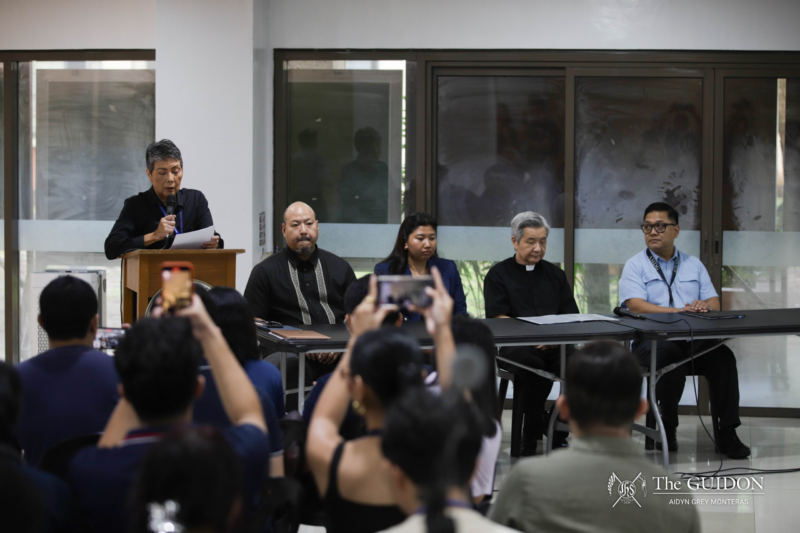
The Spanish Jesuit Superior General, fondly called “Father General” in a morning talk in the Henry Lee Irwin Theater on July 14, visited the Philippines as part of the Jesuit Basic Education Congress and the 150th anniversary of the Jesuits’ arrival in the country.
His talk tackled two goals and challenges in today’s Jesuit education. One is depth: “What is the depth of education we provide [for students], and how might we go deeper?” The other is universality: “Should the benefits of Jesuit education be limited to these [specific] schools? Can we share Jesuit education with the poor?”
More questions, less answers
Fr. Nicolás began his talk by saying that the congress was not just about “professional updating.” His contribution, he said, will be thoughts to “evoke listening and exchange.”
“You will not be looking for ready-made answers from me,” he told his audience, composed mainly of teachers, professionals, and administrators from Jesuit schools in the Philippines.
Fr. Nicolás then outlined the main goal of the Society, which is related to the goal of Jesuit education: “to develop students for action,” he said. However, he counters himself with another question.
“What do we need to do to achieve this goal? I don’t have answers.”
Magis and choices
Fr. Nicolás, however, proposed two concepts, or “frontiers,” that may help his audience reflect on Jesuit education. In discussing “depth”—his first frontier—he corrected the misconception with the concept of magis, or that of doing more.
Magis, if wrongly translated, can be interpreted in light of a competitive and consumeristic culture. “[It] can fool us into thinking this is the Ignatian magis,” Fr. Nicolás said. Magis, he added, is not about doing many things, but doing “what satisfies the soul… [and a] deep understanding and appreciation of what is important.”
He discussed the saturation of images and the ease of information that students have today, and explained how these may promote superficiality, and even isolation and insecurity. He added that this also promotes a secular and pluralistic culture: “All around young people are given more and more choices: choices of values and beliefs.”
“When I look around and see so much fundamentalism, I struggle to think how students can think more deeply,” he said. The challenge, for him, is for Jesuit schools to produce “people of discernment,” or those who make choices based on inner values and beliefs, rather than outside influences.
A note on globalization
Fr. Nicolás related another translation of magis—that of excellence—to a “narrowing sense of belonging” that comes with continuous comparison with other schools and institutions, and with globalization.
One of the negative effects of globalization is “a greater fear of the Other…we get caught up in tiny, suffocating worlds…[where] the outsider is eliminated,” he said.
Quoting an encyclical, Caritas in Veritate, or “Love done in truth,” he said, “As society becomes ever more globalized, it makes us neighbors, but does not make us brothers.”
Thus, he called on the schools, the Jesuit system, and even the Philippines to break this narrowed sense of belonging, the limitations of the educational system, and extend help to its Asian neighbors.
The challenge
Sociology and Anthropology Professor Mary Racelis, in the talk’s open forum, said Fr. Nicolás’ talk inspired her.
She asked, “[But] why are we not at the forefront of thinking of what it means to be a Catholic in a multicultural world?”
James McTavish of the Loyola School of Theology had a related view. Describing a contrasting social reality between corn vendors along Katipunan Avenue and Ateneans who pass by them every weekend, he asked, “How can Jesuit education form students who want to serve the Filipino people?”
Fr. Nicolás went back to the frontiers of depth and universality to respond. He added that aside from patience—coming up with solutions require long-term thinking, he said—creativity is also needed, since most of the old solutions will not work.