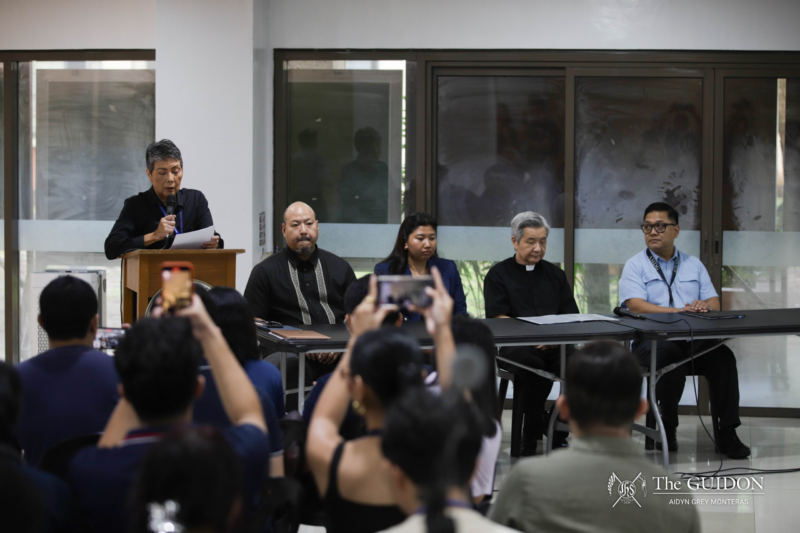
Enter “Edukasyong Kalidad na Angat sa Iba” (E-Kasi), a public school rehabilitation project organized by the Ateneo Center for Education Development (ACED) and the Quezon City (QC) government.
“Public education in the Philippines has a lot of problems…to build this nation, we will have to work on the education of the Filipino school children enrolled in public schools,” said Assistant to University President for Basic Education Carmela Oracion. “About 92% of Filipino school children [are] enrolled in public schools.”
150 years
E-kasi is comprised of 16 partner schools, said Oracion. It has been helping 143 public schools in Quezon City, 30 in Parañaque, and others in the provinces.
Oracion said E-kasi is about addressing all problems of a school in an interconnected way. “[We want] to focus on a total school development approach—the involvement of the entire school community.”
Oracion said that this approach ties up with the University’s 150th anniversary and its final theme of “Building the nation.”
“It’s the scale. We have a scale of 4,300 elementary and high schools in the Philippines. It’s so huge [that] you have to work with them one school at a time,” she said.
Quoting University President Fr. Ben Nebres, S.J., E-Kasi Project Coordinator Amelia Lorena Perez (AB SoS ’08) said that nation-building begins in education.
She said, “Quezon City is the home area of Ateneo, so what better way to affect change than start with our own area, our own university?”
Teach, empower, strategize
Perez said that E-kasi’s goal of developing schools begins with profiling, where schools’ situations are assessed and analyzed.
“[After profiling], we help them do strategic planning which is coming up with a doable improvement plan,” said Oracion. “We will help them achieve the different action steps outlined in their plan.”
The changes to be implemented in a school will be on a case-to-case basis, depending on the school’s need, said Perez.
“Targeted intervention is one little aspect of [the plan],” said Oracion. “We have training for the principal, other school leaders, and [we will hold] teacher empowerment programs.”
University professors such as Chemistry Associate Professor Armando Guidote, Ph.D, Political Science Professor Alma Salvador, Ph.D, and Mathematics Professor Catherine Vistro-Yu, Ed.D usually volunteer to help train public school teachers and principals for E-kasi, said Oracion.
The project will also utilize teachers from the Ateneo Grade School and High School. “These are fellow grade school and high school teachers so it’s important that we bring them resource persons that we can relate with,” she said.
Teacher training, which is a major aspect of the E-kasi program, will start on April. Another batch will be trained in August, said Perez.
Apart from training, E-kasi also caters to infrastructure needs and the students, said Oracion. “If children are malnourished or if they have difficult conditions like worms that affect their studies, [we help them]. So we bring in the health. We take a look at everything.”
Call for volunteers
The project is promising, but not without challenges and doubts.
Oracion said that she would occasionally ask Nebres if they are moving forward with E-kasi. The University President would always reassure her that in the past 30 years of the project, he can now see developments.
One difficulty E-kasi encounters is the lack of volunteers. “There is so much to be done…We’re talking about half a million children, ten thousand teachers.”
Perez said that the project also needs more publicity. “We’re making sure everyone knows this is going on…Everyone is informed.”
For Oracion, education, especially in public schools, is not a simple matter. “You cannot think of it in a black and white mode.”
“When you talk about education in public schools, problems are not confined to issues of curriculum and instruction. Health comes in, the family comes in. So all these things must also be addressed.”