After winning first runner-up in the “Best Project of the Year” Award, Stephen Michael Co (IV BS Bio) encouraged science and engineering majors in the University to pursue their efforts in advancing science and technology.
Co, along with finalist Stein Alec Baluyot (IV BS Ps-MSE), was recognized in the Bank of the Philippine Islands-Department of Science and Technology (BPI-DOST) Science Awards.
The BPI-DOST Science Awards recognizes students who excel in the specialized sciences and come from accredited universities, like the Ateneo de Manila University, the University of the Philippines (UP) Diliman, De La Salle University, and the University of Santo Tomas.
Through a series of screenings and presentations, six students, including Co and Baluyot, were chosen to proceed to the finals.
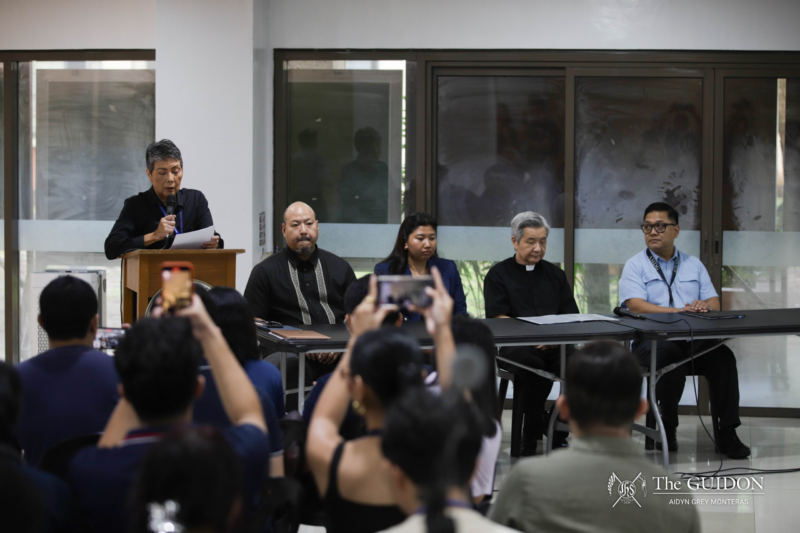
On January 19 at the BPI main office in Makati, the finalists presented their theses and the top three “Best Project of the Year” Awardees were chosen.
Finely filtered
BPI and DOST allotted almost half a year to the whole process of choosing the “Best Project of the Year.” They started accepting nominations for the awards August 2008.
According to Co, the award was his dream. “I was in second year…when biology student Martin Generoso was nominated by the school. At that moment, I was thrilled at the prospect of winning the award for myself…I’ve never let go of that dream.”
For Baluyot, his thesis getting to the finals was unexpected. “Yung iba, marami silang ginastos tapos kumplikado talaga yung sa kanila [kaya] hindi ko talaga inaasahan na makakapasok ako sa finals (The others spent a lot on their thesis, and theirs is very complicated so I never expected that I could make it to the finals),” he said.
Dedications
Co entered a thesis that was about a synthetic coconut cadang-cadang viroid. This was a group thesis with Luisa Isabel Misa (IV BS Bio) and Arianne Borda (IV BS Bio). “I am very grateful to my thesis partners… and I dedicate our project’s success to them,” Co said.
Co was awarded because he represented the team, and had the highest grades in the group.
According to Co, the aim of their thesis was to contribute to the discovery of a cure for the cadang-cadang disease. “[The disease] costs the Philippine coconut industry…$40 million.”
“The disease was first described in 1931 and a cure has not been found to this day,” he added.
On the other hand, Baluyot did not have groupmates but he had his adviser Nathaniel Hermosa II, Ph.D., a physics assistant professor, to rely on.
Baluyot’s thesis was on bored helical phases and the dynamics of their intensity profiles. “It [the thesis] was curiosity-driven,” said Baluyot.
Hermosa added, “There’s no problem [that we want to solve], actually. Pero tinignan lang namin kung saan kami dadalhin [ng research] (but we tried to see where the research will bring us). We’re just curious about some things.”
Appreciation of efforts
According to Co, achievements like being recognized in events like these help in advancing science.
“The BPI Awards, as well as other events like [the] SOSE awards, provide avenues of recognition and appreciation to Ateneo science students who work very hard on their theses for the advancement of scientific knowledge,” he said.
For Baluyot’s colleague Michael Paul Jallorina (V BS Ps-MSE), however, the impact of studies like this is gradual.
“I think any kind of science scholarly work in general is not directed at solving [problems]…I think the impact of [studies like these] isn’t really instantaneous…it’s more of a long-term thing that [when developed further] would explode into something great [later on],” Baluyot said.
The BPI-DOST Science Awards Ceremonies will be held on March 11.