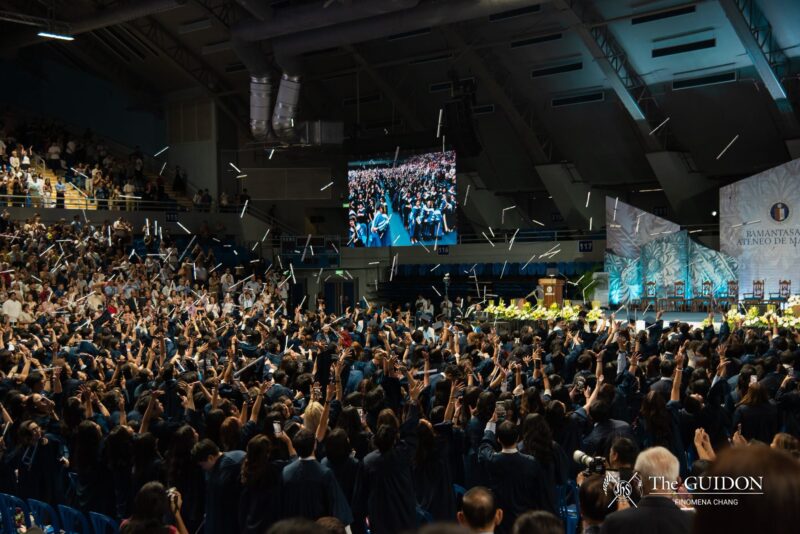
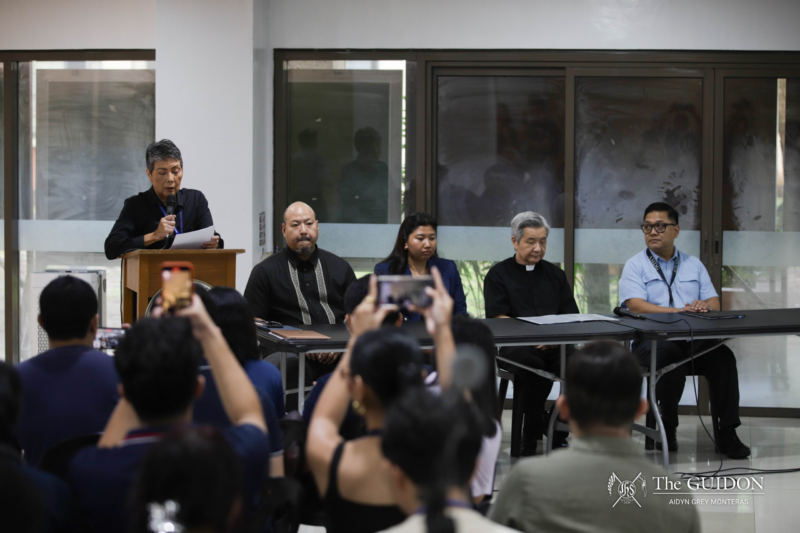
Castillo gave this invitation in his closing remarks, during the Sibol program’s graduation ceremony on January 16 at the Colayco Pavilion. After six weeks of leadership trainings and workshops, student leaders of various orgs who were part of Sibol shared their experiences about the program.
An extra class
Potential leaders of orgs were handpicked by their respective heads to participate in the Sibol program.
These participants then attended different training workshops and activities that aimed to teach organizational development and leadership management skills. The program started November 11 and ended January 13.
“At first I was cynical because it’s every Tuesday. [Aside] from having classes, you also have an extra class,” said Jeffrey Ray Cape (III AB Comm) in a mix of English and Filipino. “We also have homework,” he said.
Despite the additional workload, however, Cape said he found the program worthwhile. “It teaches you self-awareness. And you build a network of friends from other organizations,” Cape said.
“It’s a new experience being with the leaders from other orgs,” said Kathreen Marie Solis (III AB Psy). “We have different points of view and we have different perspectives on things, so I gained a lot of insights from other people here.”
“You realize what’s important. You get to know yourself better,” said Maria Andrea Camille Juan (III AB Eu). She added that she learned about different leadership styles through Sibol. “I really thought there was one leadership style. “But then it’s more than just that. Different situations call for different styles, different ways of approach[ing].”
“It’s very enlightening for me…it opened a lot of new ideas, like how to facilitate meetings,” said Dana Dominique Estrada (III AB IS).
Only the beginning
Samuel Jonathan Nepomuceno (III AB MEco) said that the session he remembered most from the program was the last session about self-discernment management.
Nepomuceno described a speech Sibol Program Director Frederick Brian Lipio shared to the class. The speech was about a statue of the Greek god Apollo.
“It has no head, has no arms. Yet, despite his disfigured body, he radiates a certain glow of respect [that] makes people stop and look at him at the museum,” shared Nepomuceno. “From my understanding, the challenged posed there was that we’re complete—you know I have my head, my arms, my body—why can’t we be like that?”
Lipio said that this was not the end, but only the beginning for Sibol’s participants.
“Simula palang ito sa mga balakin ninyo, simula palang ito sa mga mabubuting pagbabago na maari ninyong gawin pa (This is only the beginning of whatever you may want to do, the beginning of the good changes you can still do),” he said.