The forum aimed to clear misconceptions about the two most prominent religions in the Philippines, said Gerard Kristoffer Flores (IV AB PoS), YFC president and events head for YFC Week.
“Part of our formation as Ateneans is to become men and women with and for others…what better way to do this than to expand this understanding of ‘others’ to various religions specifically to our Muslim brothers and sisters?” He said.
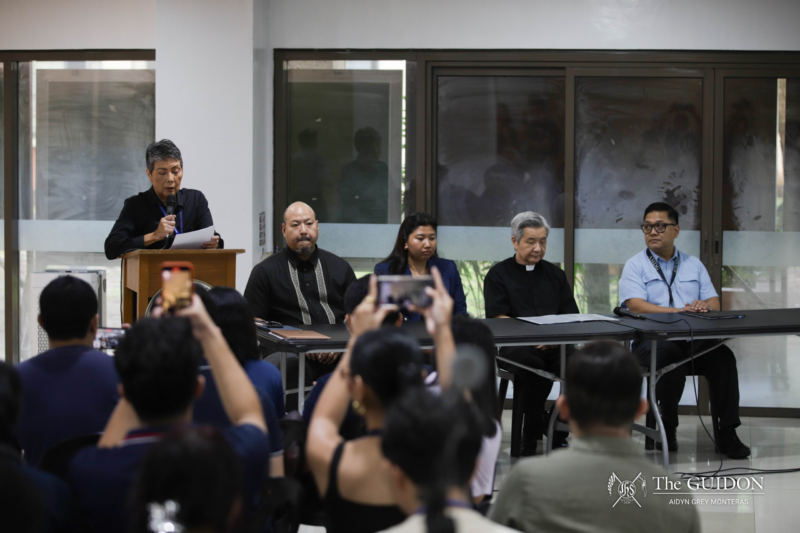
Islamic Studies Professor Fr. Rene Oliveros SJ, Guimbang, Marawi City Sultan and Professor Punduma Sani, and Chief of the Judicial Division of the Comelec Center in Manila Atty. Saga Mabaning, shared their knowledge and experiences of the two religions during the dialogue, titled “Bridging the Gap.”
“Misunderstood”
“The religion of Islam is actually a misunderstood religion…it is never really given the chance to explain itself,” Mabaning said. Contrary to common belief, Islam is actually a religion of peace and love, he added.
“Terrorism is one thing that is totally abhorred by Islam.”
Sani also reiterated this during the open forum when he strongly refuted the idea that Muslim soldiers love their guns more than their wives.
“I tell you, I have never made love with an armalite,” he said to a laughing audience, in a mix of English and Filipino.
Two faiths, one God
For Oliveros, whose mother is a Moro and whose father is a Catholic, Islam and Christianity are not that different. He points out their similarity through the story of Mary in which the only difference is that in the Koran, Mary has been predisposed to conceive and there was no need to say yes.
Mabaning also said that both religions denounce idolatry. “Christianity and Islam shared the same monotheistic God, and the same mythology for the Hebrews known to Muslims as the Torah,” he added.
Conflicts, bridges
In response to a question raised during the open forum, Oliveros said that the two different faiths had nothing to do with the conflict between the Muslims and the government. He added the conflict is about the dynamics between the majority and minority.
“The source of the fight in Mindanao is pure greed and bad politics. People want to grab land and it is the few and the poor who are affected,” Sani added.
Mabaning said that the Muslims are only trying to claim their legitimate land.
Danielle Marie de Castro (IV AB PoS), agreeing to what the three speakers explained, said, “’I’m a political science major myself and the whole time, we’re studying on how the government is not doing enough to make sure that everybody gets access to land.”
Oliveros said that even though conflicts and differences arise between the two, what should be given importance is human dignity.