“WORLD PEACE? I cannot do it alone.”
Indeed, for Menandro Abanes, a University of Peace (UPeace) student, the point of working for peace is to know people and understand them.
“We should do this together,” Abanes said. “Just that— invitation of others — there’s a point of working for peace.”
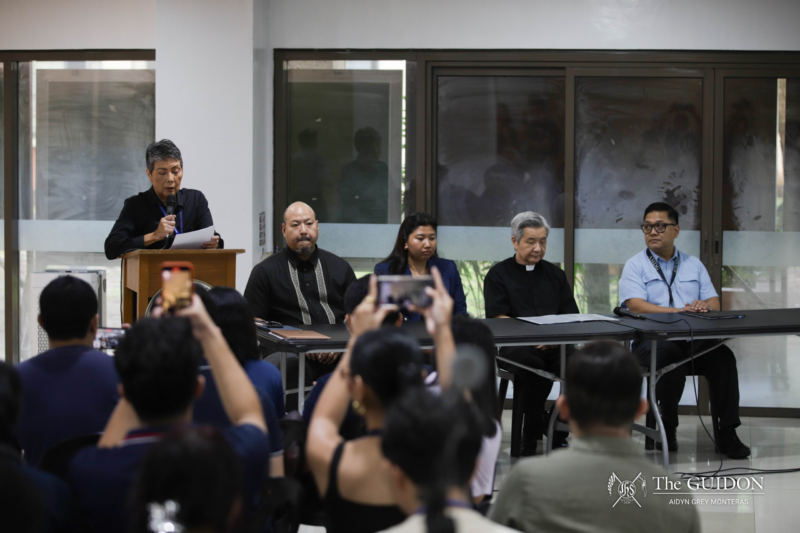
Abanes is one of the 24 students who took up Peace Studies in the Ateneo last April. The Dual Campus Masters’ Program, a collaboration between UPeace, the Nippon Foundation, and Ateneo, aims to support students from Asian countries who do not have a proficient command of the English language, by taking English courses at the Ateneo.
UPeace students will fly to Costa Rica, where the UPeace headquarters is located, to take courses for their MA in International Peace Studies. To complete their MA, they will return to the Philippines, take several courses offered by the Ateneo, and have internships with peace-related and international organizations.
UPeace is the only university mandated by the United Nations to provide a Master’s degree on International Peace Studies. The program is now in its second year at the Ateneo.
Why study peace?
Peace Studies is “of utmost importance,” said Benjamin Barretto, MM, Political Science Department lecturer and administrative assistant for UPeace.
“Whether we deny it or not, there’s an ongoing war in Mindanao, plus, of course, war against the insurgency,” Barretto said. “So there has to be a way to close all this conflict so that we can concern ourselves with more important issues and concerns.”
Studying peace is also about making people understand that violence is not the solution to problems. “It’s about engendering and understanding, and the appreciation of other human beings,” said Balazs Kovacs, JD, a UPeace instructor.
Opportunities
The Dual Campus Program provides many opportunities to students, Kovacs added.
First, the program uses the lower level of English proficiency. “It gives an opportunity to people who would otherwise be excluded from the opportunity of conducting studies in a foreign country in the medium of English,” he said.
The program also allows people to interact with people of diverse cultures. The world becomes smaller because of UPeace, said Abanes, a Filipino student.
“Before, if I think of Pakistan—[I think of] Musharraf,” he said. “But now, I think of Usman—a classmate. It becomes personal…you become personal to Pakistan.”
A Japanese UPeace student, Yoko Yokoyama, didn’t find it difficult to handle being with classmates of diverse cultures.
“After all, we have more similarities than differences… as everyone is from Asia, I feel a strong bond among us as Asian friends.”
A maturing program
Despite the opportunities that it provides, the Dual Campus Program still has some weaknesses, said Kovacs.
One of the weaknesses is that the program is “logistically complicated to coordinate.”
“Because some of the students come from so-called restrictive countries… it’s sometimes not easy to get a… visa for that,” he said. “Sometimes [it’s] really a logistical nightmare. It puts some strain on the staff… and the program.”
The program is new and needs more time to mature, Kovacs added.
Learning ‘peace’
For Yokoyama, UPeace has given her the opportunity “to think over and over what is ‘peace’ and what I can do to help people to pursue happiness.”
Abanes, meanwhile, said UPeace has helped make the task of peace building seem less difficult.
“It made me feel that I’m not alone in this world…that I’m not alone in this task to make a difference.”