Photo by Ean L. Dacay
It’s easy enough to look back, now that the Nebres years are in the books. The past is set in stone, and is clear and measured and safe. There are no surprises, no unforeseen twists to throw us off. To study the school’s history is simple.
Indeed, a much harder task would be to look forward, to gaze into a future not yet written, and to chart a path based on this hazy vision. Few people are lucky enough to see their lives unfold as they would have it—but to marshal and unite thousands of bright and empowered young men and women in a common goal? That calls for an uncommon man.
Fr. Bienvenido Nebres, SJ proved to be such. Fr. Jose Ramon Villarin, SJ may very well be another.
Passing the mantle
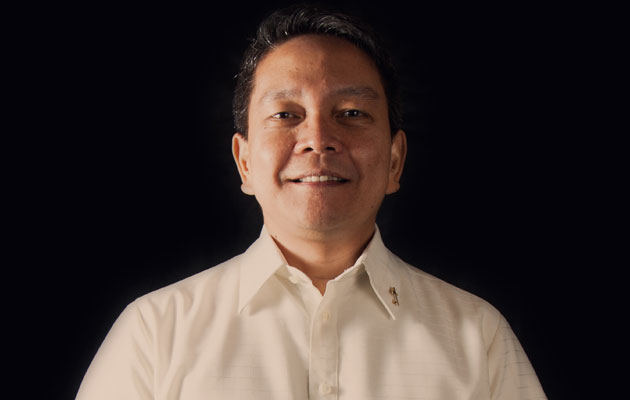
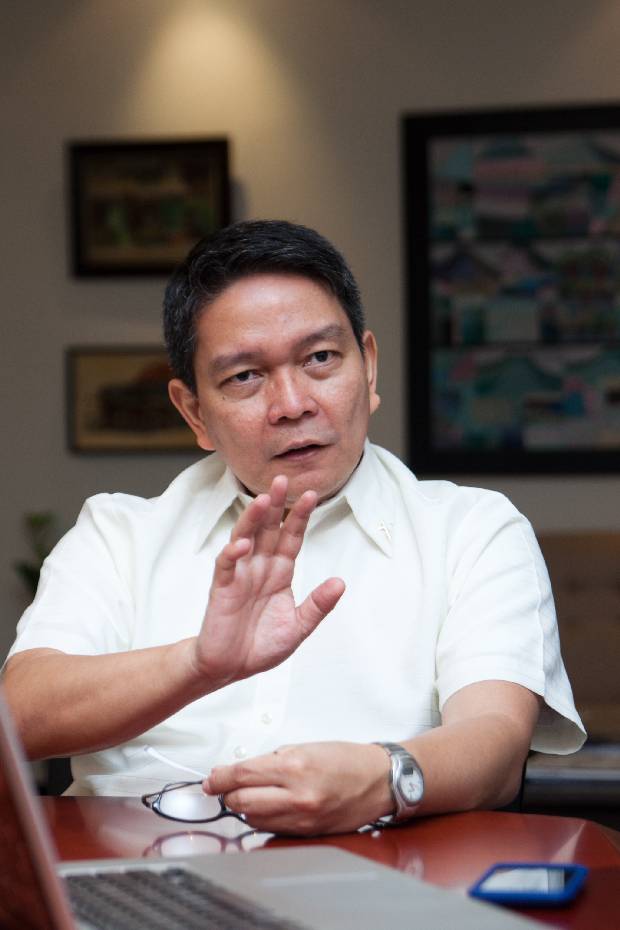
Sitting in his office on the second floor of Xavier Hall is a scientist who can see the future, or rather a future, one that is bright and full of hope. He knows all too well that the road to a rosy tomorrow will be no walk in the park, and yet it is a road he has already begun treading in earnest.
Villarin asks if he might have his cup of coffee during the interview. He wastes no time in getting down to business, yet still manages to maintain a disarming manner. You can tell that he has a lot on his mind, and a lot on his plate, but he has the determined look of a man who relishes the work before him.
He only took the post of president of the Ateneo de Manila University three months prior, and within that time span, a lot has already happened. Nevertheless, all eyes are still on him, and he and his decisions are front and center. Moreover, he certainly has a tough act to follow.
His predecessor was the driving force behind the Ateneo for 18 years, after all, and was instrumental in leading the university to where it is today in terms of academic excellence and social involvement.
“Fr. Nebres is a brilliant Jesuit—very incisive, very intelligent,” Villarin says. The two are no strangers. In fact, as a young, sophomore physics major in the Ateneo during the 1970s, Villarin was nudged on course by Nebres, then dean of what used to be called the College of Arts and Sciences.
“In college, he was already developing us students as leaders. He invited me to a seminar, and I asked him, ‘Why me? I’m not even heading an org yet,’” Villarin shares. “Pero parang basketball siguro iyan. He could scout talent.”
Nebres would always be remembered for his efforts in building the country, which served as a pillar of his administration. As Agustin Rodriguez, PhD, chair of the Philosophy Department, says, “Fr. Ben tried to put us at the forefront of nation building in actual, practical things, achievable things, such as education, housing and health.”
Villarin is every bit as ardent a believer in nation-building as Nebres is, but the two Jesuits are not the same person—nor should we want them to be. For all of Nebres’ successes, he had his own share of criticisms, such as those concerning his pragmatic approach to nation-building.
Needless to say, though, the change in leaders does not mean a change of challenges, and this perhaps empowered Villarin to declare: “I’m continuing these directions [set by Nebres].”
“But I’m putting a stress on sustainable development,” he points out, betraying his academic background as an environmental scientist. Villarin was among the scientists who worked with the Intergovernmental Panel on Climate Change, which was awarded the 2007 Nobel Peace Prize alongside former US Vice President Al Gore.
Foresight
When asked how he would differ from Nebres in terms of areas of priority, Villarin says, “The green and sustainable goals are in a sense new, or will receive additional emphasis.”
“Why? It’s your issue,” he asserts. “Environment was not [my generation]’s issue, and it’s still not. It’s the issue of the young people.”
Rodriguez, who also writes and lectures on poverty and development, says that humanity will be “facing multiple crises in the next fifty years, [given] the end of oil, the end of topsoil, water, cheap food, and on top of all that, the [pervasiveness of] greenhouse gases, the population explosion, and poverty still unabated.”
It is in light of this impending future that the Ateneo should feel genuinely thankful—it has a leader who has a deep understanding of these realities, therefore putting the university in a prime position to adapt and respond to the challenges.
“People don’t see the danger, but it’s going to be a much more uncertain world by 2050, 2080,” Villarin explains. “I’m not going to be here [by then], so I’d like to build systems and structures that will last.”
It takes a person with sharp eyes and a keen mind to peer into the horizon and anticipate such looming problems, so perhaps it seemed only logical for Nebres back in the ‘80s to urge Villarin to pursue a masters of science in physics in the United States. The younger Jesuit was initially unwilling—he wanted to forego his studies upon entering the Society of Jesus to join in the work of nation-building.
Villarin says that he wondered back then, “‘Physics, nation-building—what’s the relation there?’ But that kind of a vision—sometimes it’s hard to see what others see. But you just take it in faith that they see farther.”
I see a value in speaking up—people also listen to our silence.
– Fr. Jett Villarin, SJ, President, Ateneo de Manila University
Under Villarin, poverty elimination would remain very much at the core of what the Ateneo is working towards. Villarin shares, “I’d like to slay the monster [of poverty]. Society is still very unequal. So I’d like to do something in terms of access to basic services—so we’re looking at public health, public education.”
“It’s pathetic,” he says. “When you go around the schools and hospitals, it’s really sad.” He ties his focus on the environment to the issue of poverty. “They’re related—environment and development. So it’s a poverty issue as well. We have to look at poverty at the same time as we do the environment.”
And to tackle such challenges, he believes that what the country really needs are leaders of a specific quality. “Ako, tingin ko talaga, we need leaders. We have specialists, and they’re good at what they do, but who will step back?” he asks. “Who will stand on a hill, and look at the big picture, and connect all these things? I hope the Ateneo can train its young men and women to be these kinds of people.”
“Poverty is a monster with many hearts, and we need leaders who will orchestrate that simultaneous or calibrated slaying,” he says.
Photo by Ean L. Dacay
Making waves
Villarin’s biggest departure from Nebres’ leadership style might very well be Villarin’s decision to be more politically involved. However, he disagrees with observations that Nebres particularly shied away from politics.
He says, “I don’t think that’s fair, because Fr. Ben was very much involved in politics. His was just more of working quietly.”
“But I see a value in speaking up—people also listen to our silence,” Villarin says. “There are times when you really need to speak out. Sometimes, it’s difficult because it sets you up, because you take the first volley of fire, so [you think] it might be better to keep quiet [instead]. But there are times when people will look to us, and they will ask, ‘What does the Ateneo stand for?’’’
And it would seem that Villarin is, even now, already having the Ateneo play a more involved and active role in governance. “It’s happening already,” he says. “The mining sector is taking notice. We had a study, and we invited them to critique [it].”
He is referring to the Ateneo School of Government’s recent conference, The Future of Mining in the Philippines, where one of the presentations was an academic study raising questions about the purported benefits of mining to the Filipino people. The study prompted the country’s Chamber of Mines to put out an advertisement in national newspapers denouncing the conference as a “farce.”
And this approach extends to a lot of other things. “A few months ago, the energy secretary was here, and we [asked], ‘What’s the problem? Why can’t we mainstream renewable energy?’” Villarin says. “‘Solar, wind—is it expensive? If it’s expensive, why can’t we make it competitive? I’d like to continue the dialogue. These are some issues on the ground that I hope will catch fire, [and] will snowball into a big effort.”
Casting the mold
Villarin believes that social transformation must start at home. “If we develop this campus, I hope it can be a template, a model for others to emulate,” he says. Right now, the administration is looking for ways to make the campus a more environmentally sustainable one.
He says that one of the proposals that have been raised in order to reduce the sheer volume of cars in school is to raise the price of the parking sticker to P5000. “That would [force] change,” he explains. “I studied here, so I know how it was before. The air was different. May space. You walked, you could walk. It’s hard to walk now.”
But Villarin is determined to see changes and improvements not only within the school, but in wider circles. “Not just Philippine society, but Asian—global. If I clean the Ateneo but C-5 is still dirty, I don’t make a dent… We’ll have to work with the MMDA, with the DENR, with the Office of the President.”
Rodriguez makes the same point. “We always keep asking how we’re going to leave our mark, how to become a top university, and [the answer is that] we have to be daring. It’s just a little thing—we should project more of our research [to the] public sphere.”
Hopes
Villarin sums up the direction he’s setting for the university as an effort on three fronts: creation, nation-building, and identity and mission.
“If we’ve moved closer to those three, I would say [it’s] mission accomplished,” he says. “I’m a pragmatist in that regard. I don’t think we will do that in five and a half years, but we’ll [accomplish] something already.”
“I’m just being bogged down. [Ateneo] is a ship; it doesn’t turn fast,” Villarin explains. “It’s not easy, of course… My experience [in Xavier University] was [to be] thrown into the water to see if I could swim. I did swallow a lot of water, meaning I made a lot of mistakes.”
“But it was also enjoyable because I could see that people were open and people could move, people could be inspired.”