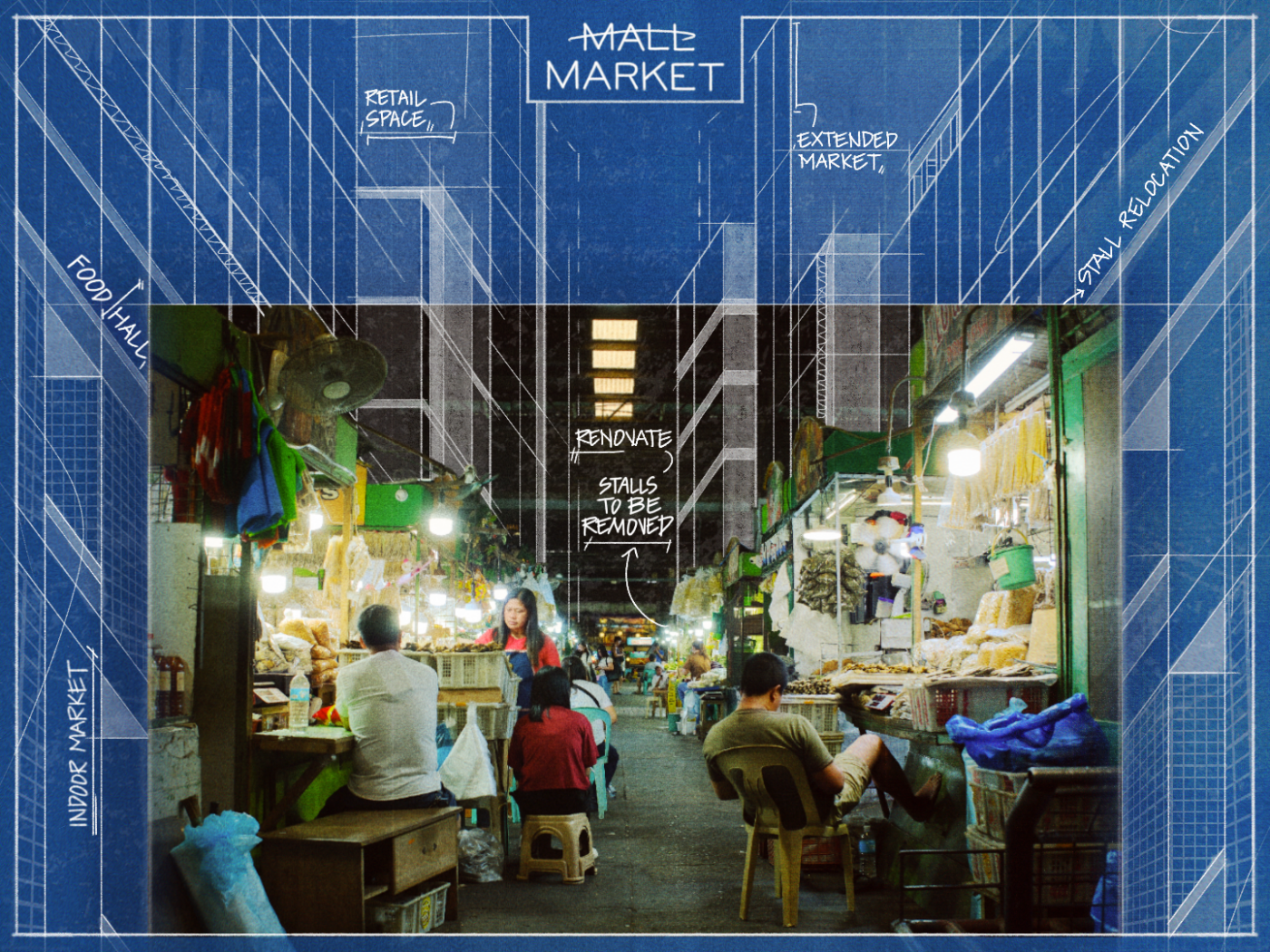
ACROSS THE Philippines, privatization is slowly turning public markets into spaces that fewer people can afford.
Recent market privatization has been scrutinized by the public due to multiple clashing interests. From anti-vendor development to logistical and financial costs, sectors often challenge each other to ensure that their interests are properly advanced. This is where the Public-Private Partnership (PPP) Code comes in, as it opens avenues for the government to accomplish infrastructure projects in cooperation with the private sector.
The balancing act
Projects under the PPP Code center on three sectors: the government, private sector, and civil society, each meant to ensure that projects function from development to maintenance.
To ensure proper infrastructure developments, Ateneo de Manila University (ADMU) Development Studies professor Kriszia Lorrain M. Enriquez-Gascon discussed how PPPs are a way for the government to distribute its responsibilities. In particular, PPP allows the private sector to come in and aid the government financially and logistically. Meanwhile, civil society serves as a “watchdog” throughout the process.
After all sectors partake in the modernization plan, the execution follows. Enriquez-Gascon noted that redeveloping public markets lies in their “standardization,” which can introduce changes like fixed stalls and processes like uniform garbage collection. However, this restricts vendors, as heavy-resourced bulk services like seafood and household items may not properly adjust when given a confined space.
This standardization reveals clashing interests, as exemplified by the Baguio Public Market modernization plans, where the public expressed concern over the power imbalance in decision-making between the Baguio City government and SM Prime Holdings.
Thus, Enriquez-Gascon emphasized, “Conflict is there to begin with, but it has to be tempered and safeguarded by existing laws and regulations.” According to her, reinforcement of existing legislation is important to ensure that the interests of all parties are properly heard.
Pricing people out
In practice, the push for standardization reshapes who can participate. Under the PPP Code, private partners must recover large investments, satisfy lenders, and stabilize cash flow over long concession periods. PPP-managed markets, however, operate on a different logic.
According to ADMU Development Studies professor Segunda Joaquin E. Romero, PhD, traditional public markets are structured less around profit maximization and more around keeping everyday transactions accessible and affordable, which weakens once profit dictates how they are organized.
For vendors, the shift toward profit-driven management materializes in rising rental fees and rigid tenancy arrangements. Even when stall rents remain under local government control, Romero noted that the commercial logic “reshapes customer movement [and] vendor competition.”
He cited the rebuilding of the Mandaluyong Public Market as an example of a fiscally successful PPP project that ultimately favored retail businesses over traditional market traders. At that time, the city partnered with a private developer to rebuild the market destroyed by fire into a commercial complex that combined the public market with street-front stores and entertainment facilities. While the project generated high commercial activity and revenue, the integration of such spaces demonstrated how redevelopment can alter the character of public markets.
Beyond tenancy-related constraints, vendors also face layered compliance costs, which Romero attributed to private partners’ need for mechanisms that allow gradual rent and rule increases. For him, this misalignment makes PPPs legal and fiscally attractive, yet socially corrosive when reduced to construction alone. “Design is not neutral, [as] it determines which economic actors can realistically exist,” Romero argued.
As vendors struggle to cover higher expenses, what once was a place for daily life becomes a space shaped by purchasing power.
Public pushbacks
With the pressures of privatized retail becoming more pronounced, vendors, students, and various groups who view public markets as communal spaces have mobilized in resistance.
Koalisyong Makabayan Local Coordinator Christian Dave Ruz described public markets as “communities that must be preserved,” rather than mere commercial spaces. This perspective has translated into concrete opposition across different localities.
In 2023, proposed upgrades to the Iloilo Central Market raised fears of displacement and rising rents for long-time stallholders, with resistance remaining localized among vendor groups. Similar concerns appeared in UP Diliman, where a 2024 plan for a commercial food hub near Area 2 drew criticism for prioritizing revenue over stallholders.
Among the most consequential cases was the Baguio City Public Market, where large-scale protests led to the withdrawal of SM Prime Holdings’ redevelopment proposal in January. Ruz stressed that SM’s withdrawal was the result of deliberate and sustained resistance, cautioning that it “should not be mistaken for corporate benevolence.”
Rather than rejecting development, resistance from those embedded in the everyday life of public markets challenges who controls development and to whom it is accountable. Ruz situates this as a response to weakened public responsibility, arguing that, “The moment social services are turned over to corporate control, we are not just losing its soul, we are enabling negligence of authorities accountable to its people.”
In each case, the fight is not against change but exclusion. Public markets thus remain contested spaces, where access, affordability, and livelihood—not profit—set the terms of progress.