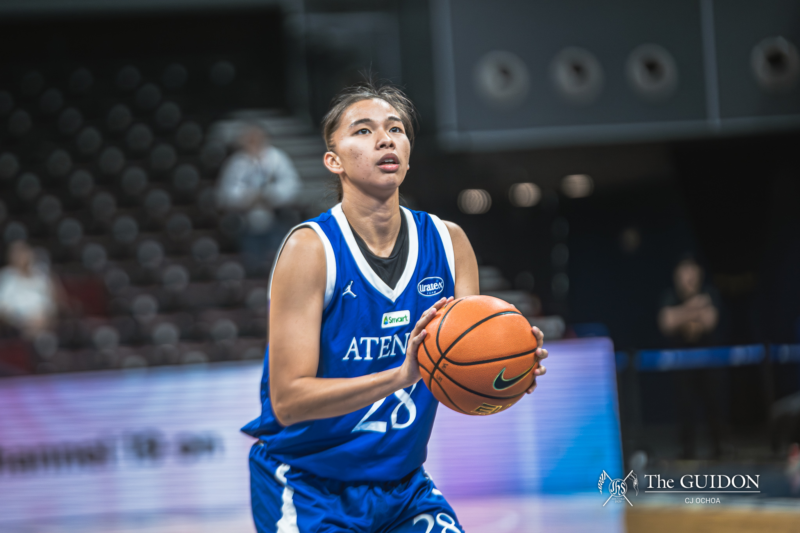
AS BLUE Eagles, Atenean sportspersons evolve to possess two things: an eye for what is beyond their playing field and the courage to take the flight ahead.
Among the many locals who pursued international waters, athletes such as Yokohama B-Corsairs Guard Kiefer Ravena and Alas Pilipinas Team Captain Jia De Guzman have opened new frontiers, proving that Filipino talents have what it takes to compete in the global arena. From Ateneo’s courts to international stadiums, these two athletes worked harder so others could dream bigger.
Collegiate icons
Guided by his parents, who were also athletes, Ravena grew up in a household that valued labor and grind. According to him, once they set their sights on a goal, they were taught to put in the work themselves.
Despite sharing the family pride, Ravena’s name came with a price, as he was exposed to the limelight as early as childhood. The Ravena brothers and their youngest sister Dani took up the responsibility of becoming sports exemplars, with Kiefer leading the charge.
The eldest Ravena brought home two University Athletic Association of the Philippines (UAAP) crowns, out of the six collectively notched UAAP titles by the three siblings.
Off the competitive arena, Ravena, too, carried the same principles of hard work. In particular, he organized FASTBR3AK to raise funds for typhoon victims as well as mentored younger players in his sport. With such a journey, Kiefer’s story proves that a Blue Eagle’s dedication remains even after graduation, as it also shapes one’s character after college.
De Guzman, on the other hand, stepped into immense pressure as she faced the challenge of proving that Ateneo could remain the season’s juggernaut after Denden Lazaro, Ella De Jesus, and Alyssa Valdez bid farewell to their UAAP stint, leaving big shoes to fill.
By commanding the court with outstanding playmaking instinct, De Guzman painted a new chapter for the Blue and White, which led the Lady Eagles to their first championship in the league and then another title in Season 77.
Surrounded by Ateneo’s values, De Guzman shared in an interview that magis was not simply just a motto for her; rather, it became the foundation of her game. As a setter, she acknowledged that her role was not simply for her own achievements, but for helping others achieve success for themselves.
Both De Guzman and Ravena are testaments to how Ateneo molded two paths toward the same ideal. Ravena realized that greatness meant creating space for others to shine, while De Guzman found that her greatest strength was helping teammates discover theirs.
Forging the international path
In the pursuit of greatness, barriers such as the lack of a stronger national sports system may appear as hindrances, but Ravena and De Guzman prove that they can be overcome.
Ravena, who has always dreamt of playing internationally, asserted that self-confidence wins games. With that belief, he went to the States and took a shot in the National Basketball Association (NBA). In that attempt, he shared that even if his dream seemed “far-fetched,” he knew he would be at peace knowing he gave himself a chance.
Yet, what seemed like a closure in his NBA bid turned out to be another door leading to the Atenean basketball star’s fifth year playing in Japan.
In 2021, Ravena began playing for the Shiga Lakestars as part of their Asian Player Quota; later, he was drafted by the Yokohama B-Corsairs in 2024. The Filipino point guard shared how the transition was not smooth sailing, as he had to play and adjust to a more competitive pace in a completely different culture.
On sharing the lessons he learned, Ravena emphasized the importance of authenticity in telling his stories, highlighting that the global platform is not all glitz and glamour. By sharing his experiences abroad, he intends to prepare the next generation for the international scene.
Meanwhile, De Guzman felt the same pull of stepping onto global stages after years of local dominance. Despite conquering the UAAP, leading Creamline Cool Smashers to six Premier Volleyball League championships, and wearing her country’s colors on international stages, De Guzman shared that one dream still burned in her heart—one that pointed outside her homeland.
However, the path overseas felt narrow for De Guzman, as she recalled that playing abroad felt “unlikely because setters are rarely recruited overseas compared to attackers.” This changed in 2023, when Japan came calling for her. At that time, the V.League Division 1 Denso Airybees sought De Guzman to be their first Filipina setter.
The offer arrived at what the setter called the “perfect time.” Despite that, the volleyball star disclosed that she did not waltz into Japan and dominate from the get-go. In particular, she had to study Japanese and drill her teammates’ preferences into her muscle memory. By the end of her debut season, the 5’7’’ athlete had helped Denso finish fifth in the league, capture the V.Cup championship, and punch a ticket to another finals stage. Eventually, the team renewed her contract for a second season.
The struggles of learning a new language and adapting to a different system were worth it because she knew the purpose behind her efforts. “Knowing your why or knowing your purpose doesn’t make the journey easier, but it makes it worth it,” De Guzman expressed.
As a true ate leading Alas Pilipinas, she brings her Japan experience as she helps set a path abroad for setters who will come after her. With this, De Guzman stands as a symbol that playing is not for mere personal glory, but for bringing the wisdom she has gained home and for helping the next generation grow taller than she could have.
Hope for the future
While the Philippines has begun getting recognition on the sports map, there are adversities yet to be resolved. Among many factors, inclusivity is an aspect that Ravena and De Guzman are working hard to improve for fellow Filipinos.
“A number of athletes lack support financially, league-wise. […] Although it’s going to be really hard to find that equal part [of having enough talent and support], just being able to have a platform to showcase their talents—that’s my dream in a perfect world,” Ravena expressed.
Apart from efforts to provide greater exposure to young Filipinos through hosting international tournaments, a balance is also needed when it comes to player welfare.
De Guzman highlighted the significance of prioritizing athletes’ well-being, stating that athletes are the life of the game.
“You have to give the athletes the right program or periodization throughout the year to maximize their recovery and to optimize the level of volleyball that they can play,” she added.
To Ravena and De Guzman, being a world-class talent is more than just skill. For Ravena, it is a “privilege,” as he carries his mantra to “leave the game better [than] when you came in.” For De Guzman, it is to “find [the] good in the difficult.”
Ultimately, De Guzman and Ravena’s work is more than just for the love of the game. As the wind takes these athletes to new pursuits, there remains one thing that sends them off to higher ground and calls them back home: their “why.” To lead with purpose and to learn with humility—these Blue Eagles took the first flight, paving a better path for the younger flock who dream of ascending further.