THEY RUN, they pitch, they leap—not just for medals, but for a future. For many young athletes, the finish line is not a ribboned endpoint, but a doorway—one that might open to a college degree, a better life, and a family living more comfortably.
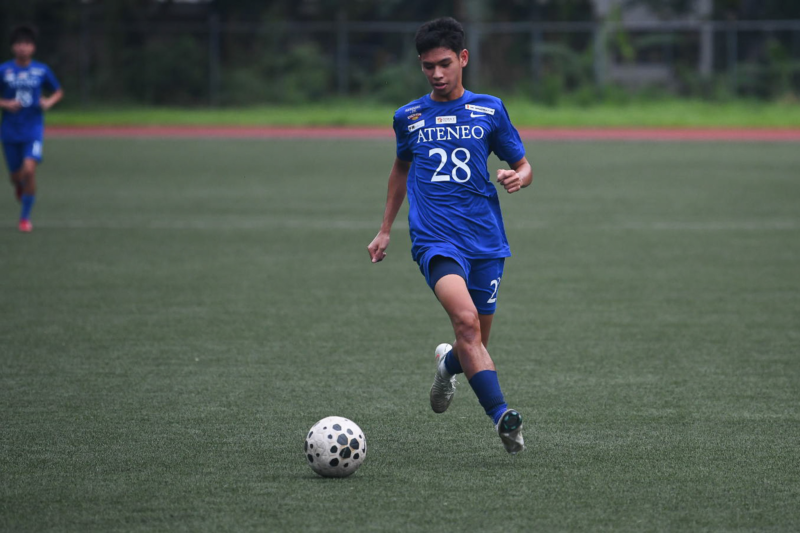
At Ateneo, athletic scholarships do more than recognize talent—they redistribute access. For Blue Eagles like Hassan Loraña (1 AB EU) and Joshua De Juras (3 AB IS), who were raised on tight budgets and tighter expectations, sports became a lifeline: a route to education and stability.
More than an athlete
For many of Ateneo’s scholar-athletes, their journey did not begin with self-rooted ambition, but with great congruence to family.
For Loraña, track and field began with a father’s instinct. His father, a former national judo athlete himself, sensed early on that contact sports was not the right fit for his son, gently steering him toward safer ground.
During a casual jog, a family friend noticed Loraña’s natural speed—an observation that set them on the track. That quiet pivot would later lead to a scholarship at the University of Baguio High School—Hassan’s first taste of how sports could unlock more than just a finish line.
Meanwhile, for De Juras, baseball was legacy. “Lahat sila nag-national team (All of them were in the national team),” the third-generation player says of his father, uncles, and grandfather. Backed by a lineage of athletes, what began as a family tradition soon earned him a scholarship at PAREF Southridge—and a spot on Ateneo’s radar.
These stories are not outliers, but windows into how sports have become a gateway to education in the Philippines. At Ateneo, athletic scholarships are more than rewards; they are entry points into a system that might otherwise remain out of reach. To qualify, students must show financial need, possess exceptional athletic ability, and earn a coach’s endorsement based on competitive merit, under the watch of the University Athletics Office.
Still, the real question is not only who gets supported, but who gets through the door. “Ako pa lang ‘yung taga-Baguio na na-offeran ng Ateneo noon (As far as I know, I’m the only one from Baguio who has received an offer from Ateneo),” Loraña shared. Next year, his twin Hussein is set to follow, a ripple effect sparked by a breakthrough.
These athletes may arrive known for their sport, but their stories rarely end there. In the University, athletic identity unlocks opportunities, but every step forward comes with something more to prove.
Weight of the win
Opportunity does not always arrive with fanfare at the Ateneo. It comes quietly in the form of monthly allowances, dorm space, and the tools needed to compete. For Loraña, it meant the basics were finally accounted for. “Kasama sa scholarship ko ‘yung dorm, food, pati gamit para sa track (My scholarship includes dorm, food, and even track equipment),” he says.
Nonetheless, stability does not guarantee ease. De Juras recalls scraping by during his first year, living on a limited weekly budget from his parents while waiting for his allowance. “Hindi rin naman ako makahingi sa parents ko kasi alam ko short din sila sa budget (I couldn’t ask for more from my parents since I knew they were struggling too),” he shared. When the support arrived, it was just enough to breathe.
Still, access comes with expectations. Ateneo’s athletic scholarship is not a free pass; it is a commitment bound by academic standards. Scholar-athletes are required to meet a minimum Quality Point Index to stay eligible. However, for Loraña, the requirement is not a burden but a responsibility—one that underscores the University’s belief that discipline must extend beyond the field.
Similarly, De Juras found the mix of academics and training a surplus of responsibility that is arduous to crack, stating that before stepping into the bullpen, he would give himself ample time to finish requirements.
Aside from studies, however, finding social support systems were difficult to navigate for the Blue Eagles in their early years. Loraña admitted that moving from Baguio meant plunging into unfamiliar territory, where his independence had become a mainstay.
“Iba po ‘yung experiences ko doon kasi mas mahirap nga po dito kasi malayo ka, wala pong nag-aasikaso sayo, (The environment here is very different from Baguio. Here, I’m more independent.)” he said.
For these scholars, the opportunity of an athletic grant is far more than what is demanded on competition day. Living far from home, striving to meet Atenean standards, and forging new connections are the quiet costs of seizing a once-in-a-lifetime scholarly opportunity.
“Tinanggap ako sa Ateneo, papakita ko kung sino ako—kung deserve ko talaga ‘yung scholarship na binigay sa’kin,” (I got into Ateneo, now I’ll prove I deserve this scholarship.)” Loraña said, a quiet promise to rise to the occasion and earn every stride.
Beacon of hope
Beyond the daunting obstacles, there remains a steady flame of hope for these persevering students. At the end of the tunnel, their academic and sporting efforts illuminate a path—not just for themselves, but for their families too.
For trackster Loraña, his scholarship allows him to financially support his two sisters back home in his province by saving up to have extra allowance.
De Juras, meanwhile, has shared that a scholarship has alleviated some of his family’s cost-related stress, deeming it an empowering avenue for working-class families. “Sa scholarship lang sila umaasa, sa sports lang. Sobrang madali o sobrang gaan kasi para din sa parents namin [na] ‘di na sila maghahanap ng pang-tuition fee,” the Atenean ace shared.
(We rely on sports scholarships. It makes things easier, especially for our parents, since they don’t have to worry about school fees.)
Besides clinching laurels for their teams, these athletes from the Eagle’s nest aspire to set a promising foundation for their future, even if that means putting more importance on horizons far from the world of athletics.
“Parang kailangan [na] isubo ‘yung pangarap para sa pamilya kahit gaano na ako katagal naglalaro ng baseball (You have to set aside your dreams of entering professional baseball for your family, even if I’ve played baseball for a long time),” De Juras added.
In the face of adversity, these sentiments convey that Blue Eagles bank on chances that bring good tidings within familial structures, where it takes sacrifice and adaptability to support one’s household in the short- and long-term.
Still, this realization does not diminish the power of sports. It is through the struggles of being an athlete, alongside its fortuitous chances, that help people from developing communities reach dreams under the brightest of lights.Ultimately, embracing a varsity scholar identity can be synonymous with being a figure of magis. It is an uphill journey of betting on yourself, while uplifting those around you. In the end, a scholarship is not just a means of living and fighting—it is a way to give: for the love of the game and the people you love.