CYCLING HAS long been a practical and eco-friendly transport option, but Katipunan’s car-centric design poses threats to active mobility. As fuel prices and commuting costs rise during the crisis, cycling in Katipunan becomes more than just a lifestyle choice for students and workers, as it is also viewed as an increasingly inaccessible transport system.
However, Katipunan continues to suffer from broken bike lanes on roads designed for cars, scarce parking, and harsh weather conditions, necessitating policy reforms to match the surge in private car ownership and road developments that continue to prioritize them.
The pull of the pedal
Cycling has become a practical response to the harsh realities of urban commuting. For students and workers navigating traffic congestion and unreliable public transit, biking is a more efficient alternative.
Ateneo Psychology Department lecturer Jaymar Patana, who bikes daily from Commonwealth to Ateneo, attests that the contrast between cycling and commuting in the country’s strained public transportation system is stark.
“I enjoy the fact that I can budget my time. With [a] bike, […] I can really say that 30 minutes is more than enough for me to be certain that I will arrive at Ateneo,” he says in a mix of English and Filipino.
Patana further highlights that cycling allows commuters to reclaim a sense of control in navigating Metro Manila’s public transportation system, reflecting why Filipinos begin to use bicycles as an alternative to costly and unreliable daily commutes.
The growing shift toward cycling underscores its potential to reduce short-distance car trips, alleviating traffic congestion in compact urban areas like Katipunan. Notably, a 27% shift from private cars to bicycles has been found to reduce pollutant gas emissions and fuel consumption by 19%. This is significant in Metro Manila, where traffic congestion contributes to 70% of air pollution.
However, these broader environmental and community benefits can only be fully realized when people feel safe and supported enough to choose cycling in the first place. Thus, infrastructure directly influences transportation behavior. The decision to bike, therefore, is shaped not simply by personal motivations but more by the systems that either enable or discourage active mobility.
Cycling against the current
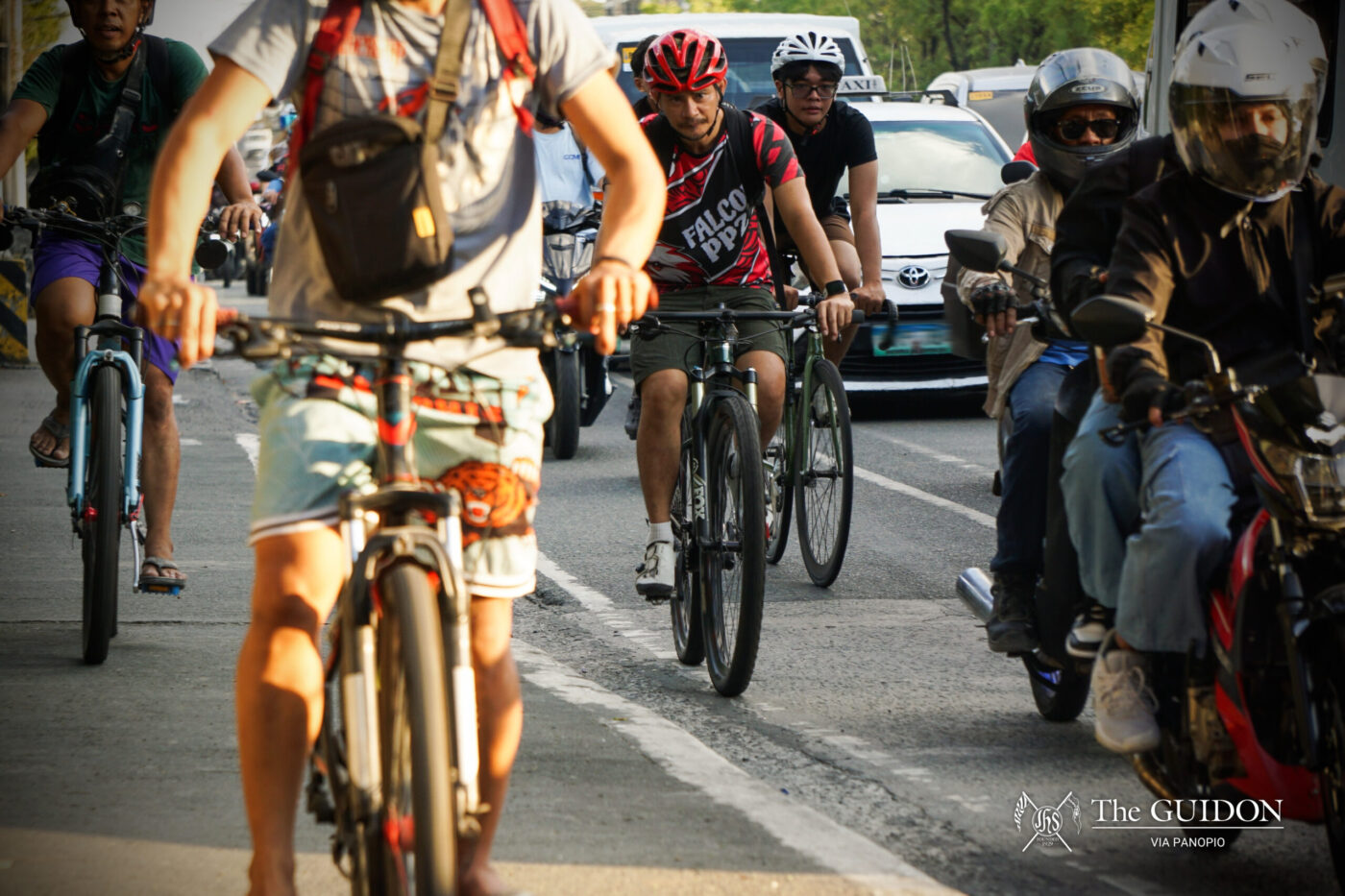
Despite its benefits, cycling in Katipunan remains exhausting and at times dangerous. Bike lanes are often inconsistent, narrow, obstructed, or poorly connected, forcing cyclists to merge erratically with high-speed vehicles. Secure bicycle parking is also limited, discouraging people from biking due to theft and accessibility concerns.
Patana asserts the constant alertness required even within designated bike lanes, highlighting that even when he is in the bike lane, there is still the fear of moving and avoiding more dangerous lanes or highways. He particularly feels this in Katipunan, where only certain stretches of the road are bike-friendly, while many are devoid of protected bike lanes.
Sebastian Subia (1 AB POS), who bikes daily from Maginhawa to Ateneo, puts it plainly: “There’s a bike lane, but it’s just paint. The paint’s wearing off. So it’s already hard enough for us to stay in the designated bike lane because of how bad the road is.”
Both Patana and Subia exclaim that they have to move beyond the “bike lanes” at times if they want to avoid accidents, ironically risking them closer to fast vehicles.
For Subia, the lack of shade and greenery along Katipunan contributes to the urban heat island effect, where roads and concrete surfaces absorb and trap heat, making daily cycling more physically exhausting and unsafe for commuters.
Reimagining riding
Building on these environmental concerns, efforts have begun to extend beyond the university to the Quezon City government, with oil price hikes prompting the public to shift toward mobility options like walking and cycling.
Notably, the Department of Public Order and Safety of Quezon City has launched initiatives to enhance the cycling experience and encourage environmentally friendly mobility. Plant boxes also provide a safe space for biking from cars, like how Subia and most cyclists suggest.
Subia also notes that integrating protected bike lanes with green spaces and wider sidewalks could reduce surface temperatures and create a more comfortable environment for cyclists.
Expanding on these design interventions, Subia calls for the need to change public perception of mobility: roads are not just for driving, but for people and accessibility.
“Restructuring must be at both the individual and infrastructural level. There has to be efforts to change that mindset—that biking is not less than owning a car,” Patana adds. He also echoes the need for bicycles to be considered a legitimate mode of transportation rather than being a secondary prospect.
The joy and frustration of cycling in Katipunan continue to exist side by side. With heat, traffic, and chaos, many cyclists continue to rely on biking as a sustainable mode of transportation. Their experiences reflect both the growing demand for active mobility and the need to address the gaps in infrastructure so cyclists can safely and comfortably move through the city.