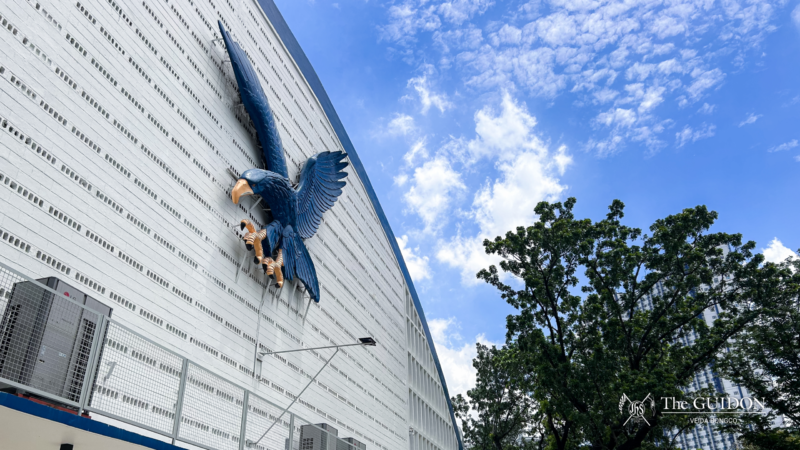
The following is the full and unabridged valedictory address delivered by Alexandra Janine “AJ” Tiambeng (BS HS ’26), who graduated summa cum laude, during the Class of 2026 Higher Education-wide Commencement Exercises, on the morning of June 19 at the Blue Eagle Gym.
Dr. Shahidul Alam, our Commencement Speaker; Fr. Xavier Olin, Provincial Superior of the Philippine Province of the Society of Jesus; Ms. Bernadine Siy, Chair of the Board of Trustees; Fr. Roberto Yap of the Society of Jesus, University President; members of the Board of Trustees; Dr. Maria Luz Vilches, Vice President for Higher Education; Dr. Czarina Saloma-Akpedonu, Incoming Vice President for Higher Education; deans, administrators, faculty and staff, family, friends, and fellow graduates, good morning.
As we gather today to celebrate a milestone in our lives as graduates of the Ateneo, we are also aware of the grief that surrounds our community and the families and loved ones of two of our student-athletes, Rene Baterbonia and Divine Adili. Before I proceed with my speech, I would like for us to honor their memory by saying a prayer.
Let’s pause for a moment of silence.
God of mercy and love, thank You for your gifts of Rene and Divine to our community. They responded to the call of love, not only by excelling in basketball, but also by carrying the hopes and dreams of their families. Now that they have departed from us, receive them with compassion to Your presence and warm embrace. May they rest in eternal peace and may we never forget their stories. We also pray for their families and loved ones, that they may be healed and comforted. Lastly, we pray for our community of Ateneans, faculty, administrators, and staff, that we may together find the right way out of this darkness and into the light of Your transforming power. All this we ask through Christ our Lord. Amen.
The uncertainty we are now facing as a community reminds me of a question I’ve asked myself since the first day I stepped foot in Ateneo: “How can I be excellent in an uncertain world?” Back then, I was an insecure overachiever who had yet to figure out if I could ever fit the University’s idea of excellence. When I met my brilliant batchmates—a collection of scholars, athletes, and artists—I immediately felt that I didn’t belong because I thought that I lacked the achievements and talents that made them excellent.
Still, my seniors said that I was lucky to be part of the post-pandemic batch who would spend four years onsite, finally in the “new normal.” Little did they know that our batch would experience so many disruptions that made life feel the furthest from normal. Was it normal for commuters among us to rise before the sun because of transport strikes? Was it normal for those with loved ones abroad to be filled with anxiety because of wars? Was it normal to watch floods expose the vulnerability of our country and the greed of our government officials? And was it normal to end our last semester back online because of an energy crisis?
Throughout college, everything around us seemed to change for the worse. And now, we are left uncertain of how we should approach the world. We are uncertain whether there is still hope for our future. We are uncertain if anything we will do can make things better. But in the face of all this uncertainty, the call for excellence remains. As we leave our beloved Ateneo, we must ask ourselves: What does it truly mean to be excellent?
As students, we often speak of grades and awards to prove how good we are or how much we know. But somewhere in between freshman year, when I failed my first quiz, and now that I’m graduating with honors, I’ve realized that excellence is measured by neither of those outcomes. Excellence is not about getting straight As, planning the most projects, or landing the highest-paying job. Rather, excellence is about committing to continuously learn, translating that learning into action, and doing all of this with love.
Surprisingly, it was not in the classroom that this realization began to click for me. Instead, it was on the spare weekends that my parents told me and my siblings to get off our phones and learn outside school. They made us carry boxes of pills and ointment to families who caught infections in floods. They filled our dining room with diapers, blankets, and soap to pack for a hospital. They brought us house-to-house in communities they were supporting to gain self-sufficiency. Unfinished huts beside landfills, neighborhoods that were hills and a river away from a health worker, children with thin limbs and bellies enlarged by worms.
Encounters like these, where I saw the disparity between what should be and what actually is, shifted my definition of excellence from success to service—from capitalizing on my opportunities to erasing the inequities that built the Hill where we stand. I’ve realized that studying in Ateneo is a privilege that bestows power but demands humility—an honest acceptance that I still have so much to learn. In our philosophy classes, we are trained to question, to contemplate, and to embrace the discomfort of sitting with the most frustrating imperfections of the world, because when we know what needs to change, we can put our learning to work.
The various ways that our batch has used our education to take a stand are why I believe our OrSem theme, Tindig, was predestined. In spite of all the uncertainty we faced, we are the batch who refused to back down whenever we knew something needed to change. We are the batch who called on our senators to uphold the rule of law; who advocated for the food security of our scholars; and who held each other’s rights in discussions of tuition fees, campus mobility, and mental well-being. Time and time again, we were reminded of how much we can achieve when we stand together.
We also taught one another that excellence can take infinite forms. It is not a one-size-fits-all medal won in the pursuit of greatness, but a quiet characteristic of every action done with great love. Just look at our batchmates. In Ems, a Health Sciences student from the School of Science and Engineering, excellence was applying academic frameworks in government agencies where she helped advance health policies. In Sebi, a Psychology student from the Rosita G. Leong School of Social Sciences, it was leading his orgmates up mountains to bring back stories of our environment and Indigenous people. In Cyrene, an Art Management student from the School of Humanities, it was curating an art gallery to challenge traditional gender norms and share the narratives of Filipino women. In Mio, a Communications Technology Management student from the John Gokongwei School of Management, together with a team behind the thesis titled “Tapo Guardian,” it was using AI to develop a home protection system for the elderly.
Anyone would call these people excellent, but in Ateneo, we call them the embodiment of magis or “more.” To have magis is not just to do more, but to love more—to love the community, the advocacy, the country so deeply that you feel a relentless tug to be more. In acting out of magis, one demonstrates excellence that is not confined to a single field or profession, but is possible for any person whose work expresses what it means to love more. This goes to all of us who are on the way to becoming doctors, lawyers, and CEOs. But also, it goes to those who are much cooler—who have chosen the unconventional road or have yet to pick a destination. As long as we are walking in step with love, we are exactly where we need to be.
My most memorable experiences with love as the embodiment of magis were in Kythe-Ateneo, the organization that supports children with chronic illnesses, where I served as President. In my quest to optimize our systems and maximize the impact of our projects, I ironically learned that being a magis Kyther sometimes means doing less. Once, I entered the hospital and was greeted by a child who was bursting with excitement, who already knew what board game he wanted from the playroom, and before I could open my mouth, he shouted, “Ate, laro tayo!” (Ate, let’s play!) Another day, I was assigned to a child who was bedridden, exhausted from a procedure, and wanted me to just sit beside him.
Both times, I had to ditch the activity that my orgmates and I had worked so hard to prepare. Both times, I felt unequipped, inadequate, and, for a moment, considered running out of the ward to let someone more capable do the job. But I was pulled back to reality by the young warrior in front of me. When you are faced with a child who is uncertain about whether they’ll get better, yet chooses to keep going, how can you not do the same? This, to me, is magis in its purest form—to swallow the self-doubt that makes you feel unsure, to count your failures with gratitude for how they contribute to the better person you’re becoming, to keep trying simply because you love the people you serve.
The gift of seeing excellence, in the choice to learn, act, and love—in the process of living rather than the outcome of a life spent tirelessly striving—is that we can find peace in not knowing the ending of our story. What matters is how we act on this page: what we say, where we stand, and how we respond to the call of the God who is the source of all this love.
I would be remiss if I didn’t take this opportunity to thank the people who have allowed us to experience love in action. To our parents, guardians, and friends, thank you for being the wind beneath our wings—for generously giving the love that has carried us this far. To our faculty and staff, thank you for teaching us what the world can and should be: more inclusive, equitable, and compassionate. To our administrators, and all who lead the Ateneo that we will forever call home, we trust that you will dedicate every effort to practicing the same excellence that you have instilled in us: the kind motivated not by achieving more, but by loving more—loving your students and their families, and putting every Atenean’s welfare at the forefront of all activities of this University.
And to my brilliant batchmates, today may mark the end of our college years, but our stories are just beginning, so keep doing what you’ve always done, and what St. Ignatius of Loyola said: give without counting the cost, fight without heeding the wounds, hope despite the temptation to despair.
Immerse yourself in reality until there is no need for immersion. Risk your pride to do what you know is right. Shatter your own definition of excellence and paint the cracks in gold. But as you change your corner of the world, don’t do it alone. Remember where you came from: the school where people lend materials to orgs they’re not part of, where groupmates share notes to help each other pass exams, where awkward blockmates become lifelong friends. Life is still unbearably uncertain, so let’s be a refuge for one another, let’s give each other grace, and let’s share the weight of the responsibility to love.
Together, we are excellent but we can still be magis as Ateneans ignited for more.
Congratulations, Class of 2026, and to God be all the glory.