AS THE sports industry remains male-dominated, women often take a back seat, enduring the limitations posed by their gender and identity. In Philippine sports, this reality has continuously reinforced traditional norms, consequently hindering meaningful and equitable representation of women in the field.
However, where inequality thrives, an equally aggressive pursuit to reshape perspectives and drive innovation in sports storytelling is present. In particular, a determined group of women in sports media hopes to cultivate an environment where female athletes’ stories transcend appearance-focused coverage.
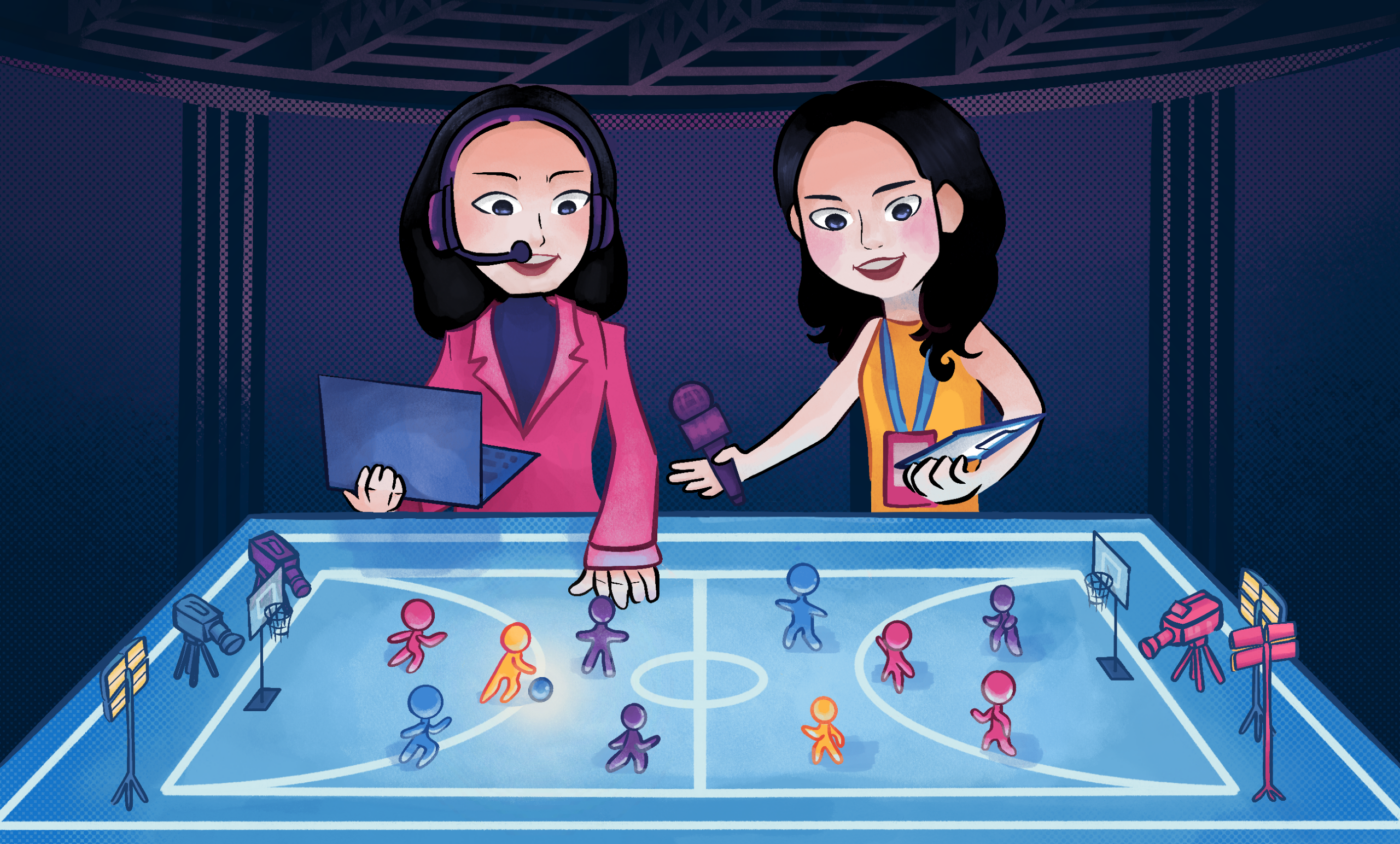
These stories, which audiences engage with, are shaped by the diverse range of ideas from the women who work behind the scenes. The addition of female producers, photojournalists, and correspondents creates a dynamic response to challenge the male-centric industries. As drivers of narratives in sports storytelling, women play a significant role in changing the game in more ways than the sports community realizes.
Beyond the spotlight
Athletes’ stories sustain the sports landscape. It is their personalities that carry powerful narratives to shape sports, making each match more personal and meaningful.
With this, sports media serves as the infrastructure that bridges these stories to the audience, with many storytellers carrying the banner of women in male-dominated industries.
In an effort to make a difference in the narrow perspectives of sports media, creative producer Cleverlyn Mayuga capitalized on her love for sports and passion for storytelling to create content that humanizes Filipino athletes.
Her humble beginnings as a Gilas fan led to her decorated career as a senior producer, project manager, and director in the sports scene. As the co-founder of Malaya Creatives, Mayuga dedicated her craft to the pursuit of authentic sports storytelling by focusing on the humanity of Filipino athletes. She is best known for the award-winning Project Puso in Paris, a mini-documentary series that followed the journey of Filipino delegates to the 2024 Olympics.
Similarly, businesswoman Ceej Tantengco-Malolos made strides in the sports industry through her advocacy for Filipina athletes. Her globally-recognized platform, Go Hard Girls, amplifies the voices of Filipina women, hoping to inspire women across industries to cement their place in spaces where they think they do not belong.
As a former courtside reporter and sports journalist, Tantengco-Malolos channels her own gender-based discrimination experiences as motivation to create safe spaces for women in the industry.
Many of the storytellers who thrive in sports media solidify the grounds for women in the sports industry. Yet, while they have steadily claimed spaces behind the scenes, the broader sports culture they work within has not always evolved at the same time and at the same pace.
For the longest time, the Philippine sports culture thrived on a blueprint that treated women like objects. Even when decorated athletes carved their names through phenomenal feats, the media packaged these triumphs as exceptions, rather than norms.
To break this practice, women in sports media needed to step into key roles that influence how stories are framed, funded, and remembered.
Female architects
Mayuga and Tantengco-Malolos are quietly challenging long-standing gender norms in sports media by taking ownership of the storytelling process and media production itself. For Mayuga, her unexpected entry into the media industry evolved over seven years in sports, eventually leading to her acclaimed work, Project Puso in Paris.
The series reflects the distinct authorship that she embodies–covering Filipino Olympians on the international stage, not as fleeting spectacles of national pride, but as individuals bearing years of sacrifice and hope.
Meanwhile, Mayuga’s projects and stories strived to capture the reality of athletes. For her, storytelling is anchored in making narratives together with athletes, rather than relying on surface- level knowledge, which fails to capture their deeper humanity. As she observed, “There is a certain level of elegance and classiness in portraying women in sports now,” pointing to a meaningful shift in how female athletes are written about.
On the other hand, Tantengco-Malolos worked alongside other women to challenge the existing gender disparity in the industry. After entering the sports industry through GMA News, she transitioned into a courtside reporter for the National Collegiate Athletic Association, where she got exposed to the very heart of the male-dominated sports media arena.
The institutional machinery of the sports media, largely shaped by male perspectives, exposed the overt gender gap that catered to the base instinct of men, prioritizing what sells over what is equitable. As a writer, Tantengco-Malolos strongly believed that the media has a “responsibility to not pander on what the people just want.”
Carrying this belief, Tantengco-Malolos wrote“It’s Time We Stop Writing About Female Athletes’ Looks,” which urged the media to focus on women’s achievements rather than their looks and sexualities. The piece challenged a long-standing blueprint in Philippine sports coverage, one that often packaged women for visual consumption.
Tantengco-Malolos still recalls how criticism and backlash surfaced almost immediately after the article was published. Despite this, she remained firm in her belief that the media holds an agenda-setting power where coverage sheds light on what matters.
This conviction inspired Tantengco-Malolos’ establishment of Go Hard Girls, a platform that grew from a podcast into a media agency and community. Now, Go Hard Girls serves as a platform that makes women-centered sports storytelling sustainable while also creating communities where young athletes and LGBTQ+ members feel seen.
The feminine infrastructure
Through their extensive efforts, Mayuga and Tantengco-Malolos demonstrate how creative control can reshape sports media to challenge gender-based biases that remain at the forefront of Philippine sports.
Echoing this reality, Mayuga emphasized that while women’s visibility has improved, the industry is “not yet fully ready to accept women as paramount, not just a passing moment.”
As progress remains incremental, both women continue to treat their projects and initiatives as structural work. Slowly, their pursuits are laying the blocks for a sports industry where women’s physicality has no bearing on whose stories are seen, covered, and funded.
In an effort to widen the lens of sports media, Mayuga and Tantengco-Malolos are helping to reshape the industry itself with the creativity that they offer. Alongside women in the sports media industry, their extensive efforts no longer just yearn for mere inclusion, but also actively reshape the structures that allow gender disparity in sports and sports media.