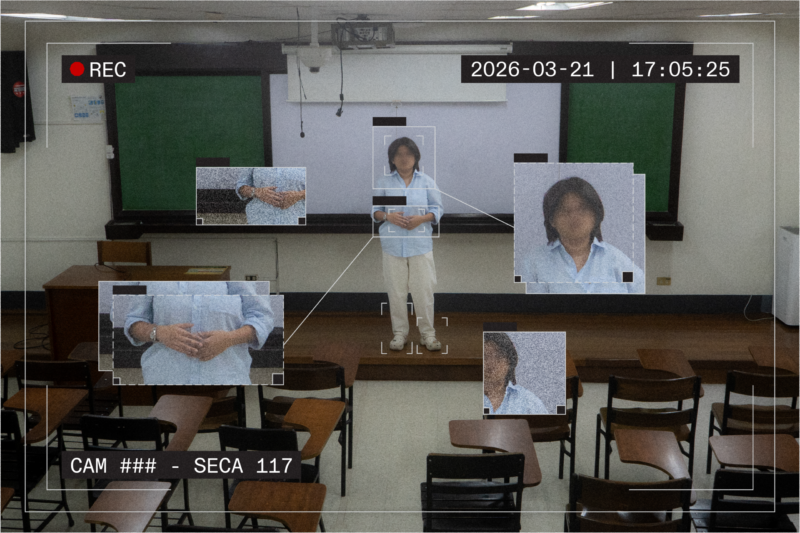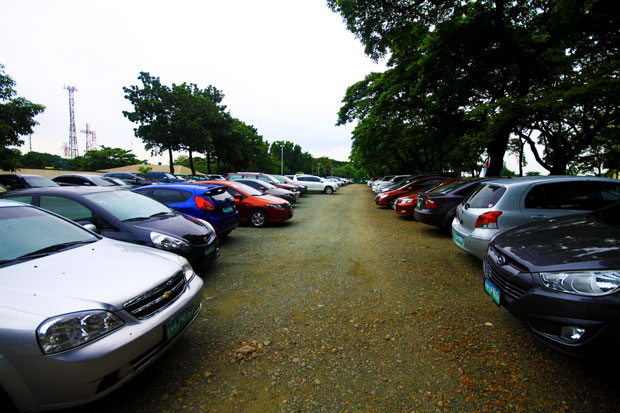
Compromised security. The Ateneo campus has been the site of a number of theft incidents recently. Photo by Ean L. Dacay
Safe and secure. In a world replete with tragedy and troubled by uncertainty, these two words represent much of what people in a society aspire to attain. Whether it is financial stability, dependability from a government rife with corruption, or unwavering loyalty from your lover, it is evident that the feeling of safety and security is a luxury man fervently longs to possess.
Unexpectedly, people use various measures to keep their material possessions and their loved ones safe. A majority of the student population lives behind gated communities, ensconced behind a perimeter of high walls. Society employs armies of private security guards to hold vigil over its homes, schools, hotels and malls.
People do what they can to be shielded from the vagaries of fate and chance, to guard against misfortune. In short, when the proverbial night falls and villains both real and imagined roam the streets, they lock their doors and hide their children.
It is tempting to say that all this stems from an inherent distrust in our fellow man. In reality, though, these are reasonable enough precautions to be taken in a country where the dread pall of poverty hangs low over the people’s heads.
And in few places is the discrepancy in wealth as obvious as it is in the Ateneo. In a country where 40 million Filipinos live on less than a hundred pesos a day, we have a school that is home to many well-to-do students, a number of whom zip around in flashy cars.
It’s of little wonder, then, that the Ateneo has been the site of many incidents of theft.
Like thieves in the night
Recently, the school was rocked by news of several alarming incidents of theft committed on school grounds. France Sison, an information design senior and one of the victims of theft last August, laments that “the response [to the matter] was quite disappointing,” on the part of the school’s security authorities (then still Leopard Security and Investigation Agency). The guards were reluctant to help her and her friend, Ionne Ocampo, report the loss of their laptops to the police.
The process of filing the police report and getting the security guards to cooperate proved to be a messy and harrowing process. One fact that had been raised was the questionable absence of guards in the covered courts parking lot, where the incident occurred, at the time of the theft.
“There was no guard at the parking lot, even though his shift had not ended,” Sison says. In fact, due to the circumstances, the school administration decided to conduct an internal investigation into the matter, in case it was an inside job.
It seems that the recent thefts were not crimes of opportunity; their brazen nature speaks of premeditation and forethought. Ocampo’s car had its window smashed, and although the force used is disturbing, it is not nearly as troubling as the fact that the car was somehow unlocked without the installed alarm system going off.
All this worry over how students are to defend themselves against such determined and resourceful foes, coupled with the clamor over the recent changing of the guards, has been enough to spark a mild hysteria among Ateneans over the state of security on campus.
The blame game
Rene San Andres, the Associate Dean for Student Affairs (ADSA), and Michael Mallillin, Assistant to the ADSA for Student Services, addressed the crux of the issue in an interview. They hold that it is not solely the responsibility of the security agency or any school office to look out for the students’ personal property and belongings, and that any effort to thwart cases of theft begins with the students themselves.
As such, the issue of negligence cannot be discounted when the topic is that of school security. San Andres says, “Oftentimes we receive reports of losses, but when we probe into the case, we discover it is triggered by an act of negligence on the part of the student.”
San Andres stresses the fact that students’ attitudes have as large a role to play as any when it comes to the security situation of the school. He cautions students against a “culture of entitlement, where everything that happens to them is someone else’s responsibility, other people’s fault.”
He paints a striking portrait of what we face in matters of security by talking about past incidents of security lapses on campus. He relates this case of systematic and thorough thieves who made use of such skilled tactics as working in a five-man team, where each of them would hand the stolen object to another, changing shirts as they left the vicinity of the school.
Mallillin adds that many of these perpetrators blend right in: one thief was caught dressed in an Ateneo shirt, an Ateneo cap, and other apparel that could have just as well been worn by a regular college student. What gave this thief away was the fact that he was wearing two school IDs, one a girl’s.
These stories might stoke student paranoia, but more importantly, they remind Ateneans what exactly they are up against. “That’s the context: we have negligent students, and we have very industrious, hardworking thieves,” Mallillin says. “They do not do these things haphazardly.”
True enough, the thieves weren’t haphazard at all when they stole the laptops from Sison’s car; it would seem to be a daring heist for any thief. “Kahit na nag-iwan kami ng gamit sa kotse, we weren’t careless naman,” Sison says. “The windows were tinted and the laptops were on the floor.” This just further underscores the dangers posed by these brazen felons—and what the community has to guard against.
“New and improved”
Megaforce, the school’s new security agency, intends to be an improvement on its predecessor, and has outlined several concrete measures to accomplish this. Jun Deiparine, Operations Supervisor for Megaforce, says that in an effort to heighten security, the campus detachment has requested for more CCTV cameras and additional guards to be brought in. The number of roving guards, as opposed to the ones stationed, has also been increased.
He is quick to assure that his agency has nothing to hide from the students, and welcomes the possibility of improvement. “Transparent kami. We want comments to improve our operations,” he says. However, he reminds the community to do its part, for “when it comes to security, it’s everyone’s concern.”
Mallillin believes that the change of security agency is for the best, especially after a nine-year run with the former agency. “I think it comes at an opportune time, because security in general can deteriorate if there is too much familiarity.”
He relates that “one of the prerequisites for hiring was that Megaforce offer better personnel and facilities to augment the current security plan.”
“Because Megaforce is a big agency,” he explains further, “they will be able to handpick the officers and guards assigned here, and they will be of a higher caliber than the previous agency.”
Mea culpa
There is a double standard that Ateneans display when it comes to security. Many students complain that security is overly stringent when it inconveniences them, such as when they are reprimanded for not wearing their IDs, but are eager to condemn security as lax when thefts occur.
“Liability assumes that there is a reasonable amount of responsibility that can be expected of a person or institution, and so that person is liable if he is remiss in that responsibility,” says San Andres, explaining the role of the guards in campus security. “But there are times when the level of accountability demanded is unreasonable.”
San Andres states that students cannot “just leave their things anywhere, and assume that the school will be sending a horde, a battalion of security people to watch over their belongings.” There are upwards of sixty guards assigned to the Loyola Schools, and to be fair to these sentinels, they cannot be expected to compensate for the complacency of nearly eight thousand undergraduate students in the Ateneo.
That’s not to say that all students are negligent, and that there are no shortcomings on the part of security personnel. However, there is a need to acknowledge that students must be able to couple personal culpability with their reliance on the larger systems in place.
While assuring that campus security is the lookout overseeing the students’ safety, Mallillin says, “We can extend only [so] much assistance.”
It seems, then, that eternal vigilance—from every possible front—is the inevitable price of security and peace of mind.
With reports from Kevin V. Mizon and Katerina D. Francisco