
Baraquel is the author of the Comprehensive Agrarian Reform Program Extension with Reform (Carper) and its earlier version, CARP.
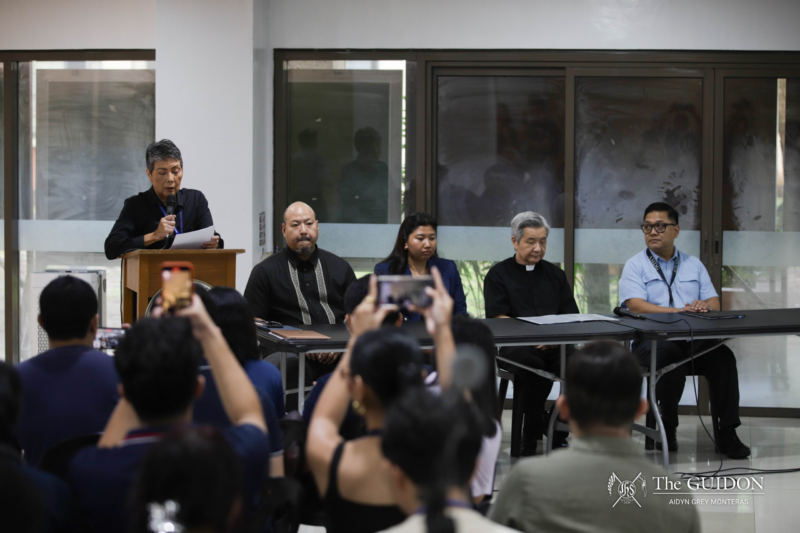
“I’m deeply happy to know how faithfully the Ateneo has supported the agrarian reform struggle of the peasants,” said Baraquel, who visited the Ateneo on March 4. (See related article, “Students echo farmers’ plea.“)
Branching out
In an interview with The GUIDON, Baraquel outlined three more ways concerned citizens can help support the passage of Carper.
One is through seeking district congress persons and linking with farmers’ organizations, especially those in agrarian hotspots where violence is common.
Another way is through supporting advocacies related to agrarian reform. “From agriculture, you go to water, you go to the forests, you go to mineral resources, you go to issues of mining, logging, you can talk about renewable energies…[and] garbage disposal,” she said.
“Para sa mga business majors, pag-aralan lalo kung paano ‘yung agrarian reform (For the business majors, you can study agrarian reform), and then beyond agrarian reform, rural development,” Baraquel added.
She also said that students should keep raising their voices politically. “[Just say] what you think about government and politics, what’s your analysis, what’s your proposition about it, [and] if you have any alternatives in mind, let us know,” she said.
“Put your money where your mouth is, like what you’re doing again these days.”
Frustration, new dynamics
Baraquel feels frustrated after Carper’s passage has been delayed many times in the House of Representatives. “On the floor, I have also shed tears out of exasperation,” she said.
The worst for Carper, she said, happened on December 2008. “This so-called extension actually crippled the program because it took out compulsory acquisition which is the most effective mode of land activation,” she said.
“This year, after that joint resolution which was like a blow to the solar plexus, and then the memorandum circular that followed, I am even less hopeful—less hopeful that we will have a fighting chance in the House,” Baraquel added.
The joint resolution suspended the distribution of 64% of the lands set to be covered by CARP, while the memorandum circular removed compulsory acquisition, one of CARP’s important components.
Still, Baraquel finds hope in initiatives led by other sectors.
“Siguro yung panggagalingan ng bagong dynamics…will have to be created by this one last stand…ng mga magsasaka, estudyante, taong-simbahan (Maybe the new dynamics will have to be created by this one last stand…by the farmers, students, and Church-people),” she said.



Was an interesting article, thank you..
Best you should edit the page title Carper author supports Ateneans’ final stand | The GUIDONThe GUIDON to something more specific for your subject you create. I liked the the writing however.