“THERE IS a very big gap in what the Church is teaching and what they’re doing right now.”
Deputy Prime Minister for the affirmative side Vincenzo Giorgio Tagle (III AB Eco-H) argued this in “Baby Talk: A Debate on the Reproductive Health Bill,” on September 19 at Escaler Hall.
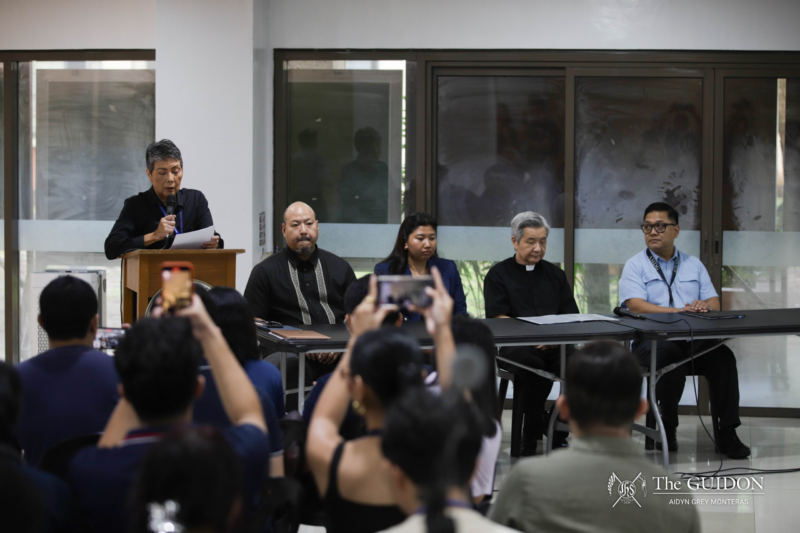
Baby Talk is the second in the series of chamber debates organized by the Ateneo Debate Society and the Sanggunian.
The Reproductive Health Bill, or House Bill 5043, aims to manage the population of the country.
With the motion “This house believes that the Church should support the Reproductive Health Bill,” two groups of three debaters each sparred on the pros and cons of the Bill.
Members of the affirmative side included Prime Minister Michael Jonathan Biscocho (IV BS ME), Deputy Prime Minister Tagle, and Whip Angelica Simone Mangahas (II AB SoS).
Prime Minister Shiveena Parmanand (II AB Psy), Deputy Prime Minister Pauline Marie Gairanod (III AB PoS), and Whip Danielle Marie de Castro (IV AB PoS) argued for the negative side.
Solution to overpopulation?
Tagle said that even though the Church is teaching Natural Family Planning, “many people are getting pregnant anyway.”
“If you look at the idea that we’re only adding one child anyway, to the farmer, to the fisherman, [they] already [have] a difficulty feeding the already—let’s say—four or five children,” said Biscocho.
The Bill allows individuals to proactively make choices and to be able to understand what’s best for their family, he added.
Tradition vs. current needs
Tagle added that the Church can change its teachings in order to “adapt to the particular social needs and preferences in our contemporary time.”
He also said that it is harmful for the Church to oppose the Bill because it would be depriving people of making various choices.
Mangahas said that although tradition is important, “we need to evaluate the current needs.”
“The Church today is not the same as the Church centuries ago. Bad things in the past are no longer bad today,” she said.
The Bill, according to Mangahas, is something that “the Church should accommodate in its teachings and something that they should do as a moral institution.”
The Church’s consistency
The opposition argued, however, that the Church should stay consistent with its teachings, and support for the Bill is “fundamentally irreconcilable” with Church teachings.
“Tradition is important and must be taken into consideration in this particular point,” said Parmanand. “You have to balance the necessity to control how many children you have with what the Church holds to be true in what She teaches you about life.”
Gairanod said that the opposition upholds the separation of the Church and the State.
“If the State wants to pass it [the bill], then pass it,” she said. “But that does not mean that the Church should change its teachings due to popular causes.”
De Castro concluded that the Church has survived for the past centuries on its traditional teachings. “Why would today be any different?”
Choices
Lorenz Ferdinand Dantes (I BS LM), who was part of the debate’s audience, said the debate explained both sides of the issue. “It also promoted the awareness on the Reproductive Health Bill issue,” he said in a mix of English and Filipino.
Dantes said that he supports the Reproductive Health Bill. For him, citizens should not be limited to the Natural Family Planning method. “Dapat mabigyan pa sila ng other choices (They should be given other choices),” he said.
Roshni Parmanand (I BS CTM) said that the debate was “really thought-provoking.”
She also supports the Reproductive Health Bill. She added, however, that she is “not sure if the Church really has to support it.”