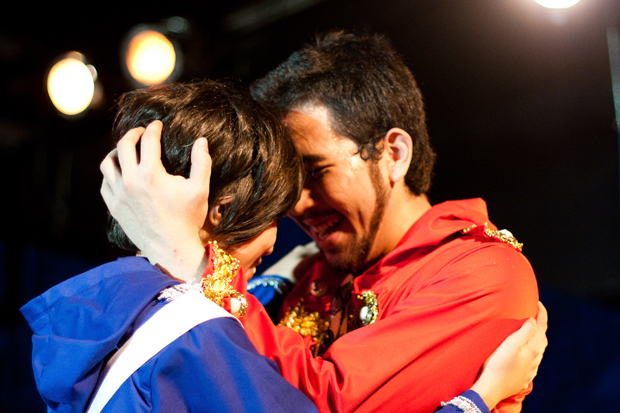
Photo by Pia Guballa
The truth evoked by one’s masterful command of metaphors, the splash of pigments given life on canvas by brushstrokes, the emotional finesse lent to a character by an actor— the singular beauty of art radiates in its multiplicity.
This multiplicity also makes for art forms not instantly mesmerizing. Art serves as a venue for innovation and deviation from the norm—graffiti, for instance, or sculptures not carved out of ivory but of books, or politicized bands performing on hallowed grounds as an act of protest.
Art, by nature, eludes definition. The simplest, broadest explanation Fine Arts Program director Ricardo Abad, PhD can offer is that art is “an aesthetic response to the world around you.”
The Jesuit influence
Whether in literature, visual art, or theater, responding to the world through the process of creating beauty is a long-standing tradition in the university. According to Heights Editor-in-Chief JC Casimiro, art in the Ateneo began as a pedagogical tool, that is, as a teaching method for students.
On the same note, Abad elaborates that theater in particular helped instill the Atenean values of sapientia et eloquentia (intelligence and eloquence) by training students to face an audience and exposing them to the seminal works of playwrights such as Shakespeare.
This was part of the Aristotelian framework Jesuits espoused, which focused on four aspects: arithmetic, science, grammar and rhetoric. The same framework persists today in the form of the core curriculum, which attempts to provide a holistic, multidisciplinary education.
Revolutionary phase
By the 1960s, a surge of resistance had risen among the global youth against the prevailing systems of society. This countercultural trend was a worldwide phenomenon and the same stirrings inevitably found its way into the Ateneo.
The spirit of resistance did not waver despite the authoritarian threats of punishment during the Martial Law era. In fact, students even felt the burning drive to actively resist the regime. While there were protests, demonstrations and lectures, those who did not engage in more physically direct and confrontational action channeled their subversive compulsions through the arts.
While Matanglawin and Heights were closed, and The GUIDON was heavily censored, the anti-Marcos sentiment was manifested through paintings—the Ateneo Art Gallery was filled with modern realist works that subtly presented the atrocities of the Marcos regime. Student theater groups staged dissident plays as well, with the Enterteynment Para sa Tao, Bayan, Lansangan at Diyos (Entablado) as the main avenue for activist theater.
The social commentary in these works was key to both informing people about Martial Law atrocities as well as providing a channel for subversive voices. Now, the surviving works live on to depict that period of Philippine history.
Postmodern, Post-Marcos
Casimiro believes that apart from a being a fight to restore democracy in the country, EDSA was a cultural battleground where the victors were the Filipino elite and middle class. This, he says, had an effect on what kind of art emerged in succeeding years.
Because of the absence of censorship, pop culture thrived. In addition, the death of the overtly political agenda—which flourished through the subversive struggle against Marcos—changed the paradigm governing local artists. “Instead of focusing on the person as human, all of a sudden, Ateneo art had focus on identity—identity as commodity,” Casimiro explains. Artists would create work that was distinctive but was also equally marketable to meet a new demand for art among the elite and middle class.
While progressive critics of contemporary society often look reproachfully on commodified culture, Casimiro sees the matter from a moderate standpoint. “In a sense, I don’t think there’s anything wrong with it. After all, if it’s beautiful, then it’s beautiful.”
Nevertheless, it’s a classic dilemma that still rings through today, more so in an affluent setting like the Ateneo. Should art be subject to the laws of supply and demand or should it only be created for its own sake?
Here, Abad offers a pragmatic argument—art needs some commercial value if only to survive. The business side of art is more focused on covering the costs for a production and gaining enough financial bases to continue producing work. For him, it’s never really about the profit. “Breaking even is enough for us,” he shares in Filipino.
According to Ramon Lerma, director and chief curator of the Ateneo Art Gallery, “[Money] is part and parcel of [art]. It’s not an evil. If not for that, an artist has nothing to live [on].”
However, he finds fault in art whose sole purpose is profit. While money is involved, Lerma believes that an artist must consider the inherent purpose of creating an object of beauty—it’s beyond asking whether or not the consumer will like it.
Making a statement
Throughout the evolution of art in the Ateneo, art has fulfilled a number of purposes, not least of which is the political. Indeed, while art is used as a tool for expression against government affairs and national politics, Abad also says, “Every artistic statement is a political statement in the broadest sense.”
Staging a play with characters that break out of standard gender roles makes a statement about social stereotypes. The simple use of indigenous Filipino materials makes for a nationalist diatribe. Such artistic statements challenge the status quo, whether subtly or overtly.
Casimiro agrees that art cannot be divorced from politics. “An effective artwork is one that would compel you to react, but not on the level of protest reaction. [It] compels you to think, question, appreciate and put value on that art form.” He adds, “It can’t be beautiful [and] it can’t be thought-provoking if it’s not political.”
Speaking specifically about Ateneo art’s audience, though, Abad says, “Ateneans don’t see the world in the political. [They’re] more concerned about, say, the private world of success, good grades, good jobs, of good pay—and it’s a very pragmatic world [which adjusts] to status quo more than defying [it].”
Consciousness
The art scene in the Ateneo has been flourishing, Lerma says. For example, the Ateneo Art Awards has established itself as a high point in the Philippine cultural calendar. However, the distance between the regular student and the Ateneo art scene remains—and it is a considerable one.
One explanation sometimes raised is the perceived snobbery in the art community. Art’s sophistication and cerebral nature can sometimes come off as intimidating and even downright elitist.
On the other hand, Casimiro says, “The problem is that the university seems to belittle art.” Proposed measures in support of the arts have included greater funding for art in the university as well as changes in the curriculum.
However, for Abad, the difficulties facing art on campus goes beyond the lack of administrative support. Rather, he blames the condition where there are “more rewards for compliance than innovation.” Here, he expresses his grievances with the bureaucratic instruments of the university.
Abad, who is also the moderator of Tanghalang Ateneo, points to the Office of Student Activity’s Performance Management System (PMS) as an example. While he acknowledges that the system instills order and promotes student leadership in certain ways, he says that the system’s assessment of orgs is based not on their creativity but on their compliance with rules. “There must be a way that we must be evaluated for the good art, [because in the end,] what is rewarded—your work or your compliance of the rules?”
Casimiro echoes this sentiment. “What about art that questions university pedagogy—how would that secure a permit from the university?”
Art has the natural propensity to break barriers and challenge perspectives. Here, art’s ability to educate can come into play in a radical, unprecedented manner—forming students to challenge social norms in creative ways. As Abad says, “We need less docile people and more fearless people.”
What makes us human
Art indeed has value, though it has fallen prey in modern times to disregard and disfavor. Nonetheless, Lerma affirms, “It gives your life meaning. Art is one of those aspects of life that [makes] us human.”
Abad adds, quoting Rolando Tinio: “[We’re] talking about intellectual poverty which art can fill up. [It can] make us emotionally and intellectually rich.”
Speaking about its social relevance, Casimiro says of the functions of art: “If we create a nation based on instance, discourse, based on evolving dialectics, informed case, informed tradition, then I think that would be a more stable nation.”
All this is not to say that students today are not creative. In the age of social media, a plethora of avenues for creative expression is available, and students do take advantage. The fruits range from art blogs by the likes of Ateneans Kitkat Pecson and Rob Cham to online fashion editorials by Reese Lansangan, from endless photo journals and poetry blogs to digital indie releases by bands on SoundCloud or filmmakers on Vimeo. User-oriented media allows for fresh content that isn’t constrained by space, cost or the number of people it can reach.
This is a progressive step, according to Lerma, but he makes the point that the new breed of contemporary artists should know where they’re coming from so they’d know what exact statements they want to make. “[They] must have a wider perspective so… they have some sense as well, when it comes to projecting themselves artistically.”
More than anything else, it’s a call for consciousness in creativity.
With reports from Apa M. Agbayani.