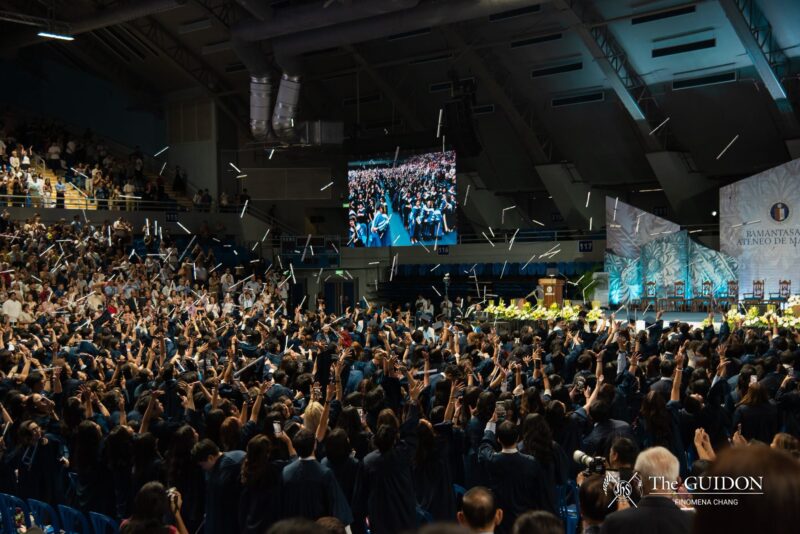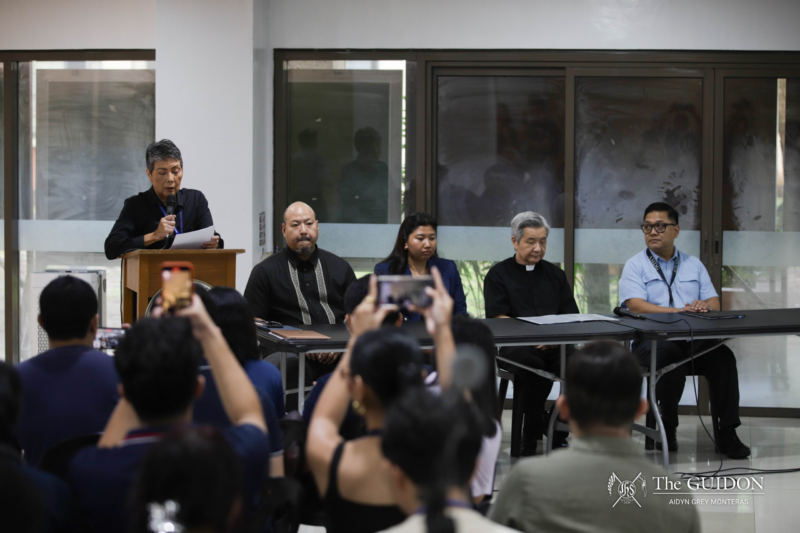
The following is the speech of Shahidul Alam, PhD, the commencement speaker for the Class of 2026 Higher Education-wide Commencement Exercises on June 19 at the Blue Eagle Gym.
Alam is a Bangladeshi photojournalist and activist who documented the struggle for democracy in Bangladesh: protests against the government, human rights abuses, and extrajudicial killings. For these significant contributions to the field of journalism, he was conferred an honorary doctorate in sociology by the Ateneo during the Higher Education-wide Commencement Exercises.
Fr. Xavier Olin, Provincial Superior of Philippine Province of the Society of Jesus; Ms. Bernadine Siy, Chair of the Board of Trustees; Fr. Roberto Yap, University President; members of the Board of Trustees; Dr. Maria Luz Vilches, Vice President for Higher Education; Dr. Czarina Saloma-Akpedonu, Incoming Vice President for Higher Education; Fr. Joey Cruz, former Dean of the School of Social Sciences; deans, University administrators, faculty and staff, the graduating Class of 2026.
Thank you for this honor. I feel blessed to be here.
Before I begin, I want to acknowledge where we are standing. The Philippines is still absorbing a 7.8-magnitude earthquake. People are displaced, homes are damaged, communities are in pain. Some of you in this room may have family caught in that. If so, you carry more than a diploma today. I share your pain.
This community is also grieving its own. Divine Adili was a sophomore on this campus–he already made friends here. Rene Baterbonia was the joy and pride of Ateneo de Davao. Both were taken from us far too young. Their families are living through something that has no adequate words.
I considered whether this is the right moment for a speech. I believe it is. What I want to say to you today is precisely about what we do with our gifts in a world that does not always give us time.
I want to begin with a word.
A Greek word that sits at the heart of this University—the word that names one of its most distinctive buildings just across the campus.
Areté.
It means excellence, but not excellence as a certificate on a wall or a title on a business card. Areté is virtue in action, a capacity exercised, a life lived at the full height of its possibility. The designers of that building also noted that, in French, arête is the name of the narrow peak of a mountain ridge—the sharp line that divides two valleys, a peak between two valleys. That word resonates in this particular room.
A gym is not a place for comfortable contemplation. It is not a place for theory or for certificates. A gym is where you find out what you are actually made of—where the distance between potential and performance becomes measurable, where discipline is not a concept but a daily practice, where you discover what you can do when you are prepared to accept pain.
This room has seen champions made. But the Blue Eagles did not become champions by admiring excellence from a distance. They became champions by showing up, by training when it was hard, by choosing the difficulty on purpose.
It also held grief. Divine trained in rooms like this one. Rene was the kind of athlete who made his teammates better. Before we talk about what excellence demands of you, we owe it to them to say their names here—in a space like this one, where effort and courage are understood. Divine Adili, Rene Baterbonia, may the work you do with what you have been given honor them. And this room, this gym, this space of honest effort, may be exactly the right place to ask what it demands of you now.
Soon, you will hold a parchment. You have worked for it, and you deserve this moment: the photographs, the embraces, the families who sacrificed to put you in this gym. All of it is real, and all of it matters.
But before you frame the degree and hang it on the wall, I want to ask you something. What does success mean? A well-paid position, a mortgage, a settled life, a family, a nice car, the latest phone? Is that it? Because if that is the full answer, if the entire weight of this formation, this tradition, this institution that carries the word areté at its heart, produces nothing more than a comfortable life for people already positioned to have one, then something has gone wrong. Not with you, but with what we told you excellence was about.
This gym carries the name of the Blue Eagle, the University’s mascot since 1938, chosen as a symbol of what The GUIDON called “the highest realms of truth” and described simply as “a fighting King.”
In that same year, an 18-year-old man named Raul Manglapus wrote a song for it: “Blue Eagle, the King,” sung at a convocation, immediately and unanimously approved. Raul went on to become a guerrilla fighter, a senator, a foreign minister. He fought the Japanese occupation. He went into exile under Marcos. He came home. He kept fighting, and the song kept singing.
The eagle they chose in 1938 also appeared on the seal of the United States. In those days, that association carried authority, even promise. I wonder what it means to invoke the guardian of liberty today when the country that put the eagle on its seal is supplying the weapons that have killed tens of thousands of civilians in Gaza, when press freedom is under systematic assault, when contempt for accountability has become a governing style.
The Blue Eagle is not the American eagle. It was claimed by this community for its own purposes: for truth, for conscience, for excellence that serves something larger than itself. That distinction is yours to defend.
Let me tell you a small story. I had left home as a teenager and returned 12 years later, wanting to know my parents as adults rather than as authority figures of my childhood. Both sides would have to bend. I was willing to try. My parents were progressive people—thoughtful, generous, publicly engaged. And yet, like many families in Bangladesh, they kept a young boy as home help. His name was Mizan. Unremarkable by the standards of the society around us, but the discomfort of it never entirely left me.
Mizan loved a popular Turkish television series, “Sultan Suleiman.” It was my father’s favorite, too. Each evening, the family would settle into the drawing room to watch, and Mizan would watch from the hallway, just outside the open door. Close enough to see the screen, far enough to know his place. We sat a few meters across and a world apart. I photographed him there, in that doorway, and later published the image in Drik’s Calendar. I gave a copy to Mizan and a copy to my mother.
The next evening, Mizan came inside and watched television with us. I do not know if anyone had told him he could. I do not know if anyone had told him he couldn’t. What I know is that a photograph, a simple act of witness, had made visible something that everyone in that house already knew, but had agreed not to name. And once it was named, the arrangement could not hold. That is what I have spent my life trying to do: to make certain things impossible to unsee.
My parents were good people. They were also, in that one quiet corner of their lives, participants in an injustice so ordinary it had become invisible. The photograph did not accuse them; it simply showed what was there. Goodness is not enough. Goodness requires seeing. And seeing requires the willingness to look at things that are uncomfortable to look at, including the arrangements in your own house.
I say this to you here, in the Philippines, with particular intention. Your country sends millions of its people abroad to work, to build other nations’ cities, to care for other nations’ elderly, to raise other nations’ children, and, yes, to keep other nations’ homes. Many of them sit in a drawing room not so different from ours in Dhaka. Many of them watch from a similar distance. They are not invisible because they are unknown; they are invisible because it is convenient for them to be. What you do with this education—whether it extends its reach toward them or turns away—is one of the central moral questions of your generation.
Why am I standing here? I’m a photographer from Bangladesh. I’ve spent my life in the company of people the world tries to make invisible: garment workers, migrants, the displaced, the disappeared. I’ve pointed my camera at extrajudicial killings, at the struggles of indigenous people, at the faces of people caught in crossfire, literal and political. I’ve been abducted, tortured, and held in a cell for over a hundred days by a government that feared the pictures I was taking and the words I was saying.
On the fifth of August 2018, security forces came to my home. I was blindfolded and handcuffed and taken away. I did not know if I would come back. Six years later, to the day, the fifth of August 2024, that same government fell. The dictator who had ordered my arrest fled the country by helicopter. I was on the streets when I heard the news. Minutes later, the police had opened fire on our group. When the news broke, I was being garlanded by people celebrating in the streets.
Sit with that for a moment, because it says something about the nature of power that no speech can quite capture. The day they came for me became the day they were gone.
I have also returned an honorary doctorate. The University of the Arts London offered me one, which I was happy to accept in the grand surroundings of the Royal Festival Hall. Later, when their chancellor turned on their own students for their solidarity with Palestine, I gave it back. I cannot claim causality, but the chancellor did step down.
I sailed on the Freedom Flotilla—a civilian vessel called Conscience—carrying journalists and medics, attempting to break the siege of Gaza. The Israeli military arrested us in international waters and took us to a high-security prison. But the flotilla did what it set out to do: it raised a global protest that could not be ignored.
When the next flotilla was organized, I intended to go again. A fractured elbow during a photoshoot in China meant I could only see the vessel off from the coast of Sicily. This time, we had our own ship, and the flags of Bangladesh and Palestine flew side by side. That vessel, too, was seized. Jubair Khan, whom I had waved goodbye to from the shore, came back with a broken rib. Those associated with the flotilla are being persecuted, but the resistance it has mobilized is unlike anything before it.
Yesterday, I flew in from Washington, D.C., where I had been as an Explorer-at-Large Emeritus of National Geographic. I wore my keffiyeh at U.S. immigration and throughout my trip. I knew there was ICE, and there were risks, but I knew what I had to say.
I tell you these things because you [should] know what kind of a troublemaker this University has invited to speak at your graduation. Ateneo knew. I believe they invited me for a reason.
When you leave this room today, you will carry a credential that opens doors. This is real, and it matters. But credentials do not tell you which room to walk into or what to do once you’re inside. My question for you? Not what you will achieve, I have no doubts about that. What you will refuse to do, refuse to look away from, refuse to go along with, because something in you says no.
Edgar Jopson studied here. He gave up what this education could have purchased for him because he believed certain things mattered more than personal advancement. He was killed in 1982. Thirty-five years old. I’m not asking you to follow that path. I’m asking you to take seriously the question his life implicitly posed: what am I willing to do with what I’ve been given?
Rizal wrote Noli Me Tangere and El Filibusterismo not primarily as literature, but as arguments about what his people owed themselves, about what it costs a society to look away from its own condition. You studied those books in school; they’re not historical documents. They’re instructions.
Raul [Manglapus] refused collaboration with the occupation, refused silence under dictatorship, refused to stay comfortable when comfort required complicity. He also never stopped writing songs.
Areté is not only about how high you soar. It is also about what you refuse to drop when the air gets thin. The young people who brought down our government were students. They had no army, no party machinery, no international backing. They had each other, and they had the refusal to pretend that what was happening was acceptable. Several of those who led the movement are now in parliament. What I see in them, more than strategy or ambition, is a refusal to pretend that what happened doesn’t matter or what comes next is someone else’s problem. They claimed their moment, not because they were ready, but [because it was] theirs. Yours is coming.
Arête, the sharp line between two valleys. You stand on that line today. On one side, the valley of what you were trained to become. On the other, the valley of what the world will ask you to be. The Blue Eagle soars into “the highest realms of truth” and knows no fear.
I don’t think they meant that Eagle has no fear. I think they meant it flies anyway. That is what I want for you. Not fearlessness. I want for you the kind of courage that flies when it is afraid. That holds the camera steady when the hands are shaking. That makes visible what others have agreed not to name. That says what needs to be said in the room, where it needs to be said, even when the room goes quiet.
The world is where it is because world leaders choose to be complicit, because of fear or for material gain. The world will become what it can because young people refuse to unsee. Because they choose to say no.
And when you find yourself in a drawing room, and someone is watching from a doorway, don’t pretend you don’t see. Take the photograph.
Mabuhay.