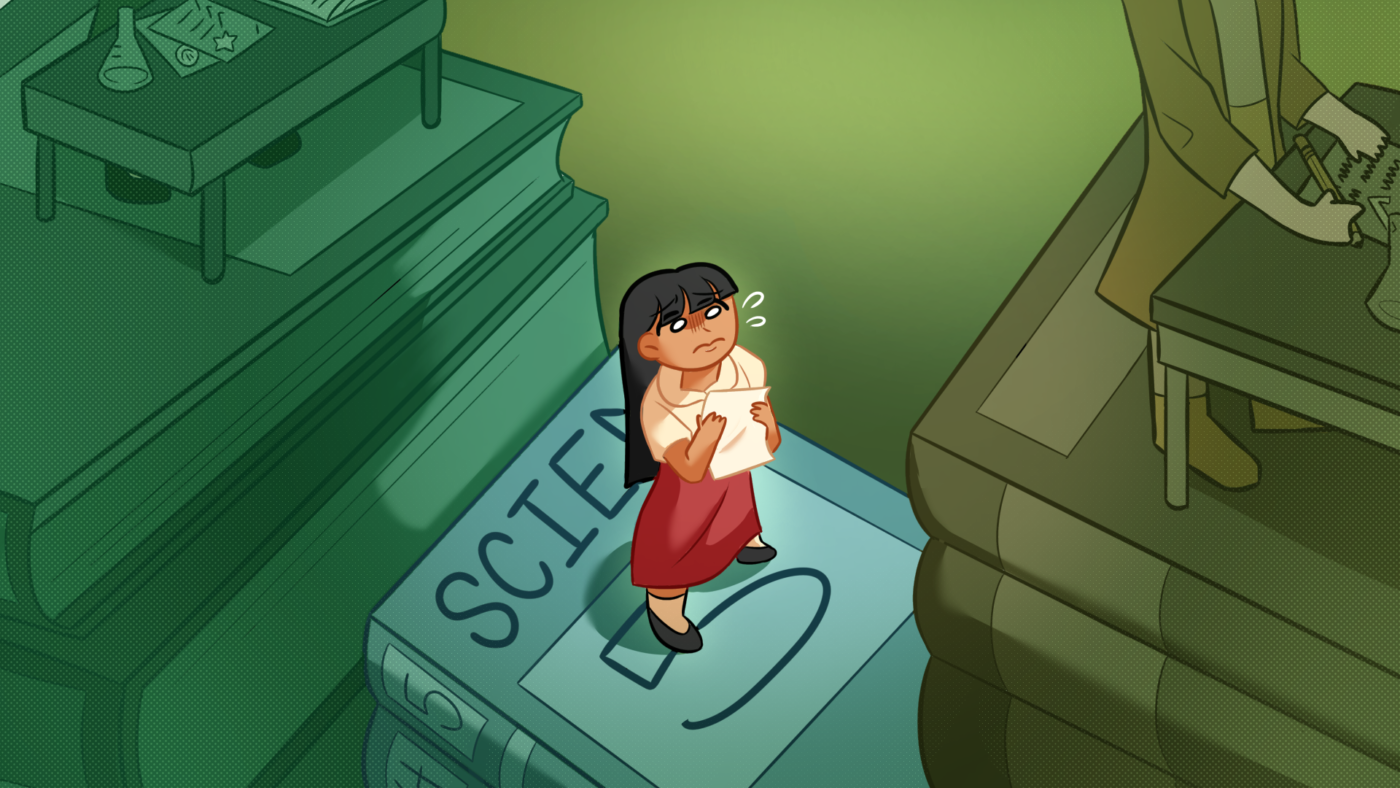
THE LATEST report by the Second Congressional Commission on Education (EDCOM 2) warns of a nationwide “proficiency collapse” beyond what Filipino students fail to learn in class.
The report further revealed that academic performance measurements, such as the transmutation grading system, indicated plummeting foundational skills in basic literacy and numeracy, underscoring the importance of holistic reforms for student welfare.
Behind the curtain
According to EDCOM 2, as much as 88% of students across all grade levels are not “grade-level ready” in literacy and numeracy proficiency at the beginning of the school year. While the Early Language, Literacy, and Numeracy Assessment described around 30.5% of Grade 3 students as “proficient to highly proficient,” the number dropped to 19.56% in Grade 6.
The 2024 Southeast Asia Primary Learning Metrics linked these outcomes to socioeconomic status, stating that low socioeconomic status remains the “strongest predictor of achievement, with gaps equivalent to up to two years of schooling.”
Reinforcing this finding, Filipino learners from poor households underperformed compared to their wealthier counterparts. EDCOM 2 explained that these learners are more likely to be in underresourced and congested schools in rural areas, where alternative educational modalities are unavailable, and where teachers have limited training or support.
Additionally, 42% among the poorest students are chronically undernourished, disproportionately impairing cognitive development, and providing the connection between welfare and education.
Compounding these social conditions are frequent class suspensions and excursions, which were also found to have lasting effects on student academic engagement. As such, students’ advancement through grade levels raises broader questions on how academic performance is assessed.
A numbers game
While perennial troubles in education remained unaddressed, policies such as transmutation grading complicate systemic issues. Contrary to its objective of reducing failure rates, it has instead allowed students to climb the educational ladder regardless of competency and mastery.
Alongside the K-12 program, the transmutation grading system was adopted to encourage progression and remain compliant with national education standards. Under this directive, raw percentages were converted to a corresponding final mark. This includes translating a considerably failing grade of 60 to meet the bare minimum passing grade of 75% for students with unsatisfactory performance.
With this system, the final grade stated on paper becomes a less accurate reflection of students’ actual performance. EDCOM 2 described and criticized this practice as “mass promotion,” in which students advance to the next grade level despite narrowly accomplishing academic requirements and exhibiting poor mastery of basic competencies.
Department of Education (DepEd) Secretary Sonny Angara refuted such claims, citing the influence of “human nature” for advancing struggling students to the next grade level. When students get failing remarks, teachers shoulder the blame from school heads and parents. Such a normalized practice creates a vicious cycle, where both teachers and students are caught in between an institutional policy breakdown.
The repercussions of obscuring these learning gaps, particularly through “mass promotion” activities, become apparent later on when students underperform in key proficiencies expected from their standing. As per EDCOM 2, this scheme “dilutes the diagnostic value of assessment and hinders accurate targeting for interventions.”
From a national perspective, the transmutation grading system widens the gap between the Philippines and its goals of delivering quality education, producing students who fail to translate class marks into concrete competencies.
Correcting the crisis
The persistence of “mass promotion” reflects a deeper problem in Philippine education: learning gaps are obscured as students advance grade levels despite learning deficiencies that remain unaddressed.
In reality, educational outcomes stem from social and economic factors that require deeper, holistic reform. Aligned with this is the EDCOM 2 endorsement of supporting early childhood development, addressing shortages in guidance and mental health personnel, and strengthening parenting and family support to improve learner well-being.
When schools are allowed to hide behind inflated outcomes, broader policy gaps in student wellness, engagement, and proficiency continue to leave students from the most marginalized backgrounds behind.
As students pass through learning levels without the necessary competencies, underlying problems are deferred to the future: higher education stretches already limited institutional resources, and working environments increasingly promote technical and cognitive skills for economic gain.
Ultimately, until policy shifts from prioritizing promotion on paper to practiced proficiency, the country risks an entire generation of graduates equipped to pass through the basic education system but unprepared to succeed within it.