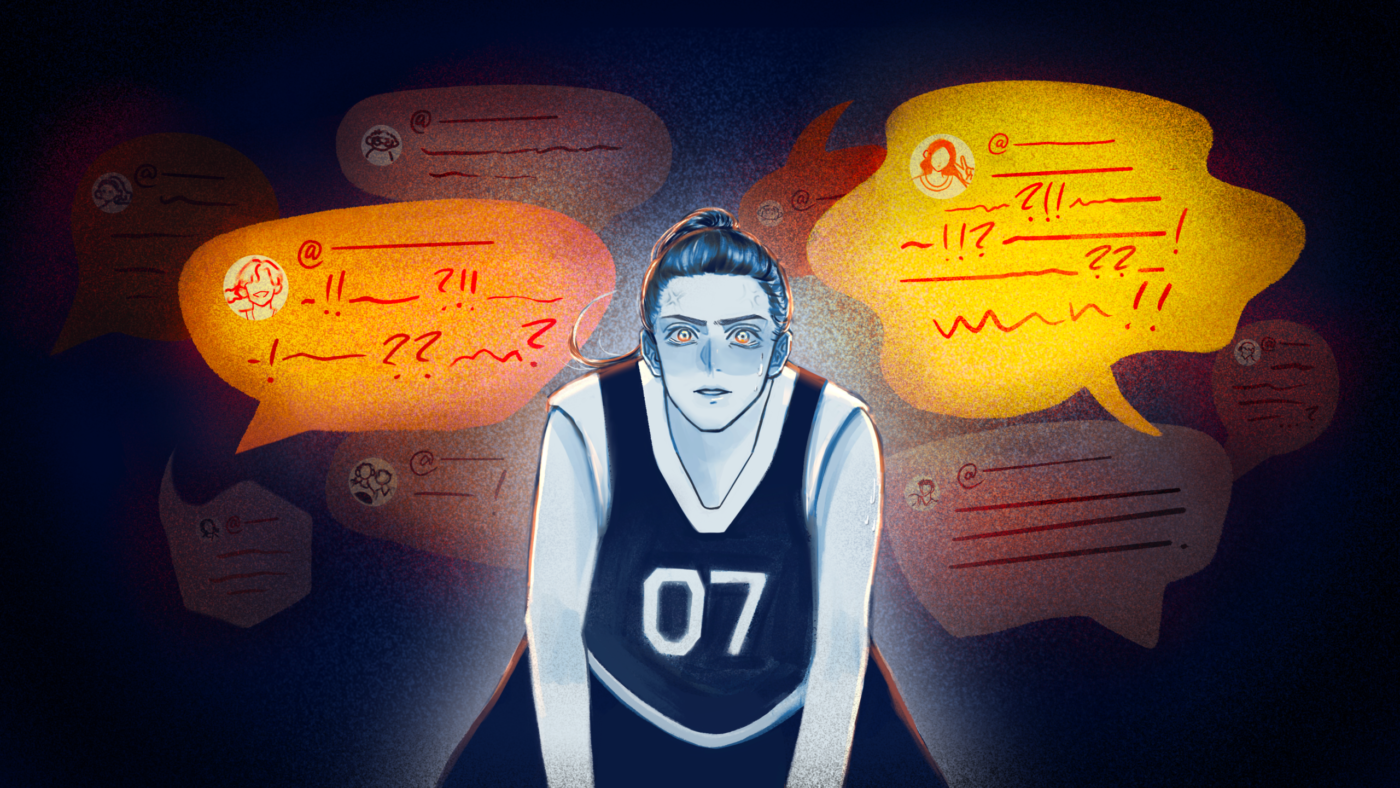
WHEN SOCIAL media became a staple in the digital world, it opened new avenues for fans to engage with sports through replaying game highlights, forming narratives, and sharing opinions online. Consequently, the rise of digital platforms created opportunities for fans to engage with athletes through posts and comments.
Today, the relationship between social media and athletes has become central to how sports stories are told and discussed. In this space, public opinion circulates rapidly, often blurring the line between analysis and anonymous commentary. While social media has created new opportunities for sports, it is also frequently used to express criticism over undesirable outcomes rather than constructive discussion.
By the second
Recent years have shown that becoming a player in the digital age is not just about athleticism or abilities anymore. Online platforms have built the idea of the “expendable athlete,” where they become the center of public attention and excessive criticism. Players are no longer judged by the full scope of their careers, but by shifting narratives constantly changed by each viral moment.
The influence of social media has not just changed how fans engage with sports, but also how they consume it. Fans around the world have switched from watching full games to seeing every exciting moment packaged and ready for the viewer through highlights and recaps.
The number of viewers preferring short-form content has also continuously grown by the year, with 75% of the current generation turning to social media content on YouTube, TikTok, and Instagram reels to catch the biggest plays, stories, and takeaways.
With increased engagement enabled by the internet, fans have freely given praise or criticism to their favorite players as fast as they could type, contributing to a culture in which players are treated as expendable. In effect, these athletes are no longer viewed solely as strong competitors in their craft but have seemingly been reduced to mere viral stars online.
Thus, the spotlight placed on these athletes has allowed for netizens to become key contributors in shaping stories surrounding them. Given the surplus of narratives from different platforms, criticism of players has also become the norm in Philippine sports, especially in the collegiate scene.
Ateneo student-athletes are no exception to this phenomenon, given their heavy presence around the University Athletic Association of the Philippines (UAAP) scene and the larger-than-life players that have graced the Blue and White.
In the UAAP Season 81 Men’s Basketball Tournament, then-freshman Ange Kouame was subjected to blatant criticism following an altercation with a University of the Philippines (UP) Fighting Maroon. Even with the uneasiness of the UP crowd booing at Kouame, many netizens voiced their thoughts on social media, with some comments straying far from the game and more as an attack on the Blue Eagle.
At the moment, all eyes were on Kouame, who received help from his Blue and White brethren in addressing the media. While the dispute passed on like nothing happened, for “expendable athletes,” these moments sting longer than online critics realize.
The experience of cyberbullying has had real consequences on these student-athletes. Whether it is identity reduction, distorted public expectations, or simple online harassment, the effects of social media do not simply go away over time—they stay with the players for their entire careers.
Steering the narrative
When social media takes control of narratives instead of allowing the game to happen, the conversation stops being about sports and invites targeted criticism so long as the story sees fit. Short-form clips produce narratives that fans could easily build upon, even without witnessing the entire match. As such, social media has treated these athletes as no longer human, but as talking points for gossip.
Recently, social media has served as a platform for athletes to be denounced for their character, rather than their athletic performance. This is seen in the harsh comments faced by Taks Fujimoto following the Ateneo Women’s Volleyball Team’s winless start for Round 1 in UAAP Season 88.
Additionally, former Blue Eagle libero Dani Ravena gained flak over her performance as a professional player for the Akari Chargers in the Premier Volleyball League. As a subject of constant judgment, fans have framed her inclusion in the team as a result of her mother being the manager. Ravena addressed the issue through social media and post-game interviews by acknowledging her worth and choosing to believe in what her teammates and coaches tell her instead.
While criticism is usually directed at a single player, it can also affect the performance and mental stability of the entire team, especially when attention shifts toward negative comments found online.
Sports psychologist Justine “Juju” Joseph, who works with the Ateneo’s University Athletics Office (UAO), noted that pressure always exists in sports and emphasized the adverse effects of both fans and social media.
For instance, fan approval may influence an athlete’s confidence. If they receive negative critiques, Joseph explained that this may significantly affect their performance and shape team dynamics. In this regard, she stressed that spectators play a pivotal role in influencing athletes through online commentary.
Given the accessibility of social media, fans have gained the ability to frame athletes as expendable based on viral clips, shaping perceptions that may affect team performance and mental well-being. Thus, fans risk contributing to a hostile environment that places athletes on a pedestal and equates success solely with victory.
New age, new mindset
As a transformative digital landscape, social media has become an echo chamber for fans to generate negative perceptions. These framings become tantamount to harmful behaviors that consistently expose athletes to ridicule and scrutiny. Hence, this warrants the demand for fans to become more responsible and reflective when expressing their opinions.
Joseph’s work in the UAO has been centered around aiding Ateneo student-athletes in both mental performance and internal work. She stated that players might link their sense of identity to what fans and spectators say about them online. Hence, Joseph approaches these ordeals by discussing what is within and beyond their control and developing trust in their own capabilities.
“At the heart of my philosophy, [the players] are not just athlete[s]. I look at them as a whole person,” Joseph expressed. In an effort to become more empathetic towards players, fans must therefore recognize that athletes are human beings bound to make mistakes, endure losses, and display off-game performances.
With the pervasiveness of social media, Joseph calls on fans to express criticism with more understanding and compassion and to view players not merely as athletes but as human beings. “Your words have power, [so] let’s use our words to lift people up rather than bring them down,” she conveyed. Through these practices, fans can also reflect on their online behavior and reassess how they are showing support to athletes.
Social media provides fans with a platform to express opinions on athletes and teams alike, but an intricate line must be drawn between constructive criticism and offensive clamor. Thus, upholding healthy discourse in digital spaces must be practiced to ensure that sports culture remains a safe space not only for spectators without the full story but also for athletes who strive to perform their best in front of a crowd.