AS TOURISM steadily grows throughout the country, public and private developments have been pursued to better support foreign and local visitors. However, this expansion of tourism was not without its impacts, especially on the lives of vulnerable communities.
In 2024, tourism contributed an estimated Php 3.5 trillion to the Philippines’ gross value added, reinforcing its role as one of the country’s strongest economic pillars. However, this growth has also led to the loss of livelihood for some Filipinos. Indigenous communities risk losing access to ancestral homes, while coastal groups dependent on fishing find their livelihoods restricted.
For every resort that opens its gates to visitors, another community finds its access quietly narrowed. Behind tourism’s promise of national prosperity lies a harsher truth: its rapid expansion has deepened the gap between economic gain and the well-being of the very people it claims to uplift.
Growing in numbers
In 2025, the country welcomed 6.5 million tourists, higher than 5.95 million in 2024. The tourism sector also accounted for almost 20% of the economy, supporting 11.22 million livelihoods, which placed the Philippines first among its Association of Southeast Asian Nations neighbors.
The industry has also been recognized internationally, receiving awards with six titles in 2025, with the Department of Tourism being awarded Asia’s Leading Tourist Board.
Despite these strides, tourism in the Philippines has yet to return to its pre-pandemic momentum, as arrivals in 2025 are still 37% below the 8.26 million arrivals in 2019. According to travel advocates and industry leaders, this is due to an “inadequate infrastructure.”
To address such problems, the public and private sectors have been pursuing projects in developing tourism infrastructure to fill in the gaps. These include the New Manila International Airport in Bulacan, the Bugsuk Eco-tourism Project in Palawan, and the Samal-Davao Connector in Davao.
These projects aim to promote sustainable leisure, support the economy, and advance the Philippines’ position as a top tourist destination. Still, sustainability becomes a fragile promise when those living on the land were never asked if they agreed to these major changes.
While these changes promise a more accommodating Philippines through better tourist infrastructure and experiences, the question now is for whom this growth is for: the communities or the country?
Illusion of beauty
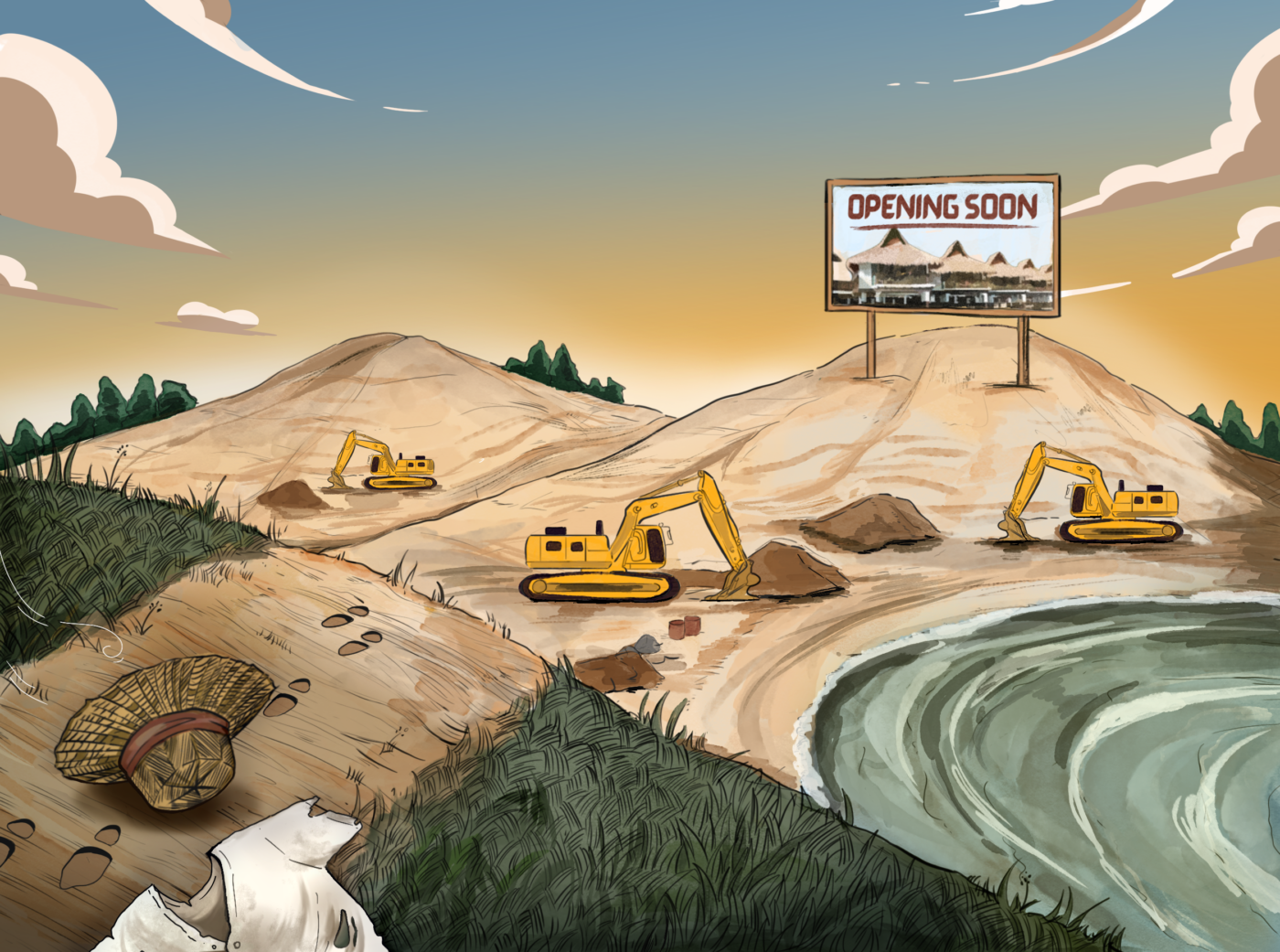
As the tourism projects progressed with construction, affected communities faced detrimental impacts from such developments. Exemplifying this, Bulacan focused on the construction of a new airport, which displaced 700 families and livelihoods in Barangay Taliptip.
Some residents have also been directed to demolish their own houses for cash incentives, showcasing the blurred line between consent and coercion in development projects. While some people have been able to return to Barangay Taliptip and fish once more, they face greater risks as the development has left lasting impacts on the environment, such as higher tides and greater floods.
Apart from these challenges, the impact of the development has trickled southwards. Mussel farmers in Navotas confront the loss of income as their tahungan were removed to support the new aerotropolis up north.
On the other hand, the Molbog and Cagayanen people in Palawan have continuously faced violence from security forces to facilitate the development of San Miguel’s ecotourism project in Bugsuk.
Meanwhile, fishermen and marine ecology alike in Davao face the looming threat of the Samal Island–Davao City Connector, as coral reefs have been extensively damaged from where the crane way was built, despite the public works agency asserting that the damage would be minimal.
The irony is difficult to ignore: projects justified by natural beauty begin by eroding the very ecosystems they market. The promise of economic growth then becomes hollow when those at the margins are left to shoulder its costs.
Community before profit
With tourism in the Philippines being driven by expansion, global examples show that growth does not have to come at the expense of communities. Alternative models demonstrate that tourism can both be economically viable and socially just, especially when local residents are placed at the center of planning and decision-making.
An example of this would be Waiheke Island, where residents are able to manage visitor caps by controlling access through ferry capacity, among other practices.
Similarly, the Algarve also prioritizes long-term strategies on environmental conservation, support for small and medium enterprises, and protecting local heritage. This ensures that economic benefits continuously circulate within the region.
These models offer clear lessons for the Philippines, where inclusive tourism would mean institutionalizing meaningful community consultations before approving large-scale projects. For the country’s future, adopting similar models would demand structural changes such as stricter social and environmental safeguards.
However, the Philippines faces larger population pressures, deeper income inequality, and heavier reliance on tourism-generated employment. With such a context, imposing visitor caps or even slowing expansion is not merely a policy adjustment—it carries political and economic trade-offs that policymakers may be reluctant to adopt.
If tourism is to remain a pillar of national development, it must also become an avenue for protecting communities that sustain it. Safeguarding ancestral lands, ensuring fisherfolk retain access to their seas, and guaranteeing that host communities share tourism profits should not be optional—they should be non-negotiable foundations.
At the end of the day, a thriving tourism industry cannot exist without thriving communities. True development lies not only in building resorts, but also in preserving homes, livelihood, and dignity.