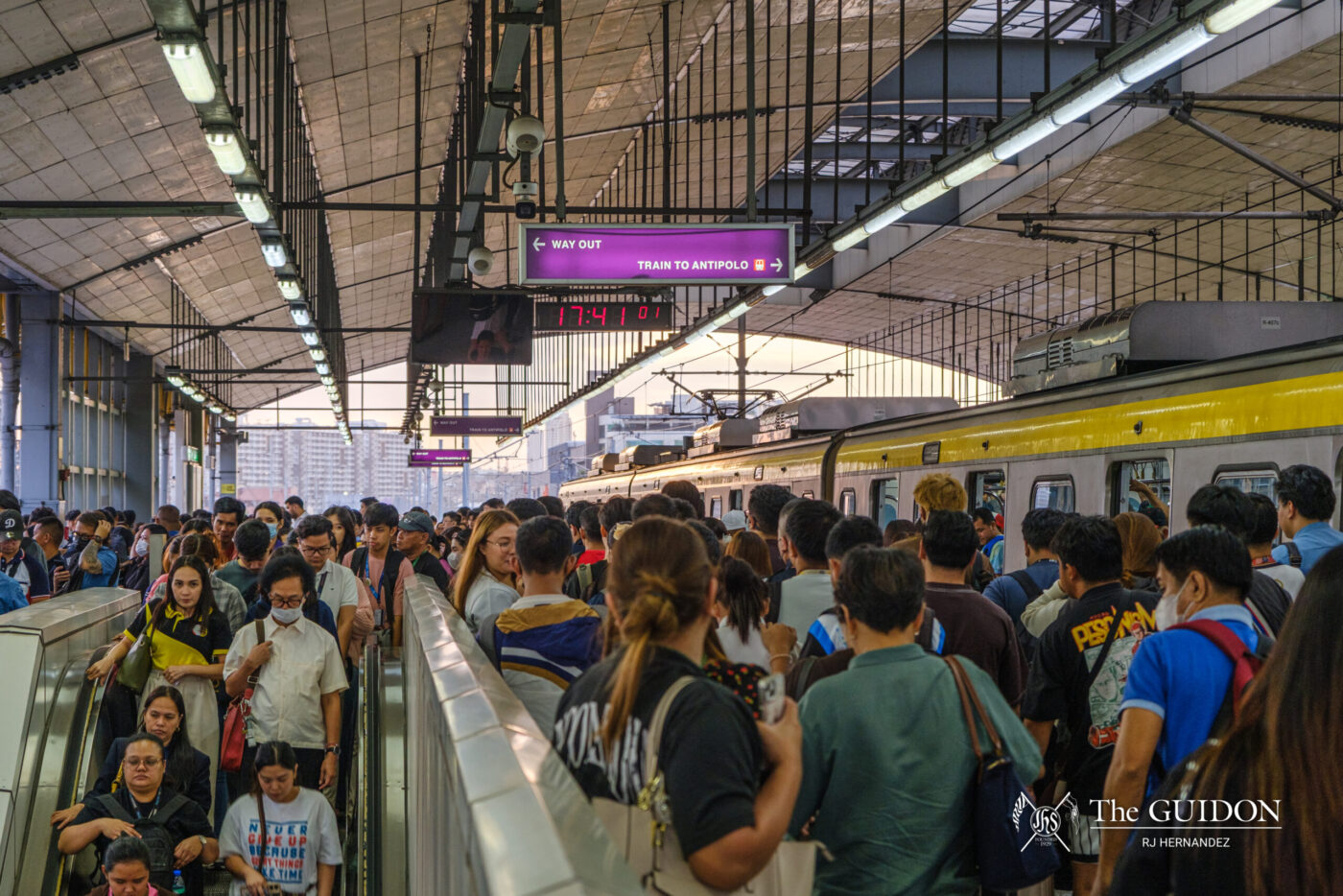
MASS TRANSPORT is meant to move large groups of people efficiently across dense urban centers. In Metro Manila, where roughly 70% of residents rely on public transportation, it is the backbone of daily life.
With the Department of Transportation (DOTr) pushing for the launch of new railway projects in 2027, the government has framed expansion as the answer to the nation’s mobility woes. Yet, amid ambitious goals, accessibility for persons with disabilities (PWDs) has been relegated to the margins, much like the sector itself.
Built to exclude
A 2023 Rappler accessibility audit revealed that up to 80% of Metro Manila’s rail system remains inaccessible to PWDs, revealing the extent of their exclusion from safe and independent access to public transportation. While Batas Pambansa Blg. 344, or the Accessibility Law, sets standards to ensure PWD access to the built environment, commuters’ experiences suggest uneven compliance with those requirements.
Resources for the Blind Inc. Program Assistant Bless Adriano noted that inaccessibility starts at transport terminals, where waiting sheds are scarce, landmarks are limited, and audio cues to guide the visually impaired are absent. “Most of the time, kinakailangan namin ng (we need a) sighted companion,” she said about the near impossibility of independent travel as a person with a visual impairment.
She also observed that digital systems present challenges, with platforms such as the Beep app only partially accessible to PWDs. In her account, inconsistent assistance training among conductors, attitudinal barriers, such as people insisting that PWDs should not travel alone, and safety concerns for PWD commuters persist.
Meanwhile, Committee on Accessibility of the United Architects of the Philippines Chair Architect Armand Eustaquio argued that these recurring accessibility failures reflect persistent attitudes within the government. He noted that, four decades after the passing of the Accessibility Law, authorities still fail to understand its purpose. “[The] underlying intent [of the law] is independent mobility, [not] assisted mobility.”
He cited cases in which inaccessible designs, such as the steep ramp at the EDSA Vertis bus carousel station, prompted proposals for personnel to push wheelchair users instead of redesigning the structure, reflecting gaps between legal standards and their implementation in public infrastructure.
When access costs more
The mistranslation from law to infrastructure incurs additional economic and social costs for PWDs. For Adriano, the failure to support independent navigation affects her logistical decisions and social participation.
As a visually impaired commuter herself, Adriano often requires a companion to navigate convoluted routes—a difficulty shared by PWD commuters. “Kailangan laging pang-dalawang tao ‘yung pamasahe mo (You always have to pay for two people’s fares),” she explained, highlighting how the need for assistance doubles commuting costs.
Without accessible routes, she added, many must factor in extra hours to find navigable paths or coordinate with a sighted companion. Even when ride-hailing services are used, the distance from drop-off points to building entrances can make attending an event impractical.
As an alternative to the stopgap option of ride-hailing, Eustaquio cited tricycles with accessible designs as a potentially flexible option for independent mobility, especially in municipalities or barangays far from city centers.
He described some tricycles with rear doors that fold down into ramps, allowing a wheelchair user to board without constant assistance. However, he pointed out that these innovations remain rare and inconsistent due to the absence of formal standards in public transportation.
While the Accessibility Law mandates PWD accessibility, including public transport, its implementing rules provide only minimal requirements, such as designated seating in mass transport vehicles. As Eustaquio noted, the DOTr has yet to issue comprehensive rules for how buses, jeepneys, tricycles, and other public vehicles should be designed or modified to be fully usable by PWD commuters.
Without enforceable design criteria, practical alternatives that could alleviate the time and financial burden for PWD commuters remain confined to isolated examples rather than a systemic solution.
Freedom in motion
Underlying these shortcomings in design are attitudinal gaps in policy. Eustaquio traces them to the medical or charity model of disability, which treats the individual as the problem. By contrast, he spotlights the social and human rights model, which locates the problem in the design of facilities and services.
He asserted, “Yung problema ay built environment, hindi ‘yung tao na may kapansanan. So ang tama sana gawin, itama yung facilities” (The problem is the built environment, not the person with a disability, so what should be done is to fix the facilities).
Building on this, Eustaquio operationalized a social- and human rights-based model for public transport infrastructure through co-design and participatory planning, emphasizing the involvement of PWDs and other stakeholders across an entire project life cycle.
Beyond awareness and attitudinal change, Eustaquio emphasized the need for institutionalized feedback mechanisms to ensure accessibility and accountability in every stage of transportation projects. This includes feedback loops, accessibility audits, and ride-through inspections to catch barriers before projects are finalized.
Echoing this, Adriano stressed that the most immediate change must come from a shift in perspective. She noted that awareness among transportation personnel and decision-makers can transform how PWDs are perceived and treated in daily commuting.
“Kapag hindi aware ‘yung mga tao (When people are not aware) that we [PWDs] can definitely travel independently and we also have the right to travel safely and securely, hindi rin magbabago ‘yung (no change will be made in the) infrastructure,” she expressed.
Ultimately, the additional costs shouldered by PWDs reveal how current infrastructure and policies fall short of supporting independent mobility. The metric of success, then, does not lie in mere technical compliance with existing accessibility regulations but in the ability of PWDs to navigate public transportation safely, efficiently, and on their own terms.