AS TURBULENT weather continues to plague the country, class suspensions become part of everyday student and faculty life. With this, the Department of Education updated its class suspension guidelines, mandating schools to identify Alternative Delivery Modes (ADM) to sustain learning amid disruption.
Within the Ateneo, debates on balancing academic continuity and community safety intensified after the University shared the Coordinating Council of Private Educational Associations’ (COCOPEA) statement calling for “flexibility” in implementing class suspensions.
However, the implications of this stance extend beyond the classroom setting and to the campus workers who support student and faculty campus experience. This position thus situates the University within a broader discussion on how higher education institutions interpret and apply government guidelines, as well as how prioritizing academic continuity affects their workers during adverse weather.
Policies on paper
On January 2025, a Second Congressional Commission on Education report found that up to a month’s worth of school days were lost in AY 2024–2025 due to class suspensions, causing “significant learning losses.” In the first semester of AY 2025–2026 alone, the Ateneo has already declared eight class suspensions.
The Ateneo’s declaration of class suspensions is primarily guided by government policies that the Higher Education (HE) Cluster must observe during inclement weather, which the University categorizes as “automatic suspensions.”
For instance, under Executive Order No. 66, tertiary-level classes are automatically suspended when the Philippine Atmospheric, Geophysical and Astronomical Services Administration issues a Public Storm Warning Signal (PSWS) No. 3 or higher. More recently, the Department of the Interior and Local Government (DILG) can also declare class suspensions. In cases where such conditions do not apply, the city mayor may instead declare a localized suspension of classes.
The University’s protocols are formally outlined in HE Memo #Y3.15 or the “Revised Guidelines on Cancellation or Suspension of Classes in Higher Education,” released in March 2025. The memo directs a shift to online classes when the PSWS is below No. 3 and assumes government suspensions apply only to onsite classes, unless explicitly specified otherwise.
Meanwhile, Vice President for Higher Education Maria Luz C. Vilches, PhD states in HE Memo #Y3.63 that Course Learning Outcomes must still be achieved despite “disruptions.”
In an email correspondence with The GUIDON, Vilches expresses that the hefty tuition fees were among the many considerations in implementing the current policies focused on learning continuity. “[The Ateneo administration’s] role is for teaching and learning to be continuous amidst disruptions. […] Parents and benefactors are spending so much money on the education of Ateneans. We have to make sure that [the] students’ learning is guarded,” she emphasizes.
Firm on its stance, the University’s public affirmation of the COCOPEA statement was met with student criticisms of the statement’s seeming emphasis on learning continuity over safety, questioning its consistency with the University’s values of cura personalis.
Some argued that the statement’s push for flexibility reflected broader trends of privatization and deregulation in private higher education. On the ground, government agencies have since promoted the use of alternative delivery modes, including online learning, to strengthen the education sector during class suspensions. This approach, however, can risk decontextualizing the unequal conditions affecting the student population and the working staff.
According to Ateneo Employees and Workers Union (AEWU) President Raymond Tano, it is rank-and-file employees who often face the brunt of safety risks during adverse weather conditions. While the Union understands the need to sustain campus operations, Tano remarks that the system often neglects the human cost of such decisions.
From paper to practice
For Atenean staff, the administration’s special work arrangements generally require the continuation of onsite work despite class suspensions.
Vice President for Human Resources Maria Victoria Cortez, PhD explains that, for those who cannot report to work onsite, there is an option to file for an emergency leave, which she clarifies as leave with pay. She adds that as another accommodation, employees whose work is not client-facing, such as office-based roles, may also request to work from home.
For Cortez, these arrangements provide the most effective compromise—upholding employee welfare while ensuring the continued operations of the University.
Cortez also points out that these special work arrangements have been in place since the pandemic, which raised new possibilities in learning modality. She explains that the absence of remote learning systems before the pandemic meant both classes and work were fully suspended, with only a skeleton workforce reporting during extreme weather.
In comparison, Tano recalls that before the pandemic, local government suspensions typically meant that both classes and staff work were paused. Current arrangements, he posits, can place workers in difficult situations—deciding whether to prioritize security at home or report to their duties on campus.
“May mga staff kasi na kahit baha na sa daan, pinipilit pa rin [ang sarili na] pumasok dahil takot mawalan ng sweldo o mapagalitan. Kaya sinasabi namin sa admin, sana mas magkaroon ng empathy at consistency. Hindi pwedeng ibang rules para sa opisina, tapos iba naman para sa maintenance o custodial staff.” Tano shares.
(There are staff members who, even when the roads are already flooded, still force themselves to come to work because they’re afraid of losing their pay or getting reprimanded. That’s why we’re telling the administration that we hope for more empathy and consistency. There shouldn’t be one set of rules for office staff and a different one for maintenance or custodial staff.)
He also observes that the implementation of these arrangements varies across staff units, citing instances where maintenance staff must first confirm the severity of flooding in their areas before supervisors approve emergency leave. This highlights gaps in how policies are experienced by administrative staff vis-à-vis maintenance and custodial workers.
These disparities are reflected in how some offices operationalize flexibility. Mira*, a program secretary, shares that her department’s staff have laptops provided by the school, which they may bring home in light of a foreseeable class suspension. She notes that when forecasts report inclement weather while they are at the office, they are advised to return home and work remotely, sometimes as early as a day before a typhoon.
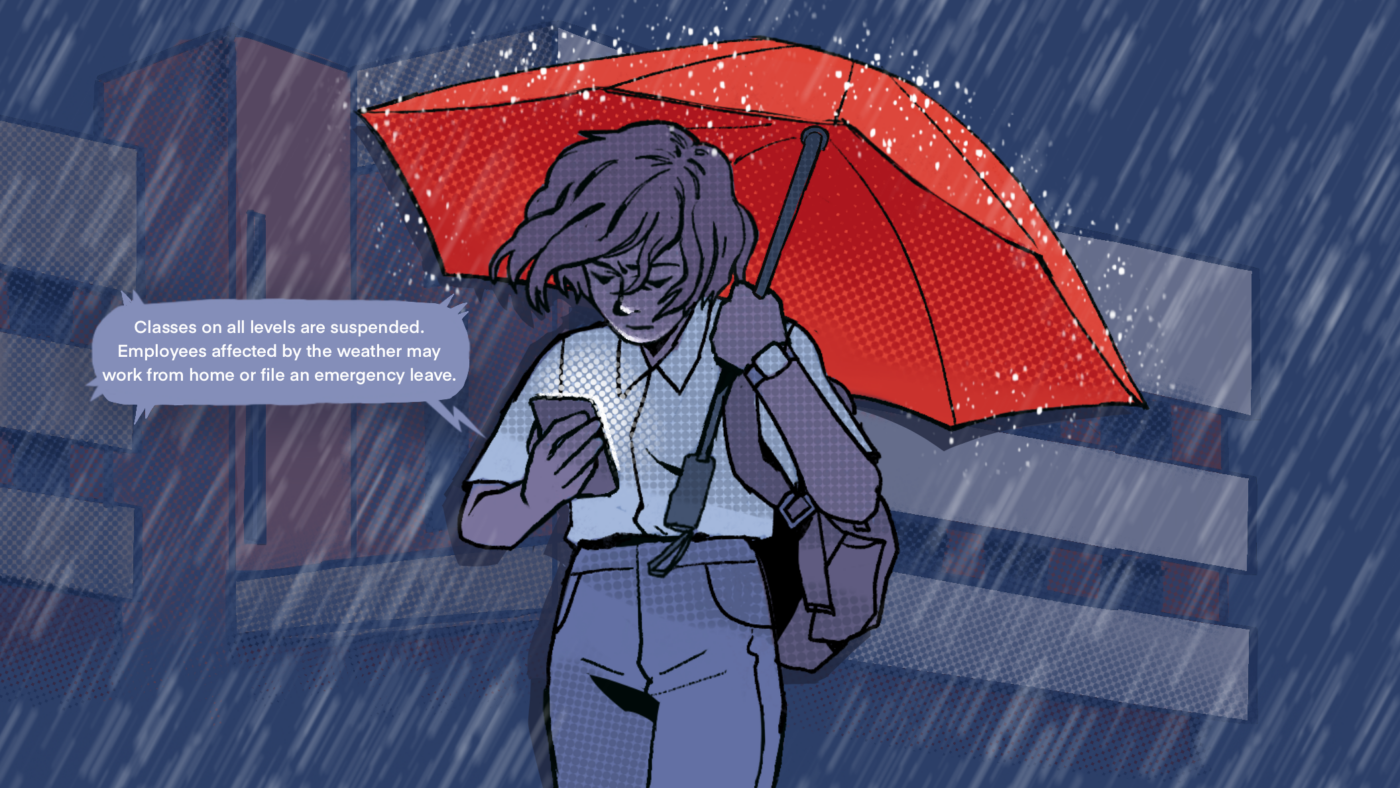
Tano discloses, however, that not all maintenance and custodial staff have regular access to gadgets or a stable internet connection. As such, several employees only find out about class suspensions while already traveling to campus.
“May staff na nasa kalsada na papasok, tapos biglang may post na suspended pala ang onsite work. Nabasa lang [nila ‘yung announcement] sa cellphone sa gitna ng biyahe, kaya madalas may kalituhan at miscommunication,” he describes.
(There are staff who are already on the road to work, when they suddenly see a post saying that onsite work is suspended. They only read the announcement on their cellphone on the way to work, so there is often confusion and miscommunication.)
With this, Mira notes that earlier communication from the administration would help employees better prepare in prioritizing safety.
According to Cortez, work-from-home arrangements are typically decided through the “judgment call of the supervisor,” who assesses the nature of the employee’s duties and whether these can be reasonably performed off-site.
These experiences provide the context for examining how the University reconciles its social mission of forming “persons for and with others” with its operations as a private institution, especially amid the escalating climate crisis.
People-first policies
Following these pressing considerations from the Ateneo community, the University has to grapple with the current state of their weather-suspension policies.
At a broader level, Political Science Instructor Gino Antonio Trinidad, MA notes that creating policies inevitably produces “relative winners and relative losers.” Thus, he highlights that policy design should begin with empathy and credible, up-to-date data about those most affected.
Tano further discusses these affected individuals, saying “Ang Unibersidad ay hindi lang [binubuo ng] gusali o sistema, kundi mga tao rin na nagtatrabaho rito araw-araw (The University is not merely a collection of buildings or systems, but also of the people who work here every day).”
Additionally, Trinidad notes that the administration, workers, and students may have their own interests, but that “the priority is always [physical] safety.”
Without a clear grasp of these on-the-ground realities, Trinidad argues that policies risk being “designed to fail,” hence stressing the need for clarity and consistency in implementing weather-related suspensions. Furthermore, he emphasizes that it must be clearly defined whether the word “suspension” pertains to onsite or online.
In response to these emerging criticisms from the community toward the Ateneo’s suspension policies and work arrangements, Cortez attests and maintains the stance that the University is always looking out for both student and worker needs.
These interests and needs of the target population, Trinidad explains, must be aligned with institutional policy. Through this, institution members can engage in the process of “identification,” leading them to gain a sense of allegiance and togetherness.
Trinidad expounds that this solidarity requires deliberate effort. “Ang ideal ay dapat integrated [ang individual member] sa organization. So much so that […] their interests are aligned,” he remarks.
(The ideal is that individual members are integrated into the organization. So much so that their interests are aligned.)
To address the concerns on the workers’ end, Tano urges the University to open dialogue with AEWU and particularly consider the context of maintenance and administrative staff when they alter policies. In this regard, he believes the emergency leave policy should be standardized by the University and not depend on supervisor approval.
As they are today, school policies attempt to accommodate the frequency and severity of weather-related class suspensions. With the University continuing to reconcile its mission of being a “persons for and with others,” the Ateneo community calls on it to align its long-term solutions on class continuity amid inclement weather with the students’ and workers’ interests.
While the discourse around the true meaning of pro-community rises in prominence, the need for participation and awareness also grows. When student learning and worker welfare are at stake, collaboration between the Ateneo and its community is crucial in the creation of a policy that is not only “resilient,” but also responsive to and representative of the entire institution’s needs.
*Editor’s Note: The name of the interviewee has been changed to protect their identity and privacy.