THOUGH THE Ateneo grounds itself in faith, justice, and solidarity with the poor, its institutional decisions and practices, instead, reveal the prevailing weight of privilege on the hill.
This privilege manifests within the University as it continues to align itself with numerous institutions and corporations known for contentious values. As these instances still occur, questions about the University’s long-standing reputation as a breeding ground for the elite are thrust into the spotlight.
Paradoxes on the hill
Elitism is defined as “the belief that some things are only for a few people who have special qualities or abilities.” Yet, according to Political Science Professor Anne Lan K. Candelaria, PhD, elitism only occurs when an institution gatekeeps processes and policies to maintain exclusivity. Such policies, she stresses, serve as an indicator that a university reinforces an existing social hierarchy.
While the Ateneo’s international rankings make the University elite, Candelaria argues that the institution does not necessarily practice elitism. In particular, she points to the holistic nature of the admissions process, which includes other variables such as essays and recommendations, as proof that the Ateneo does not engage in exclusionary practices.
However, Student Christian Movement of the Philippines (SCMP) Chairperson Kej Andrés (AB POS ‘16) asserts that the Ateneo is still “beholden to the interests of the ruling class.” He explains that this stems partly from the University’s board of directors, which includes figures from the country’s largest corporations.
Similarly, Andrés says in a mix of English and Filipino, “[Ateneo’s] partnerships with Arthaland [and] Shell, or […] even the existence of major conglomerates and business leaders in the Board of Trustees […] shows that our University is heavily commercialized and puts primacy on the demands of these corporations rather than listening to its own community.”
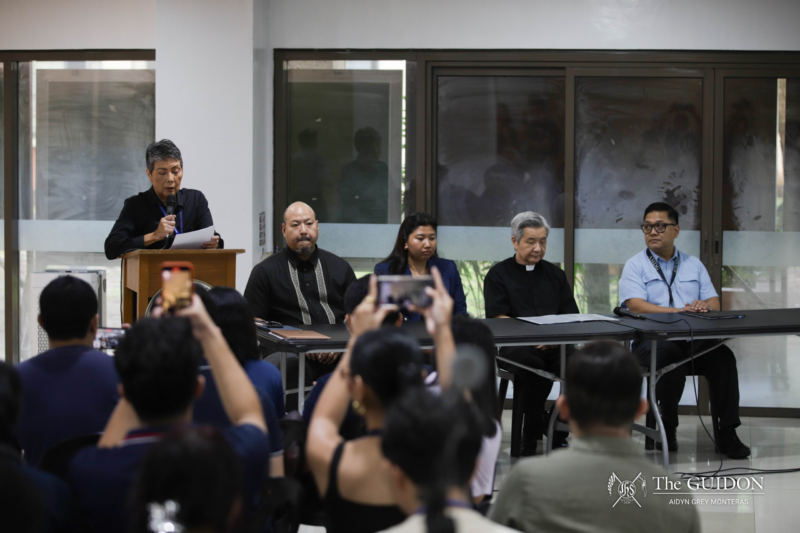
Last October, the University renewed its Declaration of Cooperation with the Armed Forces of the Philippines (AFP), reigniting debates over the school’s moral consistency. The agreement, framed as a partnership for “governance and capacity-building,” drew concerns for aligning with an institution associated with human rights violations.
Sanggunian President Annika Torres asserts that this partnership fueled much uproar from the Ateneo community, as it was alarming for the Ateneo to “shake hands with an institution that kills people.”
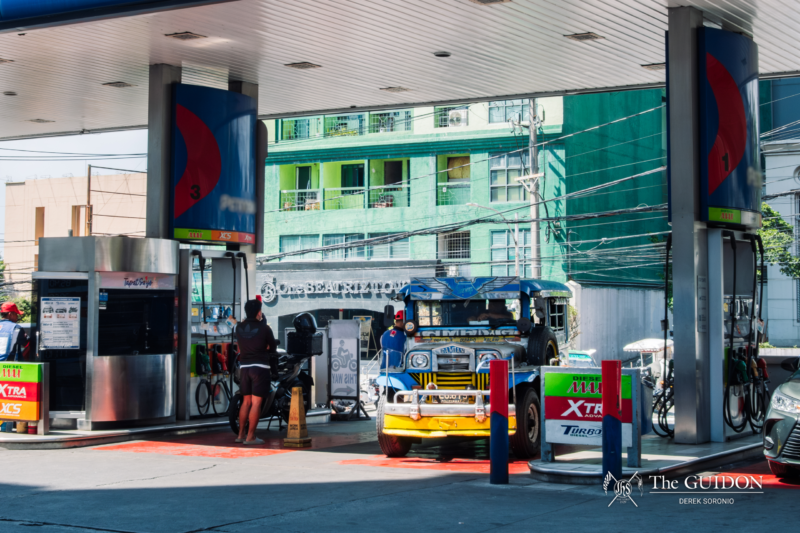
A similar outcry followed the Ateneo’s 2024 two-year energy agreement with Shell Energy Philippines and SolX Technologies. Although the deal guarantees a shift to renewable energy for the campus by 2026, students condemned it as a case of “greenwashing,” pointing out that the company’s net-zero pledges serve as pretenses to prolong fossil fuel dependence.
In 2019, the University also faced intense backlash after Irene Marcos-Araneta, daughter of the late dictator Ferdinand Marcos Sr., was invited to the inauguration of the Areté amphitheater. Many students and faculty members saw it as an insult to Martial Law survivors and victims, and incompatible with the University’s declared mission.
The controversies surrounding the Ateneo’s partnerships and decisions point to more than isolated missteps. They reveal a deeper reality about the University and the system it operates within, which Torres asserts is a mirror of the structures that shape the country at large.
The weight of our choices
For Torres, the University’s contradictions cannot be separated from the history of Philippine education. She explains that the Ateneo emerged from a colonial education system designed to produce graduates who would serve state interests.
Although the context has changed, Torres notes that the system remains unequal, shaping how institutions like the Ateneo determine which partnerships to cultivate. She argues that the renewed Declaration of Cooperation with the AFPs, and the partnerships with Shell Energy and Arthaland signal what forms of authority are welcomed into the Ateneo’s institutional life and what concerns are pushed to the margins.
Andrés echoes this, as he observes that the University often hesitates to challenge entrenched power. “Natatakot sila [the Ateneo] na banggain yung status quo ([The Ateneo] is afraid to challenge the status quo), he asserts.
He explains that this reluctance reveals how deeply elite interests shape the University’s direction. As powerful institutions benefit from existing arrangements, Andrés argues that the Ateneo often adjusts to preserve them, even as students push for more critical forms of engagement.
For Candelaria, this tension underscores the need for advocacy within the institution. Partnerships, she explains, cannot stand alone as proof of the University’s mission. They must be met with a community willing to question them.
When this scrutiny is absent, its effects become apparent in student formation. In this light, Andrés notes that institutional choices often contradict the political awareness the University claims to cultivate.
Within this tension, Torres calls for vigilance. Each collaboration becomes a measure of how firmly the Ateneo can uphold advocacy while working with state or corporate actors. She argues that the community must continue to examine how these decisions shape the University’s trajectory and the culture students carry.
Taken together, these tensions reveal that the challenge lies not only in choosing who to partner with, but also in discerning what those choices teach the community about power and the vision the administration claims to pursue.
Living what we preach
The paradox between privilege and advocacy continues to define the Ateneo’s identity. As an institution long known as a cradle of dissent, its credibility now depends on whether it can embody the justice it calls for.
To begin this work, Torres emphasizes the need for greater transparency and representation in administrative decision-making, especially when policies or partnerships shape the community’s moral direction.
“We fight for [transparency and representation] because we recognize that [they are] the very first step in ensuring that all decisions we make as an institution […] stem from a concrete and informed consensus,” Torres argues.
Andrés echoes this call, stressing that the Ateneo’s integrity must be reflected in whose voices it chooses to hear and stand with. He points out that while the University readily finds time to dialogue with powerful institutions or large corporations, it often hesitates to extend the same openness to marginalized communities within and beyond the University.
Within this context, Candelaria sees the friction surrounding these decisions as a healthy sign of democratic engagement. She explains that tension arises because the community cares enough to question the direction of the University.
Critique, Candelaria adds, must exist alongside dialogue. She contends that engagement with government or corporate actors is not inherently wrong, yet these relationships must be guided by discernment and accountability.
The Ateneo’s challenge, then, lies in being wary when collaboration enables complicity. In this sense, institutional partnerships are not neutral—they shape campus culture, influence how students participate in public life, and determine which voices are strengthened and amplified.
Integrity begins when the Ateneo learns not only to speak of justice, but to live it—in its partnerships, in its priorities, and in the nation it seeks to build.