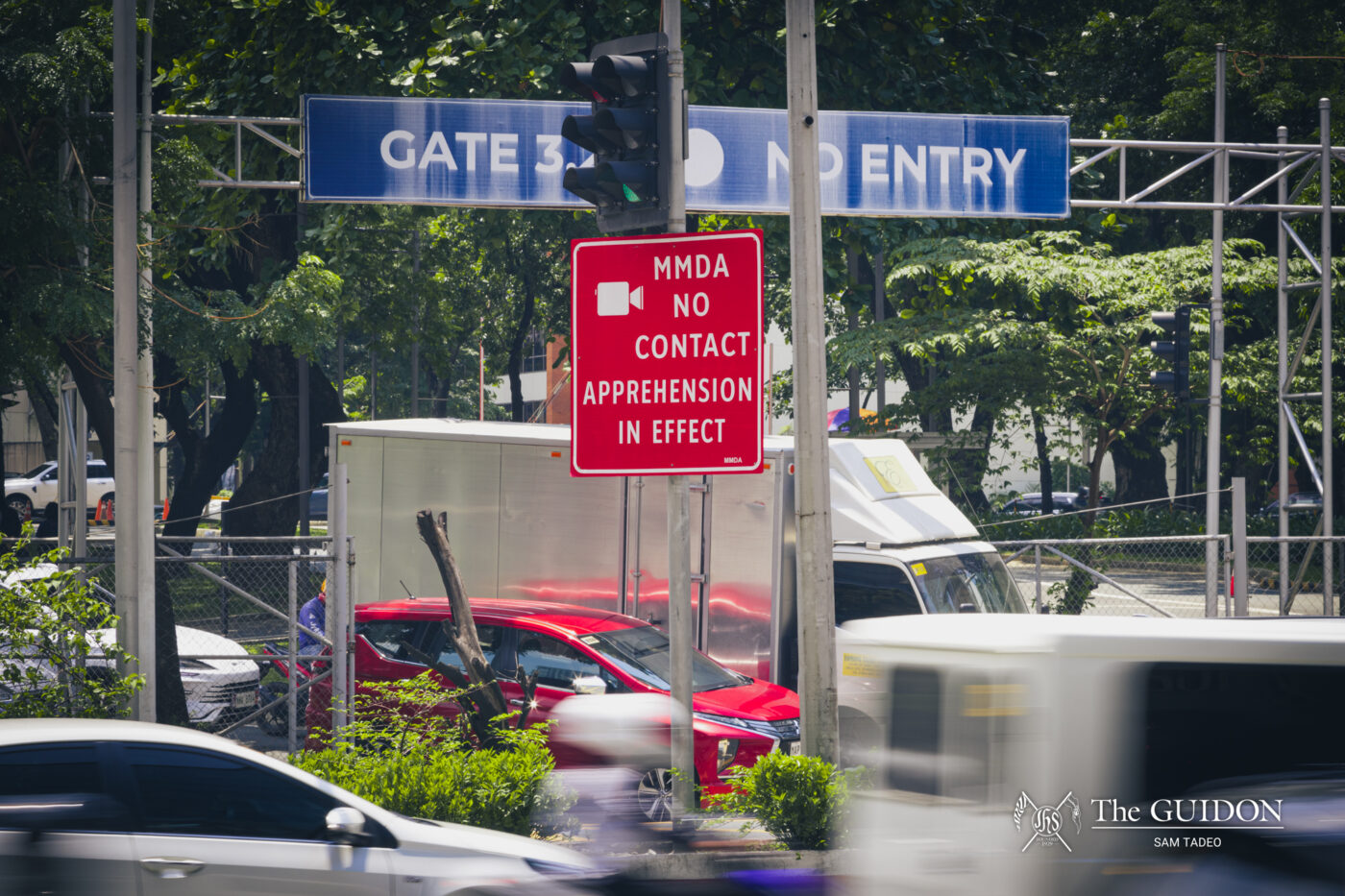
AS THE Metro Manila Development Authority (MMDA) reintroduces the No Contact Apprehension Policy (NCAP), Ateneans driving to campus weigh the policy’s promise of a faster and safer commute against the backdrop of silent surveillance.
Motorists’ concerns, such as delayed delivery of notices of violations (NOV), unclear or inconsistent signage, and privacy concerns over personal data, surround the policy’s return. The MMDA, however, reassured that the policy is implemented with improved adjudication mechanisms, manual review of camera-captured violations, and online channels for payment and appeals.
Eyes on the road
First introduced in 1995 and then reinstated in 2016, NCAP hit a roadblock in 2022 when the Supreme Court issued a temporary restraining order (TRO) on the policy over questions of legal basis, unconstitutionality, and possible violations of due process and motorists’ privacy.
Since then, the Supreme Court has partially lifted the TRO, allowing the MMDA to proceed with implementing NCAP in major thoroughfares in Metro Manila, including the circumferential (C1 – C5) and radial roads (R1 – R10), such as EDSA, C.P. Garcia, Katipunan, and Commonwealth Avenue, among others.
Under NCAP, closed-circuit television (CCTV) cameras are integrated with artificial intelligence that automatically detects traffic violations, eliminating the need for physical apprehension from traffic enforcement officers.
Recorded violations are then reviewed and validated by NCAP personnel before text messages and email notifications are sent to vehicle owners.
To check for violations, motorists may also access the May Huli Ka 2.0 using their plate number or conduction sticker, and motor vehicle (MV) file number.
With the introduction of these new surveillance systems, student driver Ryan Bautista (3 BS CH-MSE) shared how the policy made drivers like him more conscious of following road signage, even when those rules had been ignored in practice.
Despite NCAP’s reimplementation, however, he pointed out that traffic congestion still persisted along C5-Katipunan.
Towards safer streets
While some drivers remain skeptical of its rollout, NCAP’s proponents emphasized its broader goal of long-term improvements in road safety and efficiency.
According to Arnulfo Diaz, Officer-in-Charge at the Ordinance Violation Receipt Redemption Center of the Quezon City Traffic and Transport Management Department, their office saw a steady decline in apprehensions in the city since NCAP’s enforcement, with a 90% decrease in violations. Meanwhile, the City of Manila reported a 62% decline in road crashes as motorists became more cautious while driving.
Diaz expounded, “Kahit walang traffic enforcer sa area, kaya naman pala [sumunod sa mga patakaran]. Hindi sila basta padalos-dalos lalo na ‘yung mga pasaway na drivers. (Even without a traffic enforcer in the area, it turns out they can [follow the rules]. Drivers, especially the reckless ones, aren’t so hasty anymore.)”
Bautista elaborated that the policy makes it easier for Gen Z drivers like him to access the fines and fees, while also reducing the chances of “kotong” or bribery by minimizing interactions between enforcers and motorists.
Still, NCAP faces challenges, as poor traffic systems and faded signs complicate enforcement. Diaz notes that unclear signage and low visibility at night often lead to unintentional violations. While NCAP encourages more disciplined driving, he stressed that its fairness relies on consistent inspections and maintenance.
To appease motorists’ concerns about privacy, Diaz assured that access to CCTV footage is restricted and released only if the registered vehicle owner files a formal request, such as when contesting a violation.
He also clarified that each recorded violation undergoes manual validation before an NOV is sent, decreasing the risk of wrongful charges. This verification process, he added, is crucial to maintaining the system’s credibility.
The road ahead
Despite these pledges, many transport groups still oppose the policy due to the lack of consultation with the transportation sector.
“At the end of the day, a lot of those violations happen in the first place because the roads are so congested [and] hard to navigate,” Bautista asserted.
Similarly, Diaz admitted that the NCAP is not the sole solution for Metro Manila’s perennial traffic woes. “Kung gusto natin magkaroon ng permanent solution, kailangan mag-come up tayo [ng] one policy lang sa pag-implement ng traffic rules and regulations [across all cities], (If we want to have a permanent solution, we need to have a unified policy with the implementation of traffic rules and regulations across all cities,)” he explained.
Moreover, Diaz stressed the need for continuous transportation investments and comprehensive education campaigns that target not only motorists but all road users, pedestrians, cyclists, and passengers, to ensure public understanding and cooperation.
While NCAP is still far from a cure-all solution, tools like it should not just catch violators, but complement existing policies that make road travel faster, safer, and suited for all the people it serves.