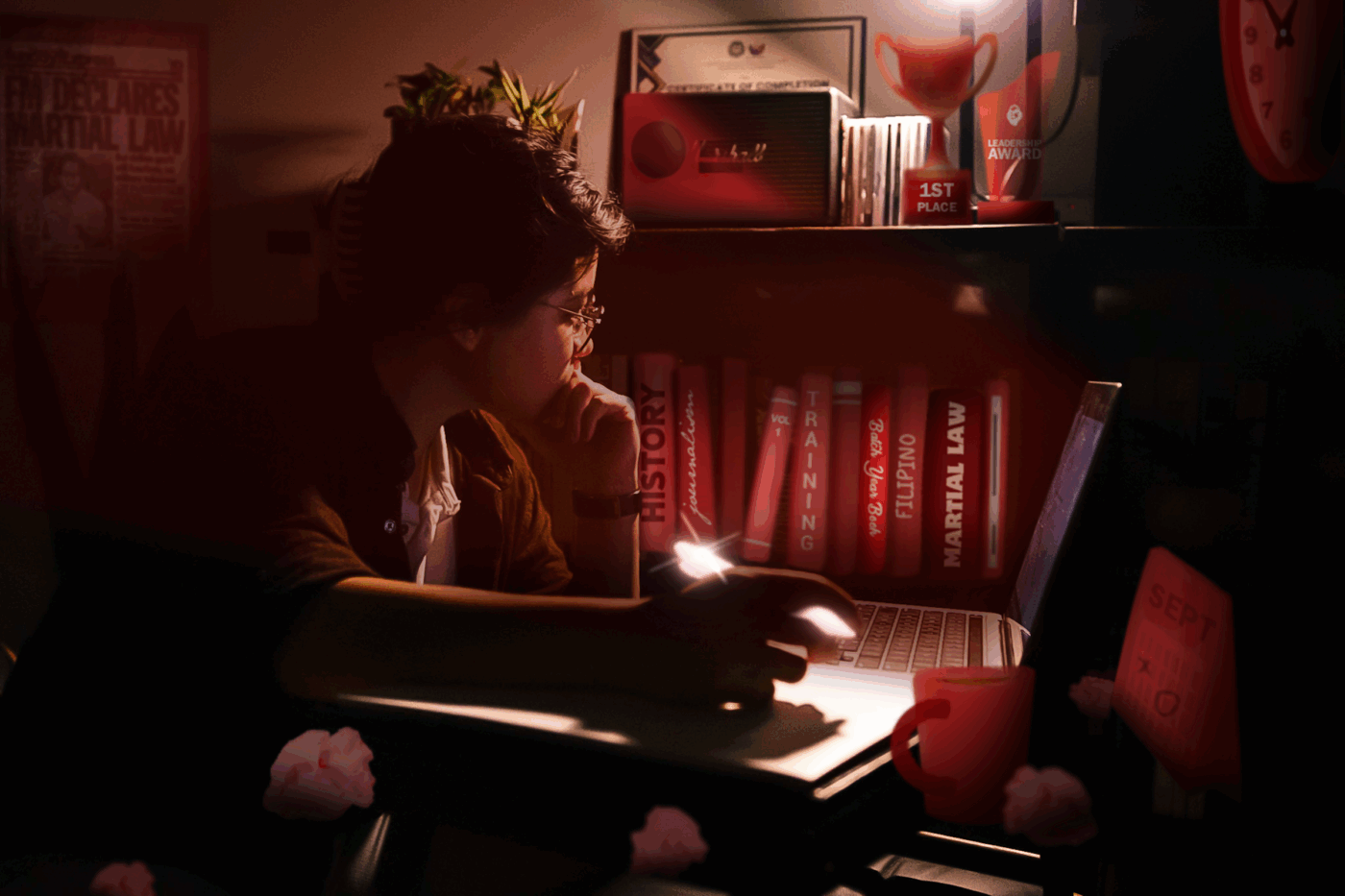
From the ‘70s until today, campus journalism has captured the lived experiences of students as they questioned the systems in place.
AGAINST THE backdrop of an unpredictable political climate, many journalists remain committed to upholding stories of the truth. Campus journalists, specifically, have become representations of the youth—raw and unfiltered in their storytelling—as they confront the challenges of their generation.
During the ‘70s, the Philippines was marked by a time of turbulence as the looming presence of former president Ferdinand Marcos Sr. crept into the lives of journalists who challenged the oppressive structures and systems. Through journalism, they told stories of life and the loss that came with it.
Setting the scene
September 21, 1972, marked the declaration of Martial Law, after the late dictator Marcos Sr. signed Proclamation No. 1081 due to “lawless elements” and “social disorder.” A week later, he issued Letter of Instruction No. 1, authorizing the military to take over major media outlets’ assets nationwide.
As a result, all media of communications and institutions deemed as “propaganda purposes against the government” were co-opted, censored, and shut down, giving rise to the so-called “crony press.” With soldiers padlocking major newspaper offices and wire agencies in Metro Manila, very few media outlets could remain in operation, with most of the remaining ones famously owned or taken over by Marcos’ political allies.
Since then, small but persistent alternative underground and aboveground setups, collectively known as the “mosquito press,” emerged. Student-led publications from the College Editors Guild of the Philippines (CEGP), initially an alliance of four college publications, also played an integral role in resisting censorship and keeping the campus press alive under the dictatorship.
Its student leaders pooled editorials, issued manifestos and petitions, organized student forums, and marched under the banner of freedom of speech during the Martial Law years. However, over time, many of CEGP’s members would encounter law enforcers in house raids and warrantless arrests, and be subjected to torture and brutal deaths at the hands of military men.
A sequence of events
Prior to 1972, the political unrest that occurred became a signifier for the historical events that followed.
Former The GUIDON Editor-in-Chief (EIC) Manuel Dayrit recalled his years as a campus journalist before the declaration of Martial Law. He highlighted that 1970 was a significant moment that shaped how the youth viewed their place in society.
Although Dayrit was initially a sports writer, he was soon called to take on roles that involved socio-political topics. He looked back at how the suspension of the writ of habeas corpus greatly influenced The GUIDON, pushing it to write about political events and possible threats to freedom of speech at the time.
Overcome with a sense of nationalism, the publication decided to publish in Filipino during Dayrit’s term as EIC in 1971, changing its name to “Ang Pandayan” before it was temporarily shut down.
Meanwhile, Jo Ann Maglipon recalled how journalism did not appeal to her at first. However, this changed after being tapped to become the Features Editor of Chi Rho Publications, the official student publication of Maryknoll College, known as Miriam College today. This position allowed her to attend the CEGP National Congress and witness the political discourse during the event.
“For the first time, I got the answers I needed, or at least there were people asking the same questions about inequality. […] Everyone seemed to be interested in things other than themselves,” she expresses.
The two explained that the CEGP used to be the “stronghold” of students who were either pro-Marcos or apolitical. In the following years, everything changed after the progressives gained control of the Guild in 1971. Soon after, the group became a space for mobilization and critical discussion on the timely issues in the country.
Aside from working on the campus paper, Dayrit also took part in fighting against unfair treatment of faculty members and, eventually, in assisting relief operations in rural areas.
Maglipon, on the other hand, realized that her campus paper was conservative and traditional, prompting her to join the underground press instead. Together with other young writers, she wrote in “Taliba ng Bayan,” where uncensored commentary and news surrounding the Marcos administration were published anonymously.
Alternative publications, such as Taliba ng Bayan, became a space for young journalists to speak out about the issues that bothered them and expose news that the administration was suppressing.
Ultimately, being part of a student-led publication shaped the decisions that Dayrit and Maglipon made as Martial Law continued, driving them to stand by their beliefs in their own ways.
Shaping the narrative
Today, the CEGP stands as the oldest and only existing publications alliance in the country. Members of the organization remain critical of matters on press freedom, filing complaints over cases of alleged harassment and red-tagging of journalists, and urging a Campus Press Freedom Bill.
At the core of the CEGP’s continued vigilance of recent administrations is the persistent antagonizing of journalists, including those in student publications, which has historically led to abuses of human and journalistic rights.
Thus, Pinoy Weekly EIC Marc Lino Abila reflected on the role of campus journalists in sparking political discussions. “Kung tutuusin, mas maraming student publications [ngayon]. Kung lahat ng student publications ay maglalabas ng report na totoo at nilalabanan ang mga kasinungalingan at maling impormasyon, mayroon tayong fighting chance [against disinformation],” he specified.
(“There are many student publications nowadays. If all these publications reported the truth and fought against lies and false information, we would have a fighting chance.”)
Once a campus journalist, Abila emphasized that the values and training expected of journalists contribute to a student’s ability to engage with complicated issues without compromising the veracity and accuracy of information.
Similarly, Maglipon advises, “To make things work, you [campus journalists] have to work together, strengthen yourselves, [and] find strength in each other because when those who can’t stand you come around, it’s better if you are united.”
While reflecting, Maglipon discusses how there is a privilege that comes with becoming a campus journalist. Dayrit adds that writers have the opportunity to engage with different kinds of people and talk about current events, allowing stories to transcend time by becoming a piece of history.
“[My hope] for [school] papers, then, [is] to become a mirror of present reality. […] [This] in a sense becomes timeless. Because if they’re relevant to your period, they’re relevant to other periods,” Maglipon says.
The long history of campus journalism as a vessel for storytelling extends beyond school grounds. Through it, generations of the youth have amplified calls for press freedom, democratic participation, and the pursuit of truth.
Today, as political climates shift, so do the roles and forms of campus journalism. Yet, the challenge still remains clear: today’s youth must continue to carry forward the lessons of history and confront the realities of the present with truth at the heart of their storytelling.