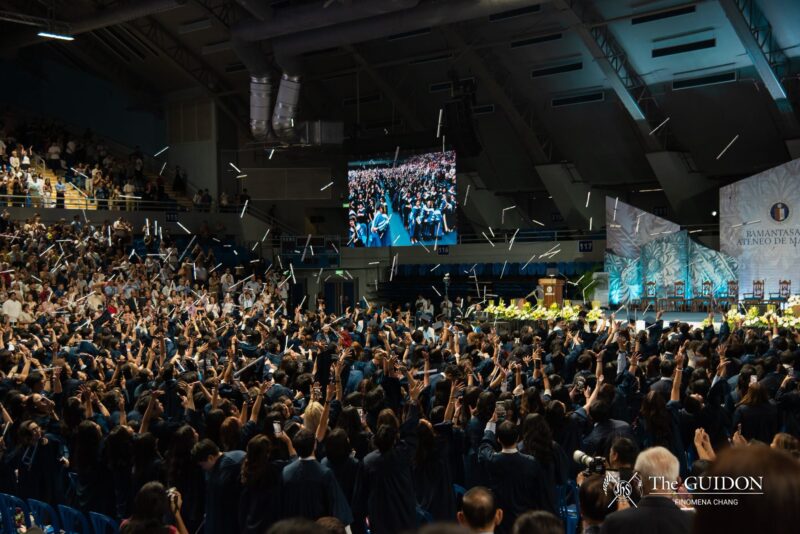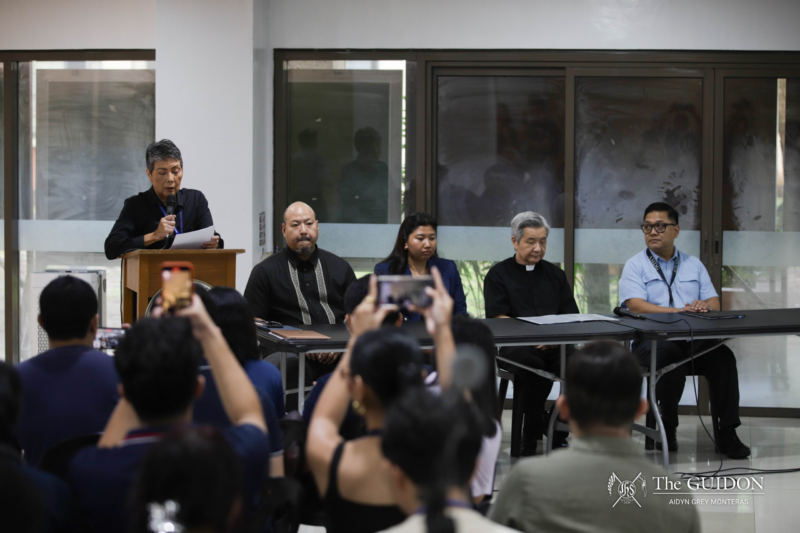
The following is the full and unabridged valedictory address delivered by Robert Nelson ‘Tobi’ Leung (BS AMDSc ‘25), Summa Cum Laude and Valedictorian of the Ateneo de Manila University Class of 2025 during the Higher Education-wide Commencement Exercises.
To Atty. Leila M. De Lima, our honorable commencement speaker; Fr. Xavier L. Olin, superior of the Philippine Province of the Society of Jesus; Ms. Bernadine T. Siy, Chairperson of the University Board of Trustees; members of the Board of Trustees; Fr. Roberto C. Yap of the Society of Jesus, University President; Dr. Maria Luz C. Vilches, Vice President for Higher Education; vice presidents and deans of the University; dearest administrators, faculty, staff, benefactors; and of course, to my proud fellow graduates of Class 2025—good morning.
To the villages that raised us, advisers, home departments, parents, guardians, loved ones, the day is yours as much as ours. There’s a somber nostalgia awaiting in the wings at every graduation. After the tarpaulins are taken down, the family dinners are ended, and the titos finally get tired of karaoke, you’ll know you can deny the weight of the years no longer. As another leaves the nest, hold your head up high, and know that the heights your children have climbed to are a testament to all the love that’s carried them.
I’ll be remiss not to take this moment to show my gratitude to the man who raised me. As those of you who are close to us will know, for the past 10 years, my father has had the herculean task of raising me and my three siblings alone. Though he’s never once taken any credit for our achievements—in fact, I don’t think he knew I was Summa Cum Laude ‘til he saw it on Facebook—he may very well be the most successful solo-parent in Philippine history, now being able to claim two Valedictorians—myself and my brother from UP—three Pisay valedictorians, and two PhDs. We love you, Dad, sorry none of us are the medical kind of doctor.
As a proud graduate of the Math Department, I began writing this speech as any statistician would—with the process of data collection, which is to say, I ran a survey because I couldn’t think of anything. Now I knew, like any good researcher, I had to incentivize my target population—the bright, brilliant minds of the Ateneo community, so I promised, the person who wrote the funniest joke would get a shoutout. Now I think I skewed the data a bit too much because 90% of the responses were jokes, 20% were jokes about La Salle, but the LaSallians in the audience will be happy to know that there were only half as many jokes about you as there were jokes about Ateneans, which tells you everything you need to know about Ateneans.
One person said, “Write about Artificial Intelligence and the danger it poses to our society.” Another sent in a one-thousand word prompt from ChatGPT to the prompt “Write the most stereotypical Ateneo valedictory you can think of.” And I think ChatGPT must be trained on Atenean training data because even its speech ended with, “The valedictorian exits to applause and the faint sound of a La Salle child crying in the background. But, the best joke award goes to one of my best friends Rivaldo Aquino of Batch 2024 who says, “Tobi really is the model Atenean. He’s made a name for himself as a debater, pretending to raise awareness for complex social issues by yelling at strangers in small rooms and answering every question with ‘it depends.’”
In the year leading up to the World Championships in Madrid, I gave well over a thousand speeches. Some in auditoriums and grand lecture halls, many more in dimly lit hallways, hiding in the corners of vacant classrooms, and a more embarrassing amount than I care to admit, fighting imaginary enemies in the shower—the shower is the only place where I won a hundred percent of my rounds.
Debate societies from the Oxfords and Cambridges of the world train in grand, historic theaters, decorated with ornate architecture. They have hosted everyone from Queen Elizabeth to the Dalai Lama. In Ateneo, we train in MVP 317–half of MVP 317 to be exact, sorry APAIR for all the shouting—where there’s mold on the benches, mysterious stains on the couch, a picture of Sharon Cuneta taped to the podium for reasons I still don’t know to this day, and the closest thing we’ve ever had to a guest of honor is the one time Fr. Jett walked into the room by accident. People ask me if I had any doubt that we could do it, that we could win the World Championships, that we could prove the Ateneo name belonged on that stage—and, I tell them every time that I did. I prayed after every single round that it wouldn’t be the end of our road.
Ambition, much like faith, is a living thing—it walks hand-in-hand with doubt. The hardest day to show up to training is the day after you lose a tournament—when you know that victory has been stolen right out from under you, when you feel like they don’t want to call you to stage just because you carried the Ateneo banner, when you’re counting all your unexcused “excused” cuts, when your confidence has shriveled up like an earthworm in the April sun and you’ve run out of hollow victories to distract you from wondering what any of it was even for. Yes, I was full of doubt.
In Ateneo, we are raised in a culture of magis—a lifestyle of relentlessly and unabashedly aspiring to more, aspiring to the absurd as a matter of habit. Ateneo is a place where mathematicians dream of writing poetry, where orchestral musicians struggle through classes on statistical theory, where would-be senators learn liberation theology, and would-be cardinals learn organic chemistry. Ateneo is a place where we are taught to never let the moldy benches keep us from dreaming of the world stage, to never let who we think we should be, get in the way of who we could be.
A few semesters after our win in Madrid, I was sitting in on a friend’s philosophy class. The professor arrives at the concept of Ubuntu, which was the topic of our World Final. He says to the class, “You know, the Ateneo debate team won the World Championship on this topic. Can anyone tell me what their winning argument was?” My friend starts giggling, starts elbowing me. Ako naman, utu-uto, I raise my hand to recite, I say, “Sir, I think they said this…” At this point, my friend burst into laughter and the professor says, “Hmm, very good. Are you a fan of the Ateneo debate team?” To which I reply, “No Sir, I just read an article about them.” And then, to my absolute astonishment, the professor replies with “Mmm, that makes sense, because you missed a few important points.” That, dear friends, is magis. Kant himself could be reciting on the categorical imperative and still miss the point.
But what they don’t tell you and what no one ever talks about is that magis comes at a price. The pursuit of greatness comes at a price. The cruelty of ambition without purpose is that everything you’ve worked for, no matter how great, will always shrink in the rearview. Many go their entire lives chasing the echoes of that applause. Even after their day in the sun is long gone, they built effigies to their once and former greatness and nest in their imagined self-importance. The world is run by insecure overachievers. They take their medals as a license to be cruel to those they deem beneath them, to stay stuck in their old ways, demanding unearned respect by invoking the ghost of who they once were, cursing themselves to forever chase the shadow of their own specter, the frail certainty they once had.
Achievement, hypocritically from me, is a vice. Merit is a drug. The thunder of applause, even for a moment, quiets the mind. There is no rush like the rush of finally, for once in your life, feeling seen. Victory offers temporary but addictive absolution. It keeps you from having to confront all the pain, all the pointless sacrifice. It gives you something to point to and say, “See, it was worth it,” but when the day finally comes that your ambition hits a brick wall, when you run out of medals to cover the scars, you will know you can no longer run from the question, “Why? What was it all for?”
A thousand speeches, in truth, make nothing happen. They will not end war. They will not solve the climate crisis. The same is true for much of what we hold dear in this University. Lebesgue integration does not make planes fly. Iambic pentameter will not solve the education crisis. Heidegger’s Dasein will not win fairer wages. The Theology of Khata will not defend the Constitution. Still, we read poetry at funerals and dance our hearts out at weddings. We quote philosophers at graduations and make speeches at the dawn of revolution. We build monuments to our melancholy, immortalize our sadness in song, and decide on a new meaning of life every time we leave the cinema.
This, dear friends, is the beauty of magis: not to do more but to be more, [and] to live the examined life—a life made ever richer by every failure, every heartache, every soul crushing setback, every disappointing defeat. [It means] to give and not to count the cost, to coil and not to seek reward, to live and not to think of the losses, to find meaning not in the being but in the becoming, to find joy not in the victories but in the sheer absurdity of daring to try. [Magis tells us] to fight, to dedicate ourselves in the service of the other so they may live not only better lives but fuller lives—not just to have food on the table and a roof over their heads, but a song in their hearts and a poem in their souls.
I’ve said it before, and I’ll say it again. I’ve seen university cultures around the world, and there’s really no place like Ateneo—where when you struggle, you struggle together, when there’s a problem you can’t solve, you solve it together. When you’re lost, you’re confused, you’re sad, all you have to do is step into the org room and someone will be there.
I barely remember any of the speeches I’ve given, but I’ll never forget the nights huddled up with coursemates in a corner of Bonchon, licking our wounds after a disastrous midterm. I’ll never forget the pep talks from my seniors before heading into the toughest rounds of my life—I’ll hold their words with me ‘til the day that I die. I’ll never forget watching from afar as my juniors’ name[s] are called to [the] stage and they finally get their medals, knowing that their trophies have made me happier than my own ever did. I’ll never forget the time we went all the way to Divisoria on a random Wednesday afternoon to buy medals for the children of Malanday. I’ll never forget the way their smiles shone in the midday sun, “Look, Ma, may award na rin ako.”
Ateneo reminds us that being men and women for others means being men and women for each other—to take strength in our shared vulnerability, to be complete in our incompleteness, to move each other, to dare, to dream, to chase, to fail, to be—no matter how absurd.
To the class of 2025, I pray we live boldly to chase the absurd, to run after our impossible dreams ‘til our legs give out, and we taste blood in every breath. The philosopher Miguel de Umamino, reflecting on the tragedy of Don Quixote, put it beautifully, “Solo el que ensaya lo absurdo es capaz de conquistar lo imposible” [which translates to] “Only one who attempts the absurd is capable of achieving the impossible.” We are the knight dueling dragons in the windmills, the bright-eyed first year who dares to call herself Atenean though she’s only ever known it by the four corners of a Zoom room, the fresh face graduate who dares to dream of a world where there is no hill, the 19-year-old who comes up on stage daring to be world champion. We are the lies we tell ourselves. We are who we pretend to be in the mirror. We are the nothings we make happen. Congratulations, Class of 2025. Ad Majorem Dei Gloriam.