MANY STUDENTS’ commuting experience reflects the variety of ways in which they travel to and from school. Many factors affect and bind these experiences together, such as car-centrism, pedestrianization, and the status of public transport.
While government initiatives such as free bus rides, streamlined bus routes, or even railway extension projects aim to make mobility more accessible, the need for further improvements grounded in commuters’ daily realities remains increasingly evident.
Ateneo-bound commute
The same observations can be made for Ateneans who rely on various forms of transportation to school. Some opt to drive or are driven in private vehicles, while others also organize carpool setups with friends or other members of the community.
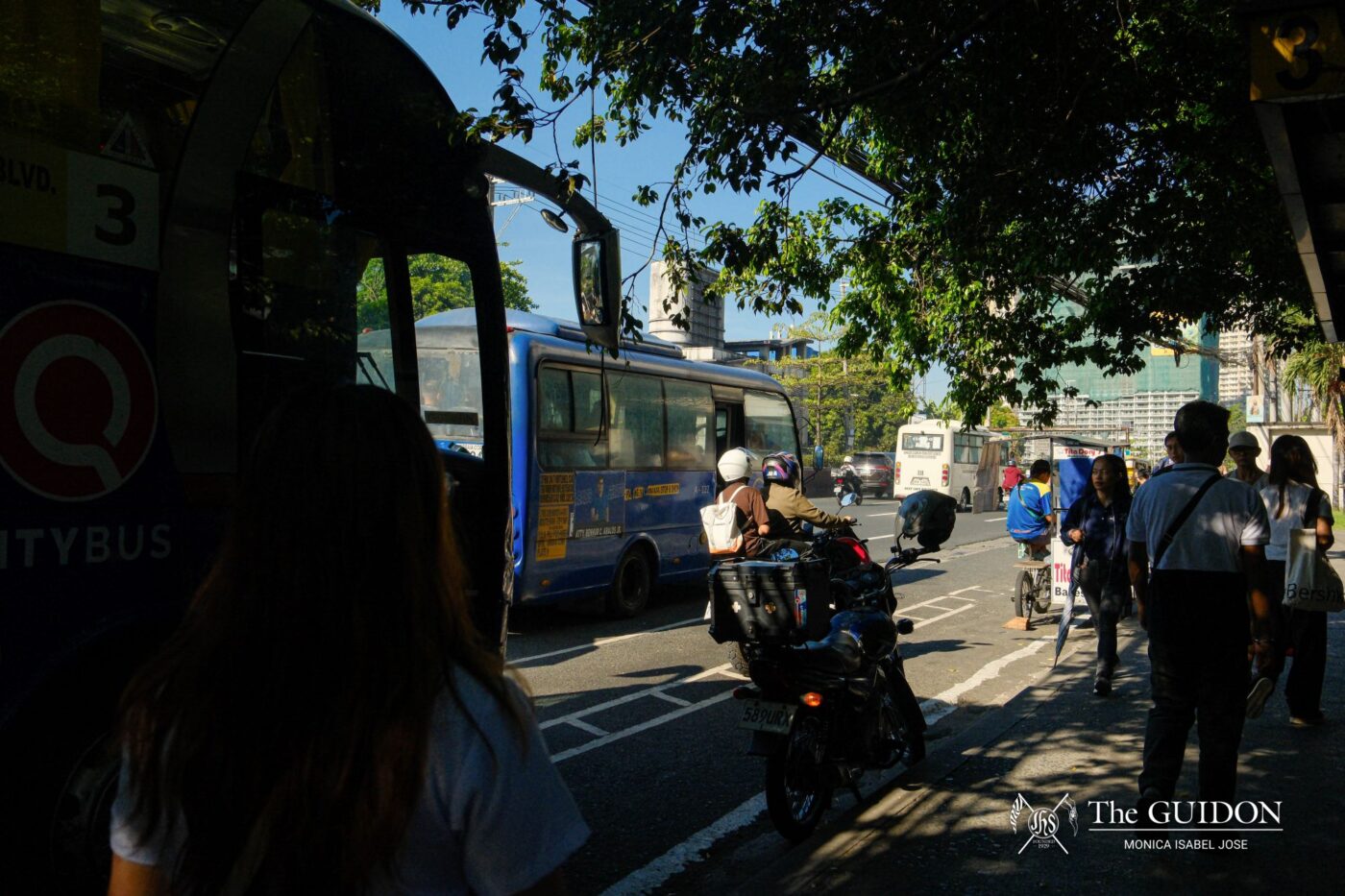
Those who live near or inside the campus usually walk, bike, or utilize other modes of active transport. Meanwhile, others take public land transportation options or urban rail transportation lines, such as the Metro Rail Transit-Line 3, and the Light Rail Transit (LRT)-Lines 1 and 2.
Despite this variety, a study by the UP Institute of Civil Engineering highlighted that private vehicles bound to or from Ateneo or Miriam College still make up the bulk of rush hour traffic in Katipunan. Faced with these realities, student commuters wade through a wide range of struggles that are further complicated by personal circumstances, geography, and daily logistics.
Atenean commuter Fate Bautista (1 BS CH) shared her experience commuting from her home in Cubao to campus. To attend daily onsite classes, she takes two tricycle rides, one jeepney ride, and a trip on the LRT-2. The routine, she says, is physically taxing.
“One challenge is pagod lalo na sa schedule ko [as] I end up using Grab or Joyride. Kapag pagod from school, mahirap maging alert (One challenge is the tiredness especially with my schedule as I end up using Grab or Joyride. When I’m tired from school, it’s hard to stay alert.)” Bautista shared.
Fellow commuter Martin Pontigon (1 BS PSY) relates to this exhaustion. In his case, he regularly travels from Valenzuela to Katipunan, which takes him two bus rides. Due to traffic and waiting time, this commute takes an hour and a half to two hours.
Public roads, private students
Though their routes differ, Bautista and Pontigon attest that commuting takes significant time from their studies.
“Unpredictable ‘yung time ‘pag nagco-commute. Kapag nakapag-readings the night before, enough ‘yung time sa commute para magbasa at mag-review, nakakampante ako,” Bautista revealed.
(The commute duration is unpredictable. If I have readings the night before, the commute time is enough to read and review, and I become complacent.)
In contrast, Pontigon mentioned that this delay disrupts not just his academic routine, but also his sleep schedule and energy for the rest of his school day.
Among the main factors behind Bautista and Pontigon’s transportation struggles is Metro Manila’s car-centrism. According to Quezon City Government Management and Audit Analyst Tristan Joseph Alcantara (AB POS ‘23), existing norms may have promoted this trend.
“A lot of Filipinos are car-centric not simply because it is the easy mode of transportation, but we have car-centrism also as a status symbol. […] [U]sing [and] buying cars contributes to traffic and climate change, accidents and dangers on our roads,” Alcantara explained.
Alcantara added that the waiting times and imbalance in the commuter and vehicle ratio affects public transportation accessibility, forcing students to devote more time to travel alone.
Smart city transportation
In light of these challenges, Quezon City Government Planning Officer and Blue Mobility Co-Founder Jericho Urquiola (AB DS ‘24) stated that one of their plans is to pedestrianize Katipunan in favor of sidewalks and bike lanes. He added that there are already active bike lanes along Katipunan, stretching from Ateneo to UP Town Center.
Alcantara also shared that the Q City Bus Program is currently operating on seven routes—some of which stop near Ateneo. Furthermore, he introduced the proposed Green Open Reclaimed Access Lane project that aims to improve walkability and accessibility to roads like Aurora Boulevard.
Quezon City Project Development Officer and Mobility March Co-Founder Beatrice Bacason (AB DS ‘23) confirmed the plan’s aims to turn the southbound lane of Katipunan into a pedestrian friendly zone. Recently, the Quezon City Government announced their plans to turn Katipunan into a walkable avenue, aiming to add more bike lanes and open spaces.
Moreover, Bacason said that the city is actively working with MobilityVision+ to survey vehicle volume using Artificial Intelligence and test out pedestrian areas through phone system infrastructure assessment.
While progress is underway, much remains to be done to achieve transportation accessibility, efficient infrastructure, and sufficient support for commuters. As such, building a more inclusive and people-centric transportation system begins with understanding these lived experiences and responding with empathy and action.