IN A political landscape where top-down decision-making persists, a people-centered government remains an idea rather than a reality.
Government agencies such as the Department of Education (DepEd) and Philippine Health Insurance Corporation (PhilHealth) often require sufficient funds to continue offering necessary social services. However, the reduction of nearly Php 12 billion from DepEd’s 2025 budget and the zero-subsidy allocation for PhilHealth have deprived both agencies of proper funding, prompting growing concern among Filipinos.
These systemic issues are also mirrored in student governments like the Sanggunian, where instances of disproportionate budget allocations and underutilized funds lead many Ateneans to question its budget planning process and its priorities in student governance.
In the red
Tasked with creating projects that serve the student body, the Sanggunian sources its financial resources from the Student Activities Fund (SAF), with the Department of Budget and Management (DBM) primarily managing them.
According to DBM Chairperson John Victor Detablan, DBM serves as the primary liaison for finance-related concerns, announcing the start of the budget season and providing units with the necessary forms and spreadsheets for documentation.
Each department’s budget depends on its proposed initiatives, with Detablan noting that established budget caps to guide allocations have yet to be formalized.
Upon receiving the budget proposals from the departments, DBM conducts a pre-review period where they provide feedback on their spreadsheets before publicizing them for students’ perusal. The Central Assembly (CA) then deliberates on these proposals through a budget hearing.
Once the finalized proposal is compiled into the student government’s General Appropriations Act, it would be sent over to the Sanggunian President, who may either veto or approve the budget.
In these procedures, Detablan notes that the Sanggunian prioritizes legally mandated minimum costs, such as educational subsidies and projects supported by multiple units that would benefit the wider Ateneo community.
While the allocated amounts are estimated based on past projects, former DBM Chairperson Lawrence Jacob Arabes explains that future allocations are not strictly dependent on how past funds were utilized.
“During my time, we had budget transfers, so we [would] get from other departments […] [to] make sure that the approved budget is fully utilized,” Arabes expounds in a mix of English and Filipino.
He clarifies that these funds are requested from departments that no longer have any remaining projects for the semester. Moreover, Detablan says that the departmental budgets also include a 10% contingency fund to account for unforeseen expenses.
However, despite these budgeting processes, both Arabes and Detablan admit that communication between departments continues to be a glaring concern. For instance, multiple departments request similar materials in separate budgets instead of sharing, which reduces overall efficiency in the budgeting processes.
No check nor balance
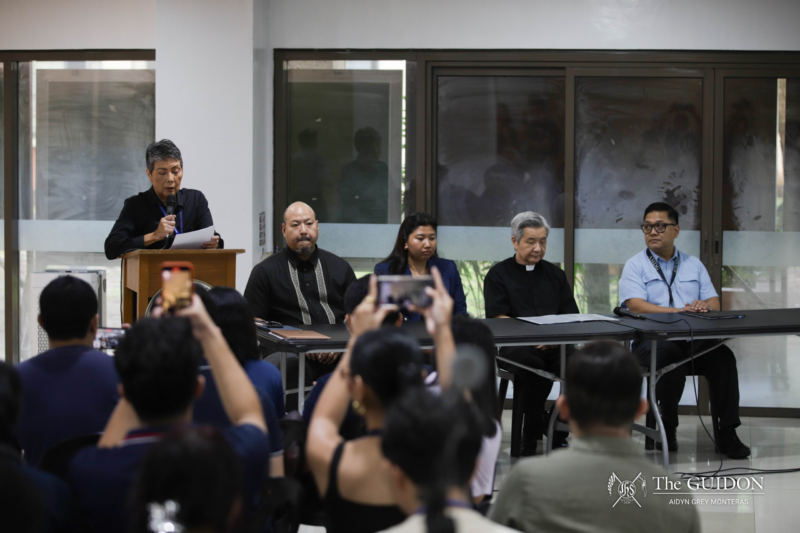
Although the Sanggunian previously operated without mandated budget caps, the recent transition of its financial processes to the Office of the Assistant Vice President for Ignatian Leadership Formation prompted the CA to align with SAF allocations. This change led Vice President Iver Delos Santos to call for an emergency meeting last March 24 to cut down the second semester’s proposed budget to Php 2 million.
Although DBM provided cost-cutting guidelines, the CA only managed to reduce the budget to Php 2.85 million by the end of the meeting. However, Detablan explained that the Sanggunian has since been gathering budget cut suggestions from the units through a Google Form, with responses set to be made public.
With these circumstances, Detablan stressed that proposing “heavy” amendments is a privilege reserved for the CA during budget hearings.
According to Detablan, while DBM can make comments on the initially proposed budget during the pre-review period, they do not have the authority to fully reject the budget of a proposed project.
Similarly, Ateneo Commission on Audit (ACoA) Chief Auditor Al Meara De Luna says that the Commission has no influence during the budget planning process, as its duty is to simply review and audit what has already been spent.
Given these constraints, Arabes asserts that decision-making on the budget remains largely concentrated among the Top 6 in the Sanggunian and other sector representatives present in the budget hearings.
With the limited role of DBM and ACoA, Economics Department Lecturer Jan Fredrick Cruz argues that there should be more rigorous planning and auditing methods to ensure that funds are allocated wisely. He stresses that both offices should have more “teeth” when it comes to scrutinizing the Sanggunian’s proposed budgets, specifically by having the authority to probe the necessity of proposed budget items.
“If the audit observation [of ACoA] is just there for reporting, […] [their] recommendations and suggestions can be ignored. [Thus,] all the effort of ACoA to review the budget process as well as the spending of the budget would be futile,” he states.
Following this, Cruz highlights the need to strengthen the checks and balances within the budgeting process—emphasizing that accountability necessitates involving student leaders who align funding with the needs of the grassroots.
True blue budgeting
As the Sanggunian continues to undertake initiatives that respond to its constituents’ needs, De Luna asserts that it must make funding decisions that genuinely reflect its service to the student body. However, Detablan notices discrepancies between the proposed budget and actual expenditures.
ACoA’s first semester report for this academic year attributes this underutilization to the overestimation of financial needs. In addition, Detablan notes that several Sanggunian projects do not push through due to a lack of foresight regarding execution.
Thus, to ensure accurate budgeting, Detablan proposes enhancing research and data-gathering methods before the budget season, highlighting that student needs should guide the Sanggunian’s funding distribution.
Aside from this, Cruz suggested that the Sanggunian adopt the Performance-Informed Budgeting method, wherein every form of spending is attached to a particular success indicator. He also stressed the importance of having a historical spending review—a system that compares present budget proposals with past budget expenditures.
Underscoring the crucial role of DBM and ACoA, Cruz emphasized that all priorities of a governing body should be deeply deliberated on. “Notice that the [Commission on Audit] of the [national] government [does] not just [question] the legality or validity of spending. They can also question the wisdom or efficiency of spending,” he says.
Ultimately, Cruz noted that the student government must always return to its primary role of representing the student body. Consequently, any projects beyond that core function must be carefully evaluated to ensure they do not divert resources or attention away from its main task.
As financial accountability becomes vital in rendering student needs, responsible budgeting essentially entails fostering a culture of transparency, trust, and student engagement, all of which are key hallmarks of good governance. Thus, as student leaders learn to build connections with their constituents, their commitment to financial integrity will demonstrate their true dedication to service.