Trigger warning: This article contains mentions of death.
ACROSS THE country, security personnel regularly work under high-risk conditions with few safeguards in place, leaving them vulnerable in a profession meant to protect others.
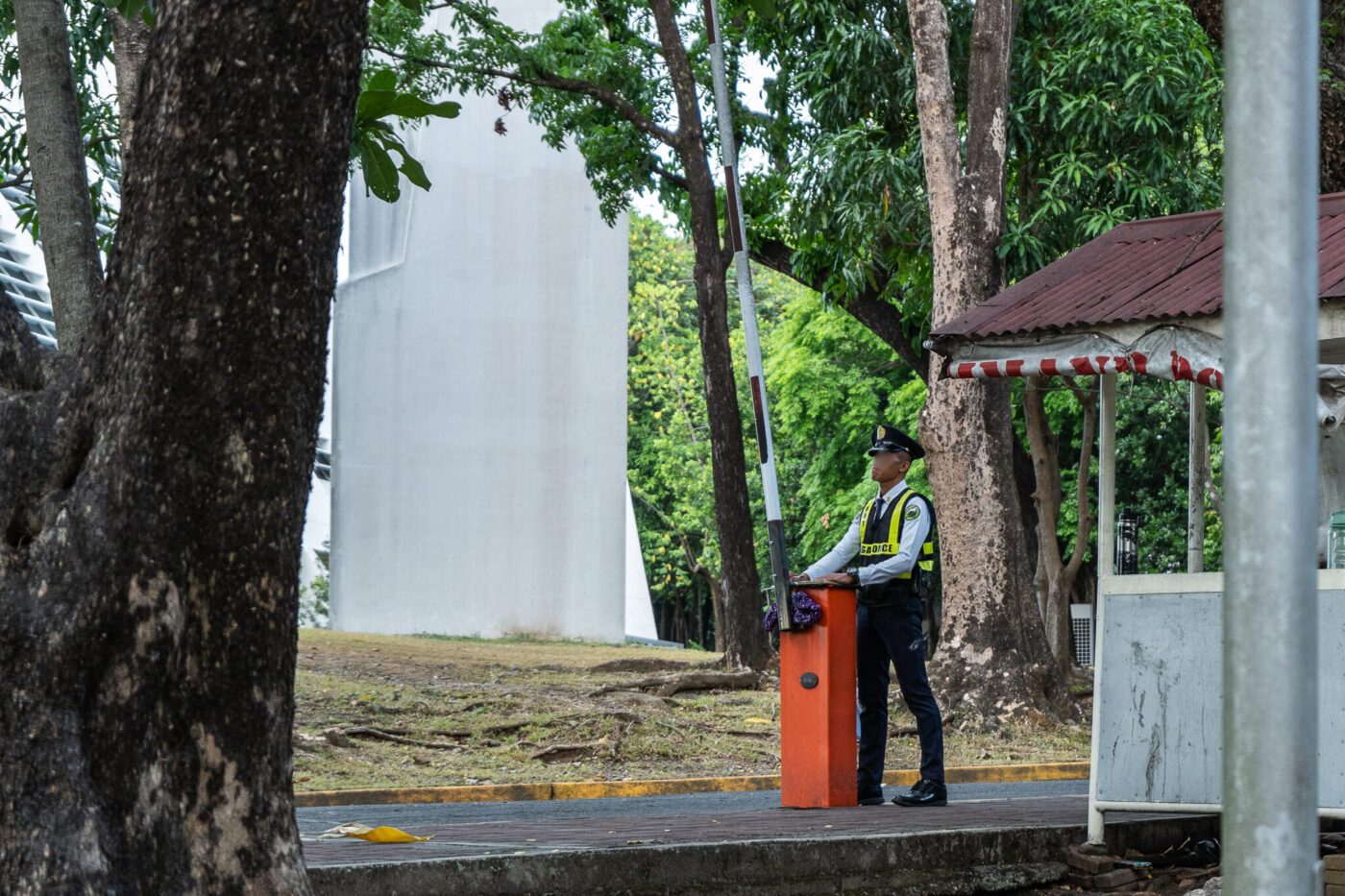
Within Ateneo’s campus life, security guards stand as the first line of defense, with their presence woven into the daily routines of students, faculty, and staff. From checking IDs at gates to guiding visitors, they ensure safety while standing long hours on their feet in varying weather conditions.
Beyond daily security duties, they are also expected to respond quickly in the face of danger—a responsibility that turned fatal for Jeneven Bandiala during the Areté shooting in 2022.
Always on duty
Security guards assigned to the Ateneo often describe their work with phrases like “sanay na” (used to it) and “tiis lang” (just endure), reflecting how hardship becomes routine through repetition.
For Rommel Dineros Jr., a 5:30 AM shift at the Ateneo Grade School means long hours on his feet, especially during dismissal when closely watching over children leaves little room for rest.
Meanwhile, Juan Teves Jr., who only recently joined the security team, struggles with night shifts that disrupt his sleep schedule.
While their work has become part of their routine, some circumstances can also be hazardous for them, with incidents such as falls, altercations with agitated visitors, or the physical strain of standing for hours in the heat adding to the daily grind.
Due to the nature of their job, reports show that security guards are more than twice as prone to fatal workplace injuries than other professions, often because of assaults or confrontations during moments of high tension.
Despite the physical toll and risks brought by the job, both Dinero and Teves have quietly come to accept the work’s demands to provide for their families. However, Psychology Department Assistant Professor Ma. Tonirose Mactal, PhD, RPsy, explains that pushing oneself too far can lead to long-term concerns on mental health, adding an invisible toll to an already demanding job.
Beneath the uniform
A security guard’s stressors depend largely on their assigned post and shift hours. Mactal points out that high-traffic areas, such as parking lots, often require guards to mediate disputes or car accidents.
Following this, Dineros observes that tensions can arise during certain shifts, particularly when young students become distressed while waiting for their guardians. In such cases, he tries to remain calm and de-escalate the situation, highlighting the emotional labor involved in their responsibilities.
These stressful scenarios, Mactal underscores, can heighten anxiety and stress levels, producing physiological manifestations through appetite changes and immune responses. When left unmanaged, these stressors can bleed through different aspects of their lives, interfering with their focus and performance on the job.
Thus, to alleviate stress, Mactal highlights the role of different coping methods in addressing the complexities of an individual’s needs. For many security guards, they adopt a positive attitude to manage the demands of their work. Beyond individual initiative, however, institutions also play a role in supporting their workers.
Beyond the badge
Existing national policies have outlined expectations from private agencies to conduct retraining sessions to assess security guards’ skills and ensure comprehension of their duties. They are also required to provide safe working environments through risk assessments, protective equipment, and psychological health policies in compliance with international laws.
Despite existing regulations, security personnel can view their troubles as weights they should shoulder. “Minsan, naiisip [at] nararamdaman talaga ‘yung pagod, gustong magpahinga. Kasama na rin [sa pinagkakaabalahan] ‘yung pinansyal. (Sometimes, you really feel [and] think about the exhaustion, the desire to rest. The financial concerns also add to [what weighs on your mind].)” Dineros shares.
Thus, when systems offer little support, resilience becomes less about choice and more a means of survival. For Dineros, seeking support is pushed to the back of his mind, choosing instead to find contentment in the simple act of providing for his family.
Mactal explains that this grit reflects the matiisin (enduring) mindset, a defining characteristic of Filipino employees when it comes to familial obligations. “Filipinos […] put a premium [on] their families. They will [go] the extra mile [to] provide for their family,” she observes.
However, with endurance being seen as a social standard, asking for help is often discouraged during times of struggle. Hence, Mactal highlights that personnel must be empowered to recognize both their capabilities and the significance of their jobs.
Given the unique struggles that security guards face, supporting their welfare through improved policies is integral to accomplishing their duties in protecting the community.