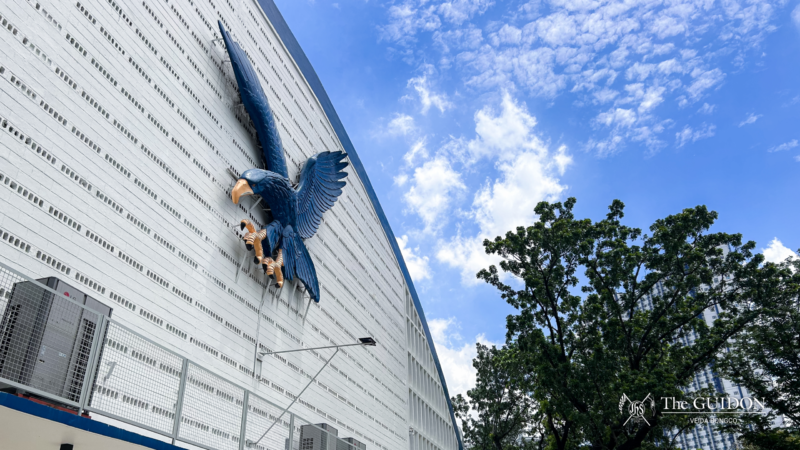
THROUGHOUT THE past decades, the country has witnessed notable Atenean alumni rise to the highest socio-political strata, wielding power and influence that could give them the avenue to become “persons for and with others.” After all, the Ateneo education has constantly been firm in advancing its mission of honing leaders who are dedicated to the highest form of service and the greater good.
However, while some of these alumni have meaningfully contributed to the nation’s progress, history has also shown how others have only become part of the very practices that exploit the country’s underserved communities.
As the midterm elections and the end of the academic year approach, it becomes all the more important to examine whether or not the Ateneo truly forms leaders who stand in solidarity with the oppressed and work to dismantle entrenched systems of injustices.
Climb to the top
While the University and its brand of leadership have become a familiar fixture in the country’s highest seats of power, the question of whether this influence has led to national development or demise remains.
For one, Joseph Estrada—who only completed basic education at the University—rose to the presidency in 1998 largely due to his “Erap para sa mahirap” campaign, as if echoing the Ateneo’s vow of service to those in need. In 2001, the ascent of Gloria Macapagal-Arroyo, who earned her master’s degree in economics and taught at the University, marked yet another Ateneo product at the helm of Philippine governance. While both administrations saw efforts for poverty reduction or economic growth, both presidencies were also prominently marked by corruption, distrust, and controversy.
When the first “homegrown Atenean”—Benigno Aquino III—became Philippine President in 2010, the nation enjoyed a surge in economic growth, with his term generally better-received than that of his predecessors. Still, his leadership projected a sense of elitism that alienated the general public.
Beyond the presidency, prominent alumni also take up space in the political arena. On one hand, the Ateneo has shaped leaders like Risa Hontiveros, who is now viewed as the most influential progressive voice for the opposition. On the other, it has also produced officials who have been complicit to anomalies and disservice such as Juan Ponce Enrile and Jinggoy Estrada.
Furthermore, many national and local government positions across the country are held by Ateneans—including in major cities like Pasig, Makati, and Quezon City which are now led by different generations of Atenean leaders. Although some are often praised for progressive reforms, their leadership remains intertwined with the reality that they are products of political dynasties.
Given these, there is no doubt that the Ateneo has fulfilled its mission of shaping the nation’s “public servants.” However, it must also confront the uncomfortable truth that some of these Atenean leaders have used their positions to enable corruption and preserve elite power, calling into question the depth and direction of its educational formation.
Magis in the making
The Ateneo has constantly instilled in its students and educators the values of magis, cura personalis, and being “persons for and with others.” Such ideals do not remain abstract, as they are deeply woven into the University’s immersion initiatives, such as the Integrated Ateneo Formation Program, which includes courses like the Introduction to Ateneo Culture and Traditions and the National Service Training Program.
While these efforts aim to cultivate socio-civic consciousness among Ateneans, they often fall short of fostering socially accountable leaders with lifelong solidarity—not just momentary sympathy—to the causes of the masses. Students’ sentiments about their seemingly transactional community encounters highlight a possible inadequacy in sustained systems of engagement.
This contradiction between espoused values and actual efforts becomes more glaring when some Ateneo alumni enter politics. For instance, Aquino vowed to create a “government for others,” which he mentioned when he spoke to Atenean graduates in March 2011. However, his administration was also plagued with actions and policies that “othered” the country’s underserved sectors, with poverty issues having minimal to no improvement despite the economic boom during his term.
Arroyo also once remarked how Atenean values, such as ad maiorem dei gloriam (for the greater glory of God) and being a person for and with others, were vital in her role as president. Despite these pronouncements, her presidency—though marked by economic gains—was marred by issues of massive electoral fraud and corruption scandals, which starkly run counter to the principles of the aforementioned values.
While the University remains committed to ensuring that Ateneans imbibe these ideals, such inconsistencies in the actions of its alumni—which can be linked to their privileged backgrounds—reduce Atenean values to mere buzzwords and empty slogans. Consequently, this elitist governance has only paved the way for the rise of “down-to-earth” populist leaders in the past two administrations, further obscuring deeper issues of inequality and power consolidation under the guise of relatability.
Thus, preparing Ateneans to be society’s future leaders and changemakers requires more than just equipping them with top-notch technical knowledge and skills; it also entails cultivating a deep commitment to addressing systemic social injustice. If the Ateneo prides itself on developing leaders that make an impact, it must continuously push its students to go beyond their bubble and lead with conscience, competence, and a genuine connection to the struggles of the everyday Filipino.
One big plight
Amid such seeming instances of hypocrisy, one cannot discount the many other Atenean leaders who have stayed true to the University’s call as they left the proverbial Hill. Ultimately, while systems can compel Ateneans to serve the marginalized, they can only go so far without individuals exercising their agency to act on their social responsibility.
At present, some Ateneans have shown an increasing detachment from having their voices represented and shaping the leadership culture that will influence their immediate environment. Such disconnection manifests a growing sense of apathy and disengagement from political affairs among students.
Over the past decade, the voter turnout for the Sanggunian elections has barely scraped 30% of the student population. Subsequently, the student government itself has faced criticism for its lack of proactivity in forwarding student concerns and genuine representation.
Nonetheless, the increase in student-led mobilizations and protests regarding campus and national concerns may point to a promising step toward combating apathy. The recent Sanggunian presidential election resulting in an abstention may have also shown Ateneans’ deeper regard and higher expectations for the kind of leaders they want and hope to become.
Still, it remains both an imperative and responsibility for the Ateneo community and the University to further foster this spirit of extensive and critical participation—not just through formation initiatives, but by actively setting a precedent through their own actions.
Thus, the Ateneo is challenged to produce not only competent leaders but also well-meaning public servants. The nation’s future demands individuals who will use their influence to disrupt systems that perpetuate inequality and injustice. In this light, Ateneans must also rise to the occasion, embodying the values they champion and transforming them into a culture of active and grounded leadership. Only then can the University truly fulfill its mission to create leaders for the greater good.