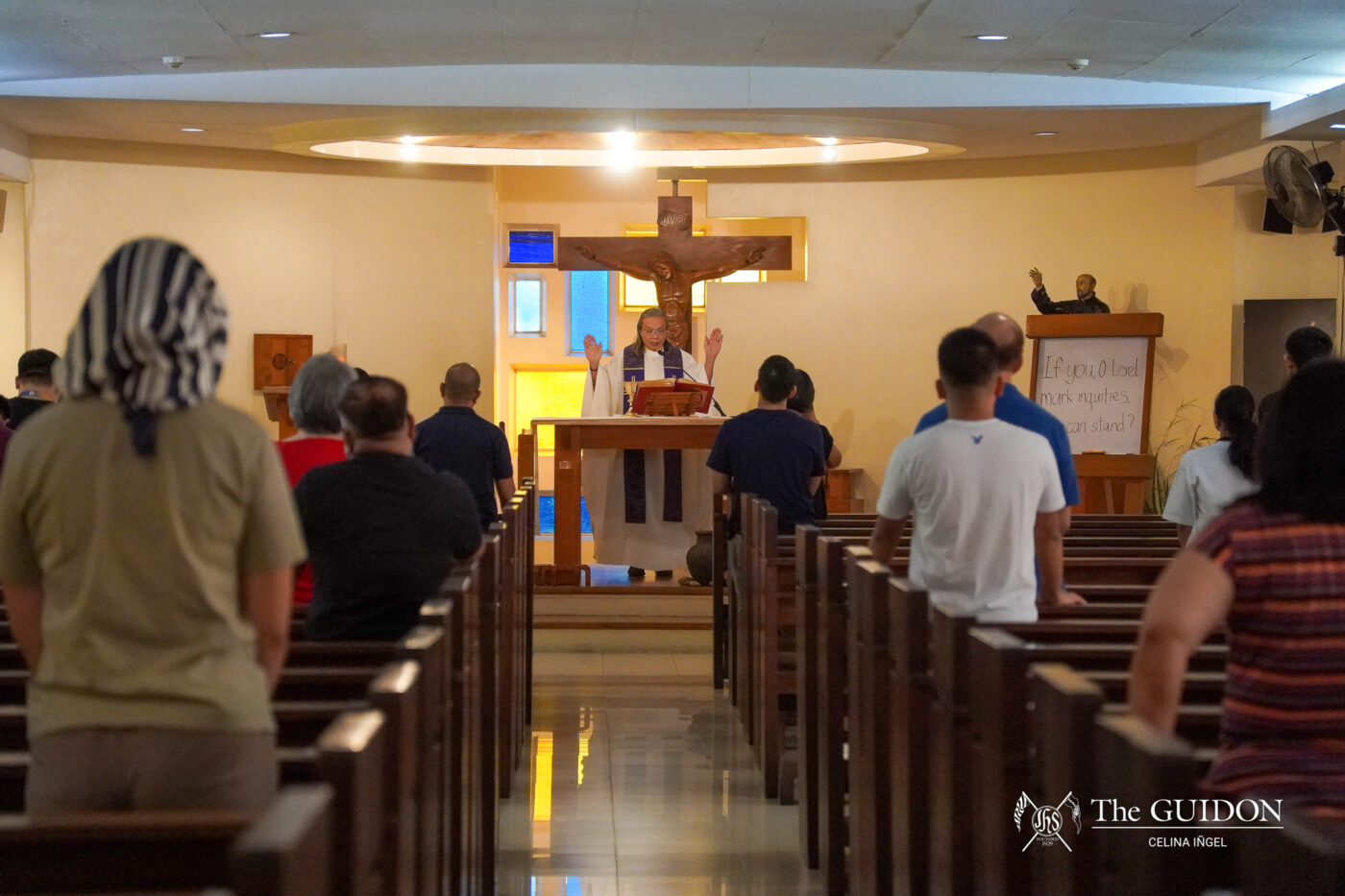
FROM FESTIVE late-night celebrations on Simbang Gabi to whispered prayers before every meal, faith is intertwined into a Filipino’s everyday routine. With nearly 80% of the Philippine population identifying as Roman Catholic, it has become not just a belief but a defining force that can dictate one’s identity.
However, the Ateneo has consistently taken a novel approach to religion—one not limited to tradition, but rather evolves alongside the contemporary realities faced by its community.
As the University attempts to balance its religious foundations with its political stances, its engagement with sociopolitical issues sparks dialogue—challenging what it means to embody a faith that is in service of others.
Nuanced national discussions
As the Catholic Church has long shaped Philippine politics, the Ateneo often stands at the forefront of these discussions involving the intersection of Catholic teachings and contemporary legislation.
Before the passage of the Reproductive Health Law, conservative Catholic groups had once opposed it for going against the value of life and God’s will to procreate. However, in 2008, professors from the University publicly supported the bill, arguing that it “adhered” to Catholic teachings by having a focus on the dignity of the human person and preferential option for the poor. In their statement, they outlined how the bill’s provisions are pro-life, pro-women, pro-poor, pro-youth, and pro-informed choice.
Another controversial legislation that Ateneo-affiliated voices have weighed in on is the Absolute Divorce Act. In June 2024, the Center of Catholic Theology and Social Justice emphasized that while divorce is not ideal, it is an issue of the public—not one of religion—and may be necessary for irreparable and abusive relationships.
Beyond policy-making, the University has also been very vocal in its support of the LGBTQIA+ community. Yet, during the launch of One Big Pride in 2019, the Couples for Christ Foundation for Family and Life condemned the event and described homosexuality as “disordered,” dismissing the LGBTQIA+ community’s experiences of discrimination.
In response, the Sanggunian denounced the statement, calling attention to the community’s systematic persecution and asserting that standing with the oppressed is a core Jesuit value.
Since then, the Ateneo has strengthened its commitment to gender inclusivity with the creation of the University Gender Hub, whose mission is to provide a safe space for LGBTQIA+ members.
Aside from this, the Theology Department had also released a public invitation to the Women’s Mass—a weekly service held for this year’s National Women’s Month honoring women’s experiences within the liturgical setting. However, the mass was met with criticism for its title and inclusion of a queer theologian as a guest sharer.
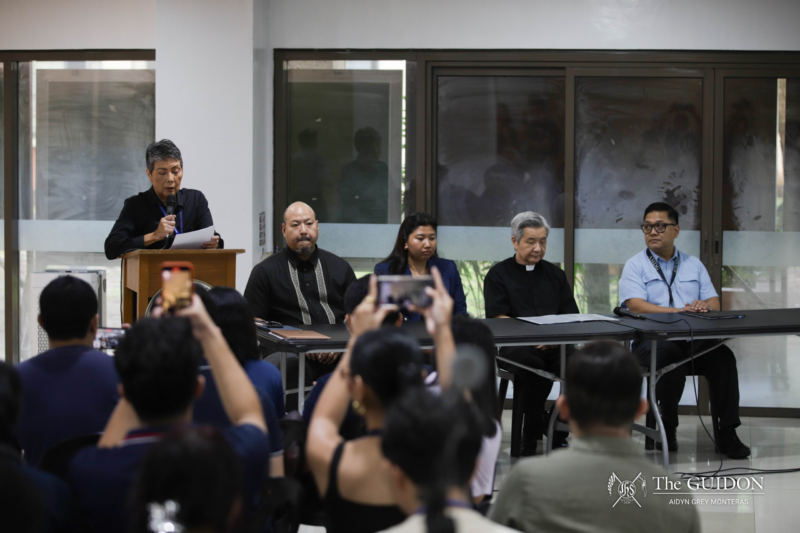
Amid such pushback, Theology Department Chair Michael Liberatore, PhD emphasizes that events like the Women’s Mass and the Mass of Welcoming are meant to amplify the voices that have long been silenced and marginalized. “These encounters […] allow us to focus on [the marginalized], draw light to them, and help us to see them,” he remarks.
While the Ateneo has a rich history of theologians engaging in sociopolitical discourse, these conversations usually begin within the classroom through classes such as the Theology of the Catholic Social Vision, where students are introduced to Liberation Theology.
Engaging in education
At the Ateneo, religious education is not confined to traditional doctrine and is grounded in real-world experiences.
Rather than pushing for certain beliefs through indoctrination, Liberatore underscores that the University anchors theology in reflection. “We’re trying to build a community that’s more responsive to the value of each person, […] the solidarity and the common good that uplifts everyone,” he expounds.
Agatha Gutierrez (4 AB COM) echoes this sentiment, highlighting that the learning environment welcomes differing views, allowing students to challenge beliefs and share their thoughts without imposition.
Similarly, Angel Rose Sarmiento (3 AB POS) observes that students holding certain viewpoints are not alienated and viewed to be against the Church. “[Ateneo’s] progressive stances give spaces for hope, reconciliation, and dialogue,” she remarks.
Although Theology classes provide the foundation for progressive discourse, its impact is still dependent on how students apply it. Thus, the Ateneo’s Theology curriculum allows students to view Ignatian values beyond theory and transform them into social action by integrating them in courses such as the National Service Training Program.
For Gutierrez, formation programs like Punla aim to instill values and morals that anchor students in reality.
In the same spirit, Friday*, a professor in the Theology Department, points out that true theological reflection happens when engaging with marginalized communities. “Theology has substance only when we [focus on] the marginalized because we can […] understand more about our faith,” she notes.
Through this engagement, Liberatore highlights that many theologians in the Ateneo are able to find ways to reflect on the true meaning of faith past “simplistic” and traditional interpretations.
Contemporary church
Traditional Catholic beliefs usually withstand changes across generations and historical contexts. However, Sarmiento argues that the Church is not a “monolithic entity that’s frozen in time.” While some priests remain highly conservative in their approach, she underscores that the Ateneo Theology Department has adapted to the “signs of the times.”
“It pushes for more progressive views on religion, […] on how we relate faith and spirituality to our social [and] political stances,” Sarmiento expounds.
In calling for more nuanced discussions surrounding national legislation, Liberatore stresses the significance of connecting faith with lived realities. “We tend to take a position—pro or anti—rather than asking, ‘What’s the issue we’re trying to grapple with?’” he asserts.
While religious sources are important, Liberatore emphasizes that they should be read with a certain understanding that considers all sides of a problem, as one cannot simply “cherry-pick” passages to fit a predetermined stance.
With the blurred line between the Church and the State, Friday explains that religion unconsciously influences policy-making, as certain beliefs are culturally ingrained by religion. Gutierrez echoes this observation, highlighting theology as a powerful force that develops one’s existing values and perspective on sociopolitical issues.
However, at times when the State falls short in serving the marginalized, Sarmiento noticed how people would turn to the Church for hope, reflecting its ability to mobilize people and lobby for a more just, loving, and “Christian decision-making” in the State. “The Church should push for a more just state in the same way that the State should also push for a more just Church,” Sarmiento argues.
Ultimately, politics and religion inevitably intersect in the governance of a deeply religious country. While traditionalists condemn more contemporary policies, progressive approaches in theology, such as those in the Ateneo, underscore the need to adapt to evolving contexts. In doing so, it reimagines what it means to live one’s faith in a world of injustice and marginalization, empowering students to act and spark meaningful change.
*Editor’s Note: The name of the interviewee has been changed to protect their identity and privacy.