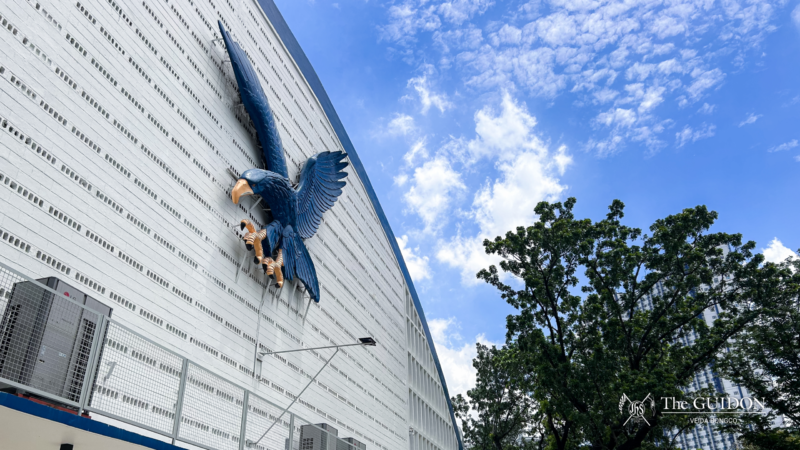
When 2009 came, the Ateneo was awash with banners and colors signifying its sesquicentennial year. The new Rizal Library building was constructed as a new school landmark, and events were organized here and there to celebrate the Ateneo’s one hundred and fifty years’ worth of history.
As part of the celebrations, there was a kick-off at Intramuros, a Sesquicentennial Mass, a grand alumni homecoming, and an elaborate restaging of the classic zarzuela, Walang Sugat, at the Irwin Theater.
Yet not one of these events was chosen to be the defining legacy of the Ateneo’s sesquicentennial. That honor belongs to an effort involving much less fanfare and noise, but is something more meaningful and enduring.
That effort is called 500@150, a project that aims to increase the number of scholars in the Ateneo for the long-term. It will provide more financially challenged but otherwise gifted students a chance to study in the university. This effort has been underway since the sesquicentennial celebration—an ongoing project that the school hopes to continue through the years.
However, the project’s progress has been unexpectedly slow. University President Fr. BievenidoNebres, SJ, says that it might take several more years before 500@150’s goals are reached.
Initial plans
According to Nebres, the average number of scholars per year for the past few years is around 1,100 for the Loyola Schools (LS), representing 14 to 15 percent of the LS population. 500@150 sought to raise that number to 20% a year, which would require the creation of around 500 new scholarships (hence the project’s name).
“We wanted to increase [the number of scholars] to about 1,600,” Office of University Development and Alumni Relations (Oudar) Assistant Vice President Hector Guballa said in a previous interview with The GUIDON.
Various offices in or connected to the Ateneo are involved in the project, such as the Oudar, the Office of Admission and Aid, the Ateneo Alumni Scholars’ Association, the Ateneo Alumni Association (AAA), the Women of the Ateneo, and the Sanggunian.
No specific time period or duration was specified in the drive for the 500 additional scholarships.
Struggle for funds
500@150’s main mechanisms in order to meet its goals come in the form of fundraising events and donations. As such, the university administration is proactively encouraging the community to gear its activities towards the raising of scholarship funds.
“For example, the batch of 1987 will be celebrating their [25th anniversary], and so when we met with them on what they wanted to do for their silver jubilee, we suggested [that they] consider raising [funds for] scholarships,” Nebres says.
He also recalls a group of Management Engineering alumni who celebrated their 40th anniversary by aiming to raise funds for 40 new scholarship grants. Nebres says they have already raised enough money for around 30.
There have also been events held in campus for the purposes of 500@150. The AAA and the Ateneo Art Gallery, for instance, have been holding art auctions for the past two years now. A percentage of the earnings from these auctions go to the 500@150 fund. This year, around P4 million has already been raised through the art auctions.
Student organizations have also helped in the scholarship drive. According to Jose Miguel Albornoz, Gabay President, a student organization of scholars in the Loyola Schools, students have had a big hand in efforts such as the Ateneo Telethon, the Big Blue Run, several fundraising concerts, and the major sesquicentennial fundraising production, WalangSugat.
Direct donation
In the same interview above, Guballa said that 500@150 also draws its funds from direct donations, which come in two forms: endowment funds and grants.
“For endowment funds, people give P2.5 million to support scholars in perpetuity,” he explained. “The money will be invested and only the interest will be used, so that more students will be given scholarships.”
For the grants, people donate around P500,000 for one student’s four-year scholarship grant.
“The [endowment fund] has a more lasting legacy,” Guballa said.
There have also been efforts to tap the graduating batches for donations. “What I’ve told graduating classes is that, [considering there are] 2,000 graduates every year… if half of [that number] would give 100 pesos a month, that would be [more than] 1 million pesos a year,” Nebres says. “If everybody did that together, it will be a lot.”
With these different sources for funding seemingly at the project’s disposal, the goal of 500 new scholarships for the future seems attainable. Nebres says, however, that progress has been really slow.
“It is much slower than we expected, and it will take several more years to reach the goal,” he explains.
Unforeseen expenses
According to statistics from the OAA, there were about 1,088 scholars in the LS during school year 2008-2009. Ten additional scholars joined the community the following year, but this school year, the number dropped to 1,072 scholars.
Various factors can explain this difference in figures. According to Albornoz, the population of students per year affects the percentage of scholars, since a higher or lower student population naturally changes the scholar to regular student ratio.
Nebres adds that additional, uncalculated expenses throw off the estimated allocations for each scholar. This affects the number of scholars that the school accepts, and consequently, the progress of 500@150.
Many scholars hail from the School of Science and Engineering (SOSE). Some of SOSE’s degree offerings, such as BS Biology and BS Chemistry and Materials Science Engineering, require a fifth year in college; the university’s initial calculations for scholarship grants, however, only cover four years of college education. As a result, these unforeseen costs in some scholars’ college education affect the funds that are supposedly meant for more scholarships.
Some scholars also take a summer semester, something not considered in the initial calculations. This is especially common for scholars who have extra subjects for certain courses or who want to take subjects in advance.
Even miscellaneous fees affect the scholarship fund. According to Nebres, the residence halls used to guarantee up to 40 dormitory grants for scholars. These past few years, however, the scholars’ stay in the university dorms is already being paid for by the university itself.
All in all, these unforeseen, additional costs have had a huge effect on the number of scholarships the school can grant. “Sometimes, we try to ask for more from the benefactors, but there are times [that] we cannot get back to them,” Nebres says, explaining how the school copes with these situations. “[This] is why we are trying to get more people involved in [500@150].”
Pushing forward
Despite the fact that 500@150 is still far from reaching its goal of having one of every five students in campus as scholars, the amount of new scholarships being brought in is definitely increasing.
In July 2009, the school had only yet succeeded in bringing in 121.5 additional scholarships, out of the targeted 500. As of December 2010, however, this number had already been raised to 183.2 additional scholarships. This puts the progress of the entire 500@150 project at 37%.
Current scholars say that the school has been providing them what it promised. “I don’t really pay for anything, nor do I know about the breakdown of the expenses incurred by the school [on my behalf],” says junior Rasia Tan, a financial aid scholar.
Like most scholars, she has her tuition and fees paid for. All the school requires her to do is to maintain a certain quality point index and to contribute 10 hours of community service every semester.
If the 500@150 effort eventually succeeds, then the school would have a lot more students like Tan—financially challenged but gifted and deserving of an Ateneo education. For Nebres, this is definitely something everyone in the community must strive for.
“[Students can] give up one Starbucks drink [every] month, and perhaps donate 1,000 pesos a year,” Nebres says, affirming his belief that everyone in the community can help out in the effort. “Individually, that seems like a small amount, but if all 2,000 students in the campus did that, then they would all be able to support more than 16 scholars throughout their stay.”
With reports from Luther B. Aquino
Ateneo scholarships by the numbers
Research by Niko S. Lok
Number of Scholars for SY 2005-06 to SY 2010-11 (First Sem data)
| Financial Aid Scholars | MeritScholars | Academic Scholars | AthleticScholars | |
| 2005 – 2006 | 828 | 60 | 23 | – |
| 2006 – 2007 | 831 | 67 | 27 | – |
| 2007 – 2008 | 834 | 86 | 20 | 127 |
| 2008 – 2009 | 837 | 87 | 18 | 146 |
| 2009 – 2010 | 825 | 95 | 30 | 148 |
| 2010 – 2011 | 781 | 101 | 34 | 156 |
Total number of scholars
2005-2006: 911
2006-2007: 925
2007-2008: 1067
2008-2009: 1088
2009-2010: 1098
2010-2011: 1072