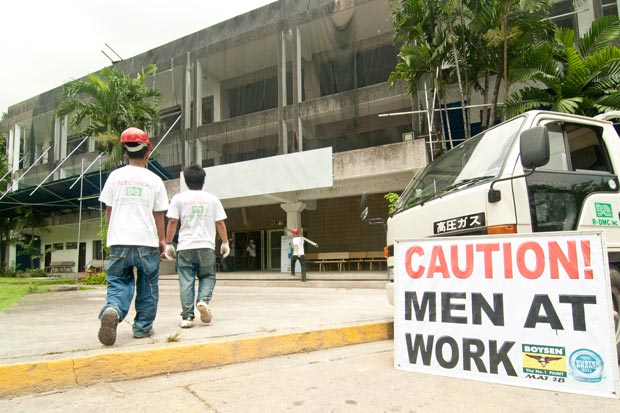
Construction ongoing. Renovations continue all over campus, signaling not only only a new school year, but new buildings as well. Photo by Migi Soriano
A NEW school year is not the only thing greeting Ateneans this June.
A renovated Rizal Library Annex, cement benches and repainted buildings, among others, are set to dot the campus landscape this school year. These renovations are in line with an eight-year building repair cycle created by the Office of Administrative Services (OAS) with the University Physical Plant Office (UPPO).
Second admin building
Constructed in 1989, the Rizal Library Annex currently houses the University Archives and the Rizal Mini Theater (RMT). Architect Jose Arnulfo Batac, director of the Facilities Management Office of the UPPO, said that the building would soon house other administrative offices.
“We’ve got central offices distributed across campus… All of these offices are in different buildings, so [the administration] has decided to consolidate all of them,” he said.
The transfer is projected to make administrative processes easier and more organized, as the annex building is located just next to Xavier Hall, the main administration building.
This is the first large-scale renovation to be done on the annex building. Batac said that only minor repairs were done on the structure in previous years.
Upon completion of the project, the new building will be occupied by the offices of Public Relations and Communications, Alumni Relations, Ateneo Center for Education, Management of Information Systems for the Loyola Schools, Central Accounting Office and Office of International Relations.
In line with this new purpose, the building will no longer be managed by the Rizal Library administration. It will also be renamed Faber Hall after Blessed Peter Faber, one of St. Ignatius of Loyola’s first companions.
Eco-friendly repainting
In addition to the structural renovations, the annex building will also be repainted and given a brick finish, as most new buildings on campus now sport this scheme.
Assistant to the OAS Director Architect Michael Canlas added that Berchmans Hall, Gonzaga Hall and Kostka Hall are also scheduled for repainting and repairs this year.
Renovations follow the mentioned cycle created by the OAS—buildings are grouped by age and are scheduled for repairs every eight years.
Last year, Faura Hall was repainted; in 2009, it was the PLDT Convergent Technologies Center, the Physical Education Complex and the John Gokonwei School of Management buildings.
To complement the school’s green efforts, Canlas said that the renovations made use of Boysen’s KNOxOUT paint, which absorbs smog and is self-cleaning.
New cement benches
The effort to improve the school’s aesthetic identity does not end with consistency in colors. Other fixtures around campus are also being changed to adapt to the design of the buildings around them.
Last May, the yellow plastic monoblock chairs that lined the SEC Walk were replaced with cement benches. While many complained about its lack of backrests, Canlas explained that the change was made for safety reasons, as the cement benches are stronger and are less likely to break under the constantly changing weather conditions.
Other renovations
Aside from these, other expected renovations around campus include the following:
The old Department of Communication building will be used as a Fine Arts building
The installation of generator sets in Gonzaga Hall and the Manuel V. Pangilinan (MVP) Center for Student Leadership.
Renovation of pedestrian gates (Gates 1, 2.5, and 3.5)
Funding
OAS Director Marie Joy Salita said that the funding for renovations has already been allocated for by the administration. Before approval, budget proposals have to be presented to the deans of each school and the Office of Student Activities.
The creation of the eight-year cycle for renovations is a way for the school to properly allocate and use the budget. Of the school’s entire budget for a year, 5-10% goes to the funding of renovation and maintenance projects.
Editor’s Note: Vice President for the Loyola Schools John Paul Vergara was supposed to address questions about funding, but his interview with The GUIDON didn’t push through due to illness.